State juvenile justice data book shows overall declines but rising share of violent offenses
April 24, 2026 | Children, Youth, and Families, Department of, State Agencies, Executive, Washington
This article was created by AI summarizing key points discussed. AI makes mistakes, so for full details and context, please refer to the video of the full meeting. Please report any errors so we can fix them. Report an error »
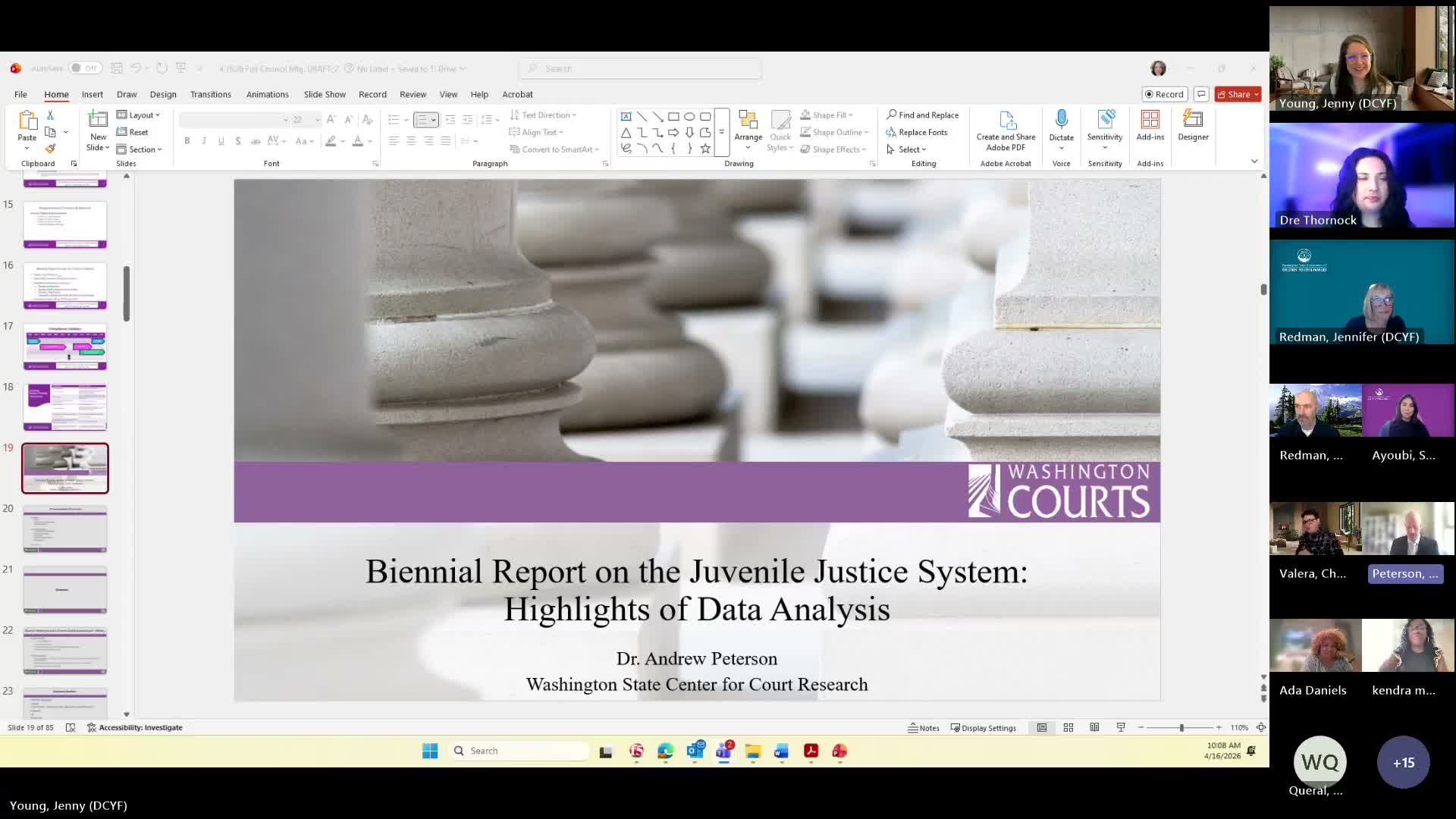
Andrew Peterson, principal research associate with the Washington State Center for Court Research, told the Partnership Council that the center’s biennial databook shows broad declines in juvenile justice involvement while some measures and risks are rising.
“We’re back up to around 80 percent, maybe, of where we were pre COVID,” Peterson said, summarizing statewide arrest trends for 2024 compared with 2019. He said the center’s county-level and dashboard tools will allow stakeholders to dig into trends by race, age and offense type.
The presentation highlighted that detention admissions remain far below pre‑pandemic levels — roughly 60% of earlier levels — a change the researchers said may represent a new normal after reductions in non‑offender and lower‑level admissions. At the same time, Peterson said, “we’re actually seeing an increase in the violent person felonies” and that the share of violent offenses has grown to more than 40% of juvenile offenses in recent years.
Peterson and his colleague Rachel Sanford also flagged data‑quality problems in law‑enforcement reporting. The researchers presented evidence that ethnicity fields have become increasingly blank in police data since about 2019, which both undercounts Latino individuals and overcounts white individuals in arrest tallies. “We’re overcounting white individuals in the system. We’re undercounting Latinos,” Peterson said.
The presenters described the new victimization dashboard that makes county‑ and city‑level victimization patterns available and noted initial findings that per‑capita victimization rates differ markedly by race and gender.
On the question of youth tried as adults, Peterson said the number of juvenile decline cases rose in 2024 compared with 2023 in part because of a statutory/procedural change the panel referenced: the new filing‑age rule means some older cases now appear as juvenile declines. He pointed to a rise from 64 decline cases in 2023 to 96 in 2024 and said much of that increase reflects procedural changes rather than a sudden change in prosecutorial practice.
Council members asked about recidivism and national comparisons. Peterson said recidivism analysis was still being finalized and that earlier work shows diversion cases have lower return rates than adjudication cases; he also said Washington’s trend lines are comparable with or better than national trends.
The researchers concluded by urging improved law‑enforcement reporting, wider use of the victimization dashboards, and continued refinement of the databook. They invited feedback and follow‑up questions by email.
The presentation led to a short Q&A before the council’s scheduled break; the researchers said detention data were just finalized and that a final recidivism section remained to be completed.
“We’re back up to around 80 percent, maybe, of where we were pre COVID,” Peterson said, summarizing statewide arrest trends for 2024 compared with 2019. He said the center’s county-level and dashboard tools will allow stakeholders to dig into trends by race, age and offense type.
The presentation highlighted that detention admissions remain far below pre‑pandemic levels — roughly 60% of earlier levels — a change the researchers said may represent a new normal after reductions in non‑offender and lower‑level admissions. At the same time, Peterson said, “we’re actually seeing an increase in the violent person felonies” and that the share of violent offenses has grown to more than 40% of juvenile offenses in recent years.
Peterson and his colleague Rachel Sanford also flagged data‑quality problems in law‑enforcement reporting. The researchers presented evidence that ethnicity fields have become increasingly blank in police data since about 2019, which both undercounts Latino individuals and overcounts white individuals in arrest tallies. “We’re overcounting white individuals in the system. We’re undercounting Latinos,” Peterson said.
The presenters described the new victimization dashboard that makes county‑ and city‑level victimization patterns available and noted initial findings that per‑capita victimization rates differ markedly by race and gender.
On the question of youth tried as adults, Peterson said the number of juvenile decline cases rose in 2024 compared with 2023 in part because of a statutory/procedural change the panel referenced: the new filing‑age rule means some older cases now appear as juvenile declines. He pointed to a rise from 64 decline cases in 2023 to 96 in 2024 and said much of that increase reflects procedural changes rather than a sudden change in prosecutorial practice.
Council members asked about recidivism and national comparisons. Peterson said recidivism analysis was still being finalized and that earlier work shows diversion cases have lower return rates than adjudication cases; he also said Washington’s trend lines are comparable with or better than national trends.
The researchers concluded by urging improved law‑enforcement reporting, wider use of the victimization dashboards, and continued refinement of the databook. They invited feedback and follow‑up questions by email.
The presentation led to a short Q&A before the council’s scheduled break; the researchers said detention data were just finalized and that a final recidivism section remained to be completed.
View the Full Meeting & All Its Details
This article offers just a summary. Unlock complete video, transcripts, and insights as a Founder Member.
✓
Watch full, unedited meeting videos
✓
Search every word spoken in unlimited transcripts
✓
AI summaries & real-time alerts (all government levels)
✓
Permanent access to expanding government content
30-day money-back guarantee
