Senate Judiciary advances SB149 after adopting broad amendment package to narrow placements and lower costs
April 20, 2026 | 2026 Legislature CO, Colorado
This article was created by AI summarizing key points discussed. AI makes mistakes, so for full details and context, please refer to the video of the full meeting. Please report any errors so we can fix them. Report an error »
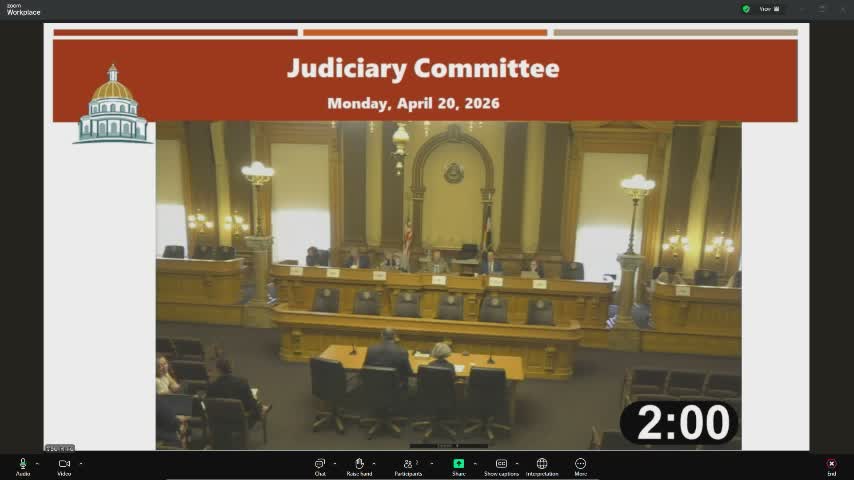
The Senate Judiciary Committee on April 20 approved a series of amendments to SB149 and voted 7–0 to send the bill to the Appropriations Committee with a favorable recommendation.
Senator Minor, the minority leader and sponsor, said the consolidated package stems from intensive negotiations that followed an introduced bill with an initially large fiscal note. "We had considerable witness testimony about this a week ago," Minor said, and the sponsors worked with disability advocates, public defenders, prosecutors and the executive branch to narrow the bill and reduce costs.
The sponsors presented a consolidated amendment — labeled L 40 — that the committee adopted by unanimous consent. Co-prime sponsor Senator Amabile outlined the package's central changes: allowing parties to waive a trial when all agree to a stipulated civil commitment, restoring prior statutory language on civil certification and the definition of "danger to others," narrowing the criteria for enhanced protective placement and creating an outpatient certification pathway that can, in some cases, bypass emergency-room admission.
"If all the parties are in agreement ... that will happen, without having to have a trial," Senator Amabile said, framing the trial-waiver provision as a measure to cut unnecessary costs and procedures. She also described a five-year repeal and a Smart Act-style review for the enhanced protective-placement provisions so the legislature can reassess whether the law is working as intended.
Amendments also add procedural protections: the sponsors inserted a requirement for a second medical opinion before terminating certain certifications and clarified that evaluations may occur in jail settings when needed. The package restricts enhanced protective placement to a smaller group of defendants — sponsors estimated in committee testimony the bill targets on the order of "25 to 50 people per year."
Technical and conforming edits were adopted in a series of amendments (L 41, L 44, L 45, L 39, L 42 and L 46). One conforming change replaces references to the Office of Civil and Forensic Mental Health (OCFMH) with the Colorado Department of Human Services (CDHS). Sponsors said many of the edits were requested by the executive branch, county attorneys, hospitals and other stakeholders to improve implementation and reduce fiscal impact.
Senator Minor described the work as a compromise aimed at balancing public safety, civil liberties and cost: "This moves us exponentially further down the path," he said of the consolidated package. The vice chair moved the bill to Appropriations; after the clerk called the roll, the committee recorded seven yes votes, and the motion carried.
What happens next: SB149 will go to the Appropriations Committee for further fiscal review and consideration. Sponsors said they will continue to work with stakeholders on implementation details as the bill proceeds through the process.
Senator Minor, the minority leader and sponsor, said the consolidated package stems from intensive negotiations that followed an introduced bill with an initially large fiscal note. "We had considerable witness testimony about this a week ago," Minor said, and the sponsors worked with disability advocates, public defenders, prosecutors and the executive branch to narrow the bill and reduce costs.
The sponsors presented a consolidated amendment — labeled L 40 — that the committee adopted by unanimous consent. Co-prime sponsor Senator Amabile outlined the package's central changes: allowing parties to waive a trial when all agree to a stipulated civil commitment, restoring prior statutory language on civil certification and the definition of "danger to others," narrowing the criteria for enhanced protective placement and creating an outpatient certification pathway that can, in some cases, bypass emergency-room admission.
"If all the parties are in agreement ... that will happen, without having to have a trial," Senator Amabile said, framing the trial-waiver provision as a measure to cut unnecessary costs and procedures. She also described a five-year repeal and a Smart Act-style review for the enhanced protective-placement provisions so the legislature can reassess whether the law is working as intended.
Amendments also add procedural protections: the sponsors inserted a requirement for a second medical opinion before terminating certain certifications and clarified that evaluations may occur in jail settings when needed. The package restricts enhanced protective placement to a smaller group of defendants — sponsors estimated in committee testimony the bill targets on the order of "25 to 50 people per year."
Technical and conforming edits were adopted in a series of amendments (L 41, L 44, L 45, L 39, L 42 and L 46). One conforming change replaces references to the Office of Civil and Forensic Mental Health (OCFMH) with the Colorado Department of Human Services (CDHS). Sponsors said many of the edits were requested by the executive branch, county attorneys, hospitals and other stakeholders to improve implementation and reduce fiscal impact.
Senator Minor described the work as a compromise aimed at balancing public safety, civil liberties and cost: "This moves us exponentially further down the path," he said of the consolidated package. The vice chair moved the bill to Appropriations; after the clerk called the roll, the committee recorded seven yes votes, and the motion carried.
What happens next: SB149 will go to the Appropriations Committee for further fiscal review and consideration. Sponsors said they will continue to work with stakeholders on implementation details as the bill proceeds through the process.
Don't Miss a Word: See the Full Meeting!
Go beyond summaries. Unlock every video, transcript, and key insight with a Founder Membership.
✓
Get instant access to full meeting videos
✓
Search and clip any phrase from complete transcripts
✓
Receive AI-powered summaries & custom alerts
✓
Enjoy lifetime, unrestricted access to government data
30-day money-back guarantee
