Committee hears student and industry testimony on social‑media protections for minors in SF 49‑97; A1 amendment adopted and bill laid over
April 25, 2026 | 2026 Legislature MN, Minnesota
This article was created by AI summarizing key points discussed. AI makes mistakes, so for full details and context, please refer to the video of the full meeting. Please report any errors so we can fix them. Report an error »
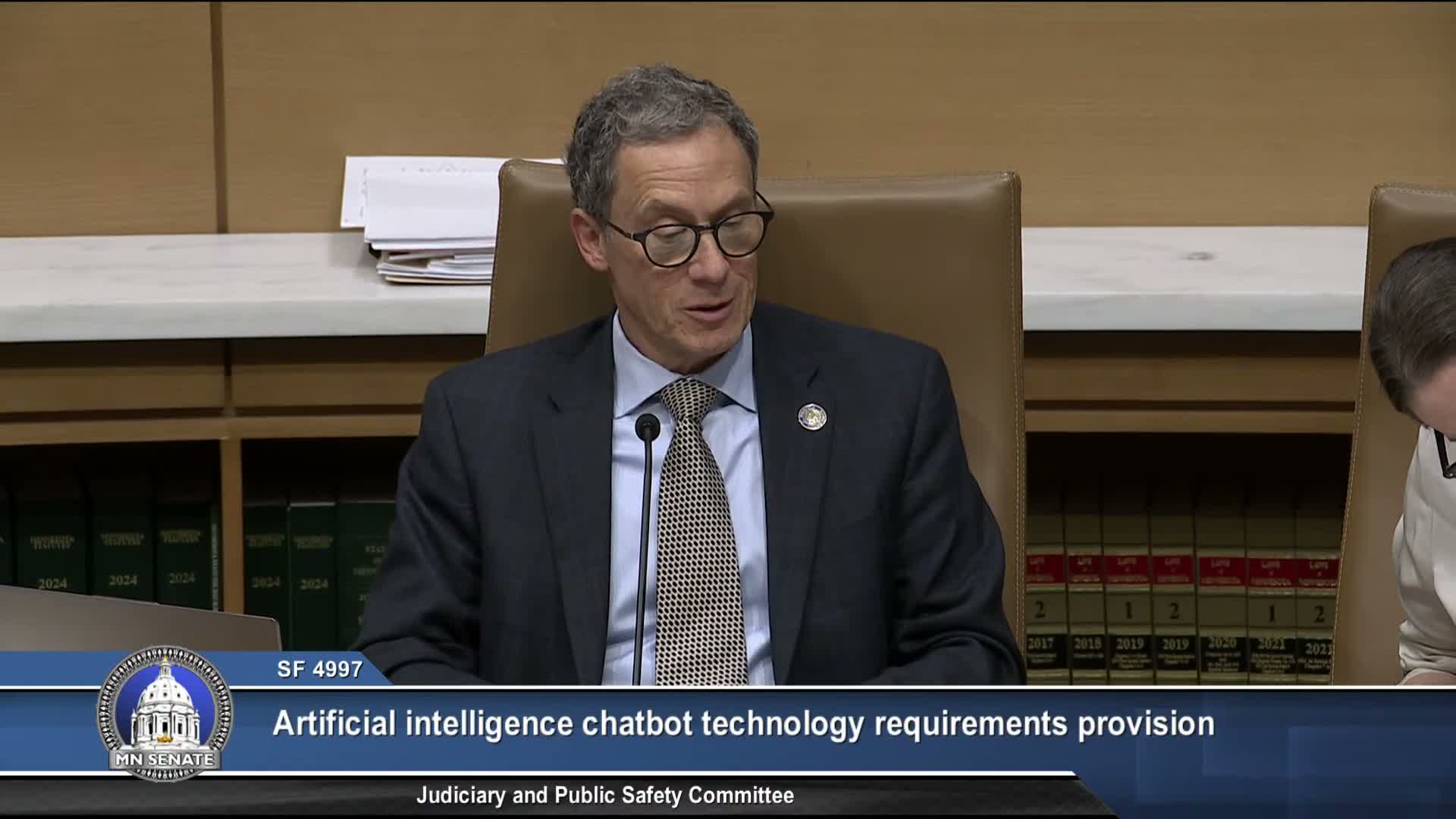
The Minnesota Senate Judiciary Committee adopted an A1 delete‑everything amendment to Senate File 49‑97 and heard competing testimony on provisions that would require verifiable parental consent for child accounts, limit addictive features for youth accounts and create a private right of action and Attorney General enforcement.
Senator Croon, sponsor of the amendment, said the draft folds language from Senate File 46‑96 into SF 49‑97 and asked the committee to focus on provisions within judiciary jurisdiction — chiefly Subdivisions 7–10 covering verifiable parental consent, nullification of contracts or terms in violation, tiers of remedies including statutory damages and punitive relief for knowing/reckless violations, a safe‑harbor for good‑faith technological efforts, and Attorney General enforcement under 8.31.
Three student witnesses described the bill’s importance. "Please vote yes on Senate File 46‑96 to protect kids like me from the addictive aspects of social media," Ruby Eichenbach, a Minnesota high school student, told the committee. Another student, Kya, said social media has harmed peers’ mental health and argued that the state and parents should have legal tools to hold platforms accountable.
Advocacy testimony supported the bill: Maggie Hagen of the Minnesota Catholic Conference said the measure would require verifiable parental consent, prohibit autoplay and infinite scroll on child accounts, and provide recourse for families and children harmed by platform practices.
Industry testimony pushed back. Amy Boss, vice president of government affairs for NetChoice (an industry group), said the bill would impose extensive age‑estimation and data‑collection requirements — for example, confidence thresholds and periodic reestimation in the draft — that could force platforms to store government IDs and behavioral dossiers, creating surveillance and constitutional risks and inviting opportunistic litigation through a broad private right of action.
Other witnesses raised civil‑rights and enforcement concerns. Manilin Houle, a Duluth Indigenous Commission member, warned that broadly written remedies could be weaponized against marginalized communities and urged caution. Senators debated the scale of statutory damages (the draft ties $10,000 statutory damages to reckless or knowing conduct) and whether the amount would deter large platforms with global advertising revenue.
Committee counsel told members that recoveries obtained by the Attorney General under consumer‑protection enforcement typically flow into the consumer protection restitution account (50%) and the general fund (50%), but senators discussed whether recovered funds should be directed toward mental‑health services or victim assistance funds.
Senator Croon closed by stressing the proposal is content‑neutral and includes a safe‑harbor for good‑faith technical efforts. The committee laid Senate File 49‑97, as amended, over for further consideration.
Senator Croon, sponsor of the amendment, said the draft folds language from Senate File 46‑96 into SF 49‑97 and asked the committee to focus on provisions within judiciary jurisdiction — chiefly Subdivisions 7–10 covering verifiable parental consent, nullification of contracts or terms in violation, tiers of remedies including statutory damages and punitive relief for knowing/reckless violations, a safe‑harbor for good‑faith technological efforts, and Attorney General enforcement under 8.31.
Three student witnesses described the bill’s importance. "Please vote yes on Senate File 46‑96 to protect kids like me from the addictive aspects of social media," Ruby Eichenbach, a Minnesota high school student, told the committee. Another student, Kya, said social media has harmed peers’ mental health and argued that the state and parents should have legal tools to hold platforms accountable.
Advocacy testimony supported the bill: Maggie Hagen of the Minnesota Catholic Conference said the measure would require verifiable parental consent, prohibit autoplay and infinite scroll on child accounts, and provide recourse for families and children harmed by platform practices.
Industry testimony pushed back. Amy Boss, vice president of government affairs for NetChoice (an industry group), said the bill would impose extensive age‑estimation and data‑collection requirements — for example, confidence thresholds and periodic reestimation in the draft — that could force platforms to store government IDs and behavioral dossiers, creating surveillance and constitutional risks and inviting opportunistic litigation through a broad private right of action.
Other witnesses raised civil‑rights and enforcement concerns. Manilin Houle, a Duluth Indigenous Commission member, warned that broadly written remedies could be weaponized against marginalized communities and urged caution. Senators debated the scale of statutory damages (the draft ties $10,000 statutory damages to reckless or knowing conduct) and whether the amount would deter large platforms with global advertising revenue.
Committee counsel told members that recoveries obtained by the Attorney General under consumer‑protection enforcement typically flow into the consumer protection restitution account (50%) and the general fund (50%), but senators discussed whether recovered funds should be directed toward mental‑health services or victim assistance funds.
Senator Croon closed by stressing the proposal is content‑neutral and includes a safe‑harbor for good‑faith technical efforts. The committee laid Senate File 49‑97, as amended, over for further consideration.
Don't Miss a Word: See the Full Meeting!
Go beyond summaries. Unlock every video, transcript, and key insight with a Founder Membership.
✓
Get instant access to full meeting videos
✓
Search and clip any phrase from complete transcripts
✓
Receive AI-powered summaries & custom alerts
✓
Enjoy lifetime, unrestricted access to government data
30-day money-back guarantee
