Sammamish staff recommend square‑foot scaling for parks and transportation impact fees; council questions affordable‑housing exemptions
April 23, 2026 | Sammamish City, King County, Washington
This article was created by AI summarizing key points discussed. AI makes mistakes, so for full details and context, please refer to the video of the full meeting. Please report any errors so we can fix them. Report an error »
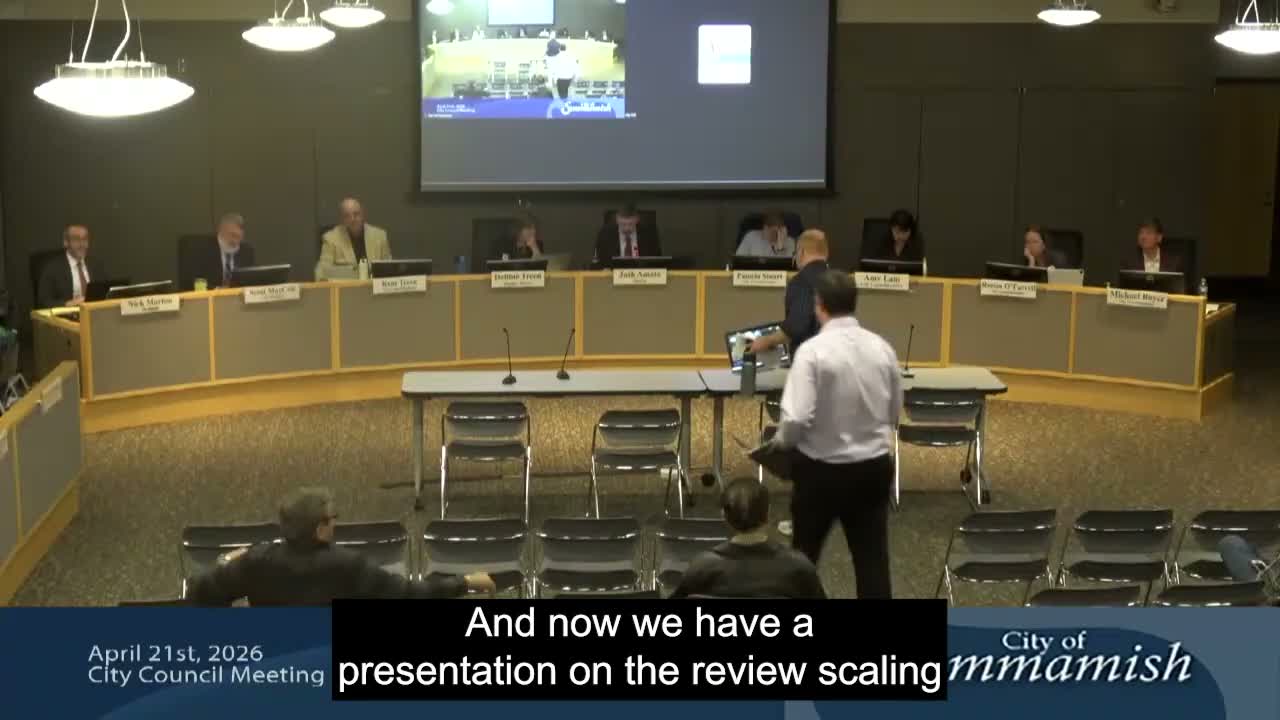
City planning staff on April 21 urged the Sammamish City Council to adopt a consultant‑recommended method for scaling parks and transportation impact fees to comply with state law that requires fees to scale with unit size.
David Pyle, director of Community Development, and Evan Fisher, the project manager, described a method developed with consultants (FCS) that converts the blended per‑unit fee into a per‑square‑foot rate and then applies a minimum and maximum bracket tied to U.S. Census and American Housing Survey distributions. For transportation, the formula divides eligible capacity‑increasing project costs by estimated new person‑trip growth; for parks it derives capital value per person and allocates future growth needs. Staff said the approach keeps Sammamish’s fees relatively aligned with neighboring cities while complying with the new legal standard.
Planning Commission members recommended the methodology and fee amounts by a 4–2 vote but urged caution because project lists and inputs will be updated. Staff recommended affordable‑housing reductions rather than full waivers: an 80% reduction for projects serving 0–50% AMI (area median income) and a 50% reduction for 51–80% AMI; legal counsel reminded the council that waiving fees for ADUs would require the city to backfill the waived portion from the general fund. Staff also recommended removing the current cap on deferrals and clarified that the city can offer deferrals until occupancy or sale.
Councilmembers asked how the formulas account for multimodal transportation goals, whether scaling will deter multifamily development, and how often fees should be revisited. Staff said the methodology’s denominator uses person trips (not vehicle trips) to make the approach multimodal, that a blended approach was selected as the most legally defensible, and that the impact‑fee code will be repealed and replaced to implement the new approach. Staff proposed a public hearing package on May 5 to adopt the scaled fees and the code changes; council agreed to consider moving forward after the public hearing.
David Pyle, director of Community Development, and Evan Fisher, the project manager, described a method developed with consultants (FCS) that converts the blended per‑unit fee into a per‑square‑foot rate and then applies a minimum and maximum bracket tied to U.S. Census and American Housing Survey distributions. For transportation, the formula divides eligible capacity‑increasing project costs by estimated new person‑trip growth; for parks it derives capital value per person and allocates future growth needs. Staff said the approach keeps Sammamish’s fees relatively aligned with neighboring cities while complying with the new legal standard.
Planning Commission members recommended the methodology and fee amounts by a 4–2 vote but urged caution because project lists and inputs will be updated. Staff recommended affordable‑housing reductions rather than full waivers: an 80% reduction for projects serving 0–50% AMI (area median income) and a 50% reduction for 51–80% AMI; legal counsel reminded the council that waiving fees for ADUs would require the city to backfill the waived portion from the general fund. Staff also recommended removing the current cap on deferrals and clarified that the city can offer deferrals until occupancy or sale.
Councilmembers asked how the formulas account for multimodal transportation goals, whether scaling will deter multifamily development, and how often fees should be revisited. Staff said the methodology’s denominator uses person trips (not vehicle trips) to make the approach multimodal, that a blended approach was selected as the most legally defensible, and that the impact‑fee code will be repealed and replaced to implement the new approach. Staff proposed a public hearing package on May 5 to adopt the scaled fees and the code changes; council agreed to consider moving forward after the public hearing.
Don't Miss a Word: See the Full Meeting!
Go beyond summaries. Unlock every video, transcript, and key insight with a Founder Membership.
✓
Get instant access to full meeting videos
✓
Search and clip any phrase from complete transcripts
✓
Receive AI-powered summaries & custom alerts
✓
Enjoy lifetime, unrestricted access to government data
30-day money-back guarantee
