Tempe council directs staff to prepare ballot measures for 0.4% public-safety sales tax and 0.1% transit tax to replace lost revenue
April 24, 2026 | Tempe, Maricopa County, Arizona
This article was created by AI summarizing key points discussed. AI makes mistakes, so for full details and context, please refer to the video of the full meeting. Please report any errors so we can fix them. Report an error »
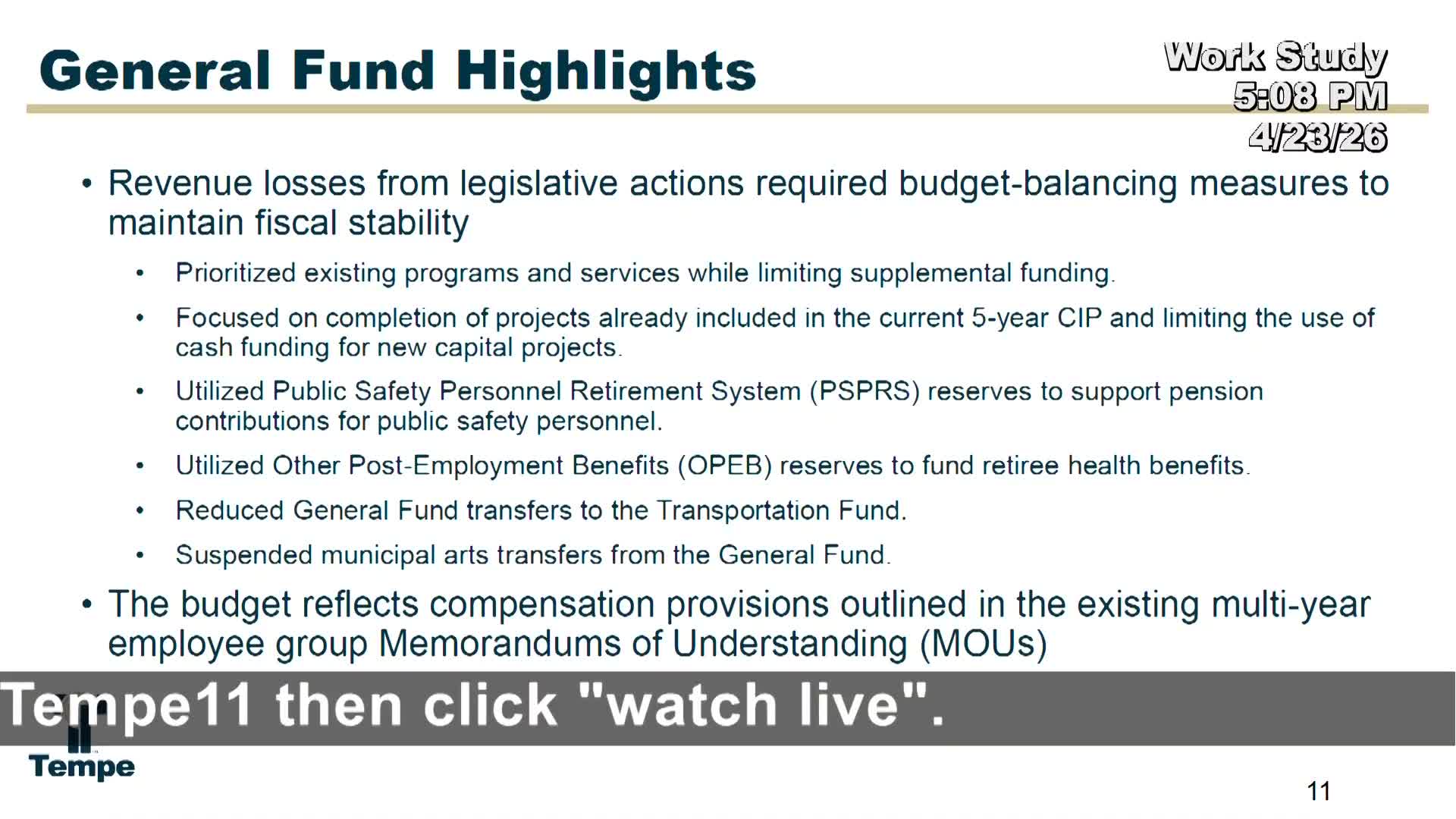
Tempe Mayor Corey Woods and city staff told the City Council at a work study session that recent state and federal policy changes have created a structural revenue gap and recommended two voter-directed sales-tax measures to restore and stabilize core services.
Deputy City Manager Lisette Camacho, who presented the proposals alongside Municipal Budget Director Robert Baer, said citywide revenue losses tied to the repeal of residential-rental taxation and other changes total roughly $21.7 million annually across three funds. "The repeal of residential rental resulted in a total of $21,700,000 in revenue loss across three funds," Camacho said, citing a $14.4 million hit to the general fund, about $6 million to the transit fund, and roughly $1.3 million to arts and culture.
To address the shortfall, staff proposed two measures to send to voters: a 0.4 percentage-point local sales tax dedicated primarily to public safety and a 0.1 percentage-point increase in the transit tax. Camacho said the public-safety tax is projected to generate approximately $40,300,000 annually; "It would first offset the $18,100,000 in lost general fund revenues from state legislative actions," she said. The transit-tax increase is projected to bring in about $10,100,000 a year to support multimodal investments, including a proposed streetcar extension and pedestrian/cyclist crossings.
Camacho emphasized protections for residents: "Importantly, we're not proposing to change the food tax rate or the tax on groceries," she said, and described ballot language that would limit uses of the public-safety revenue to police, fire, park rangers and related safety infrastructure.
Council members pressed staff on several points: whether the taxes would be permanent or temporary, alternatives to new revenue, and the timing of any public engagement. Council member Hodge asked why staff were not proposing a sunset; Camacho replied that prior temporary measures addressed short-term recessions, while the rental-tax repeal is a permanent loss that cannot be locally restored. Council members also asked about the council's fund-balance policy and whether the city could delay a ballot measure; staff said reserves and vacancy savings buy time but projected that reserves would decline and that balancing without new revenue would require substantial program or staffing cuts.
Council discussion also covered operational consequences: Council members and staff noted that extending the streetcar and maintaining transit services would carry ongoing operating costs — staff cited preliminary estimates in the range of $10 million a year for streetcar operating and maintenance — and that Valley Metro costs have been rising. Transportation Sustainability Director Eric Arison joined staff in outlining those operational pressures.
Mayor Woods asked if staff should prepare a call-of-election item for the council's April 30 meeting so voters could decide. Council members raised no objections, and staff was directed to prepare the resolution for next week's meeting; no formal vote was taken at the work study session. If approved by voters, staff said early voting would begin Oct. 7 and election day would be Nov. 3, and the new tax rates would take effect Jan. 1, 2027.
The presentation also included a schedule of public outreach (August–October) and a plan to consolidate the city's financial policies into a single document, which staff said would appear on the June 25 agenda.
What’s next: The council asked staff to return the call-of-election item for formal action on April 30 and to continue public outreach and brief advisory bodies where appropriate. Public comments earlier in the meeting urged additional engagement with the Transportation Commission before placing transit questions on the ballot.
Sources: Presentation and Q&A at the Tempe City Council work study session; direct remarks by Lisette Camacho (Deputy City Manager) and Robert Baer (Municipal Budget Director); public commenter Kelsey Files.
Deputy City Manager Lisette Camacho, who presented the proposals alongside Municipal Budget Director Robert Baer, said citywide revenue losses tied to the repeal of residential-rental taxation and other changes total roughly $21.7 million annually across three funds. "The repeal of residential rental resulted in a total of $21,700,000 in revenue loss across three funds," Camacho said, citing a $14.4 million hit to the general fund, about $6 million to the transit fund, and roughly $1.3 million to arts and culture.
To address the shortfall, staff proposed two measures to send to voters: a 0.4 percentage-point local sales tax dedicated primarily to public safety and a 0.1 percentage-point increase in the transit tax. Camacho said the public-safety tax is projected to generate approximately $40,300,000 annually; "It would first offset the $18,100,000 in lost general fund revenues from state legislative actions," she said. The transit-tax increase is projected to bring in about $10,100,000 a year to support multimodal investments, including a proposed streetcar extension and pedestrian/cyclist crossings.
Camacho emphasized protections for residents: "Importantly, we're not proposing to change the food tax rate or the tax on groceries," she said, and described ballot language that would limit uses of the public-safety revenue to police, fire, park rangers and related safety infrastructure.
Council members pressed staff on several points: whether the taxes would be permanent or temporary, alternatives to new revenue, and the timing of any public engagement. Council member Hodge asked why staff were not proposing a sunset; Camacho replied that prior temporary measures addressed short-term recessions, while the rental-tax repeal is a permanent loss that cannot be locally restored. Council members also asked about the council's fund-balance policy and whether the city could delay a ballot measure; staff said reserves and vacancy savings buy time but projected that reserves would decline and that balancing without new revenue would require substantial program or staffing cuts.
Council discussion also covered operational consequences: Council members and staff noted that extending the streetcar and maintaining transit services would carry ongoing operating costs — staff cited preliminary estimates in the range of $10 million a year for streetcar operating and maintenance — and that Valley Metro costs have been rising. Transportation Sustainability Director Eric Arison joined staff in outlining those operational pressures.
Mayor Woods asked if staff should prepare a call-of-election item for the council's April 30 meeting so voters could decide. Council members raised no objections, and staff was directed to prepare the resolution for next week's meeting; no formal vote was taken at the work study session. If approved by voters, staff said early voting would begin Oct. 7 and election day would be Nov. 3, and the new tax rates would take effect Jan. 1, 2027.
The presentation also included a schedule of public outreach (August–October) and a plan to consolidate the city's financial policies into a single document, which staff said would appear on the June 25 agenda.
What’s next: The council asked staff to return the call-of-election item for formal action on April 30 and to continue public outreach and brief advisory bodies where appropriate. Public comments earlier in the meeting urged additional engagement with the Transportation Commission before placing transit questions on the ballot.
Sources: Presentation and Q&A at the Tempe City Council work study session; direct remarks by Lisette Camacho (Deputy City Manager) and Robert Baer (Municipal Budget Director); public commenter Kelsey Files.
Don't Miss a Word: See the Full Meeting!
Go beyond summaries. Unlock every video, transcript, and key insight with a Founder Membership.
✓
Get instant access to full meeting videos
✓
Search and clip any phrase from complete transcripts
✓
Receive AI-powered summaries & custom alerts
✓
Enjoy lifetime, unrestricted access to government data
30-day money-back guarantee
