Board debates whether motions should list design details; staff recommends itemized checklist
April 23, 2026 | Conway, Horry County, South Carolina
This article was created by AI summarizing key points discussed. AI makes mistakes, so for full details and context, please refer to the video of the full meeting. Please report any errors so we can fix them. Report an error »
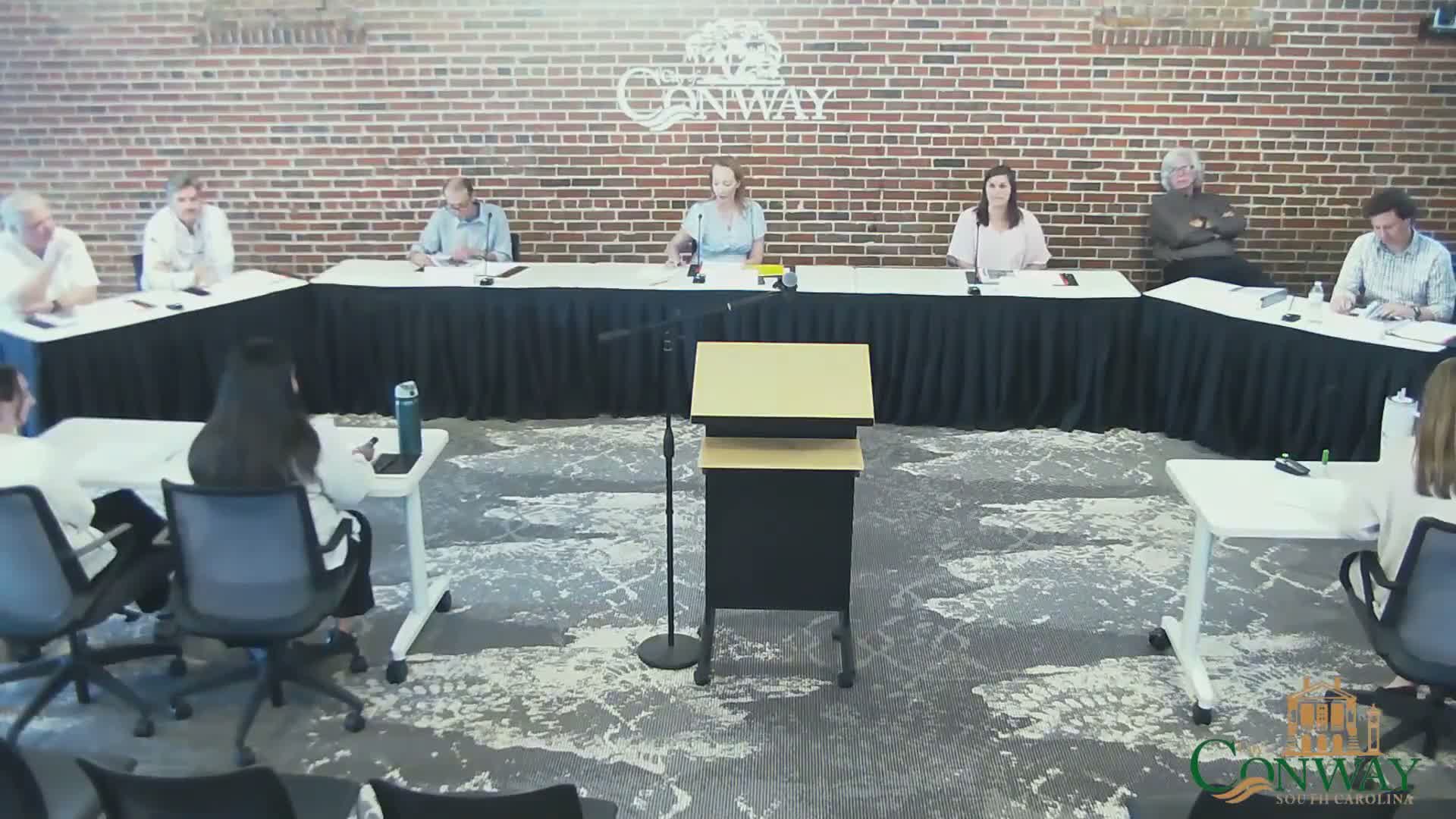
Board members spent an extended portion of the meeting discussing how to prevent key design details from being lost between discussion and final motions.
“ Showing everything on the renderings and saying approved as presented means that they have the permission to do all of those things,” a staff member told the board, urging clarity about what ‘‘approved as presented’’ permits and what it does not obligate. Staff explained that approving illustrative renderings gives the applicant permission to install elements shown, but unless a particular element is written into the motion or the record, the board generally cannot require the applicant to install it later.
Board members cited recent cases: the Olive Shop, where engineering and contractor requirements delayed a trellis; Crooked Oak, where questions about awnings and stucco raised concerns about concessions that later left noncompliant materials exposed; and the downtown splash pad, where staff described safety and ADA complications that stalled shade-sail installations. Staff noted safety issues (wind tension, mounting on older brick facades, collision risks for children) and ADA corrections made during construction as reasons some design elements could not be implemented as first shown.
To reduce ambiguity, staff proposed an itemized checklist provided at preliminary or final reviews for large or complicated projects so the board can list required elements in the motion and minutes. Several members endorsed the idea, saying it would allow the board to be specific only when an element is a make-or-break design feature without penalizing businesses completing projects in phases for financial or engineering reasons.
What happens next: staff said they will prepare a checklist framework to use in future hearings for large downtown projects and will include those items in meeting minutes or as part of a future condition of approval when appropriate.
Why it matters: specificity in motions affects what the board can enforce later and how downtown design standards are implemented—important to applicants, nearby businesses and preservation interests.
“ Showing everything on the renderings and saying approved as presented means that they have the permission to do all of those things,” a staff member told the board, urging clarity about what ‘‘approved as presented’’ permits and what it does not obligate. Staff explained that approving illustrative renderings gives the applicant permission to install elements shown, but unless a particular element is written into the motion or the record, the board generally cannot require the applicant to install it later.
Board members cited recent cases: the Olive Shop, where engineering and contractor requirements delayed a trellis; Crooked Oak, where questions about awnings and stucco raised concerns about concessions that later left noncompliant materials exposed; and the downtown splash pad, where staff described safety and ADA complications that stalled shade-sail installations. Staff noted safety issues (wind tension, mounting on older brick facades, collision risks for children) and ADA corrections made during construction as reasons some design elements could not be implemented as first shown.
To reduce ambiguity, staff proposed an itemized checklist provided at preliminary or final reviews for large or complicated projects so the board can list required elements in the motion and minutes. Several members endorsed the idea, saying it would allow the board to be specific only when an element is a make-or-break design feature without penalizing businesses completing projects in phases for financial or engineering reasons.
What happens next: staff said they will prepare a checklist framework to use in future hearings for large downtown projects and will include those items in meeting minutes or as part of a future condition of approval when appropriate.
Why it matters: specificity in motions affects what the board can enforce later and how downtown design standards are implemented—important to applicants, nearby businesses and preservation interests.
View the Full Meeting & All Its Details
This article offers just a summary. Unlock complete video, transcripts, and insights as a Founder Member.
✓
Watch full, unedited meeting videos
✓
Search every word spoken in unlimited transcripts
✓
AI summaries & real-time alerts (all government levels)
✓
Permanent access to expanding government content
30-day money-back guarantee
