La Mesa‑Spring Valley board adopts CSBA accountability resolution, approves policy updates and consent calendars
April 22, 2026 | La Mesa-Spring Valley, School Districts, California
This article was created by AI summarizing key points discussed. AI makes mistakes, so for full details and context, please refer to the video of the full meeting. Please report any errors so we can fix them. Report an error »
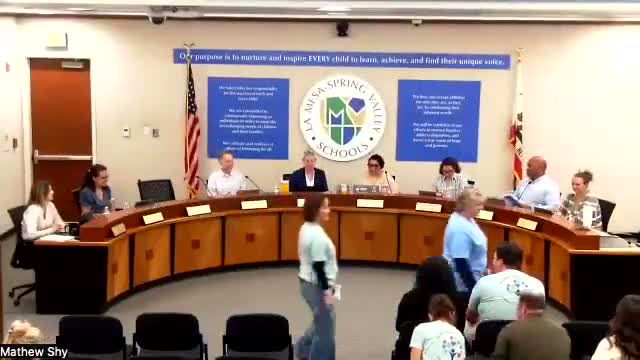
The La Mesa‑Spring Valley School Board voted on April 21 to adopt Resolution 25‑26‑20 in support of the California School Boards Association campaign to "close the state accountability gap," asking state policymakers in Sacramento to better align reporting and trust districts' local accountability planning.
A board member moved to approve the resolution and the board adopted it by voice vote; no formal roll‑call tally was recorded on the transcript during open session.
The board also considered and approved board policy updates, including a revision to Policy 3515 (recovery for property loss or damage). A board member noted the policy's numerical values had been revised to match Education Code requirements; the superintendent confirmed the revision reflected Education Code.
Consent calendars covering business services, educational services and human resources were presented and approved by voice vote. During the human resources consent item discussion, a board member praised the HR department for recent hiring of paraprofessionals for special education.
The board completed its annual declaration of need for fully qualified educators (Item 9b), an administrative declaration the district reviews each year.
Separately, the board reported a closed‑session action earlier in the meeting: it said it had voted unanimously in closed session to reject a claim and refer the matter to the Joint Powers Authority (JPA) for investigation; no additional details about the claim were disclosed in open session.
The meeting record shows motions were made and approved by voice ("All in favor, say aye"); where the transcript does not record an exact numerical tally, the board's voice votes are reported as approvals in the meeting minutes.
A board member moved to approve the resolution and the board adopted it by voice vote; no formal roll‑call tally was recorded on the transcript during open session.
The board also considered and approved board policy updates, including a revision to Policy 3515 (recovery for property loss or damage). A board member noted the policy's numerical values had been revised to match Education Code requirements; the superintendent confirmed the revision reflected Education Code.
Consent calendars covering business services, educational services and human resources were presented and approved by voice vote. During the human resources consent item discussion, a board member praised the HR department for recent hiring of paraprofessionals for special education.
The board completed its annual declaration of need for fully qualified educators (Item 9b), an administrative declaration the district reviews each year.
Separately, the board reported a closed‑session action earlier in the meeting: it said it had voted unanimously in closed session to reject a claim and refer the matter to the Joint Powers Authority (JPA) for investigation; no additional details about the claim were disclosed in open session.
The meeting record shows motions were made and approved by voice ("All in favor, say aye"); where the transcript does not record an exact numerical tally, the board's voice votes are reported as approvals in the meeting minutes.
Don't Miss a Word: See the Full Meeting!
Go beyond summaries. Unlock every video, transcript, and key insight with a Founder Membership.
✓
Get instant access to full meeting videos
✓
Search and clip any phrase from complete transcripts
✓
Receive AI-powered summaries & custom alerts
✓
Enjoy lifetime, unrestricted access to government data
30-day money-back guarantee
