Vermont DEC tells House Transportation committee EPA approval, modeling required before inspection frequency could shift to every other year
April 24, 2026 | Transportation, HOUSE OF REPRESENTATIVES, Committees, Legislative , Vermont
This article was created by AI summarizing key points discussed. AI makes mistakes, so for full details and context, please refer to the video of the full meeting. Please report any errors so we can fix them. Report an error »
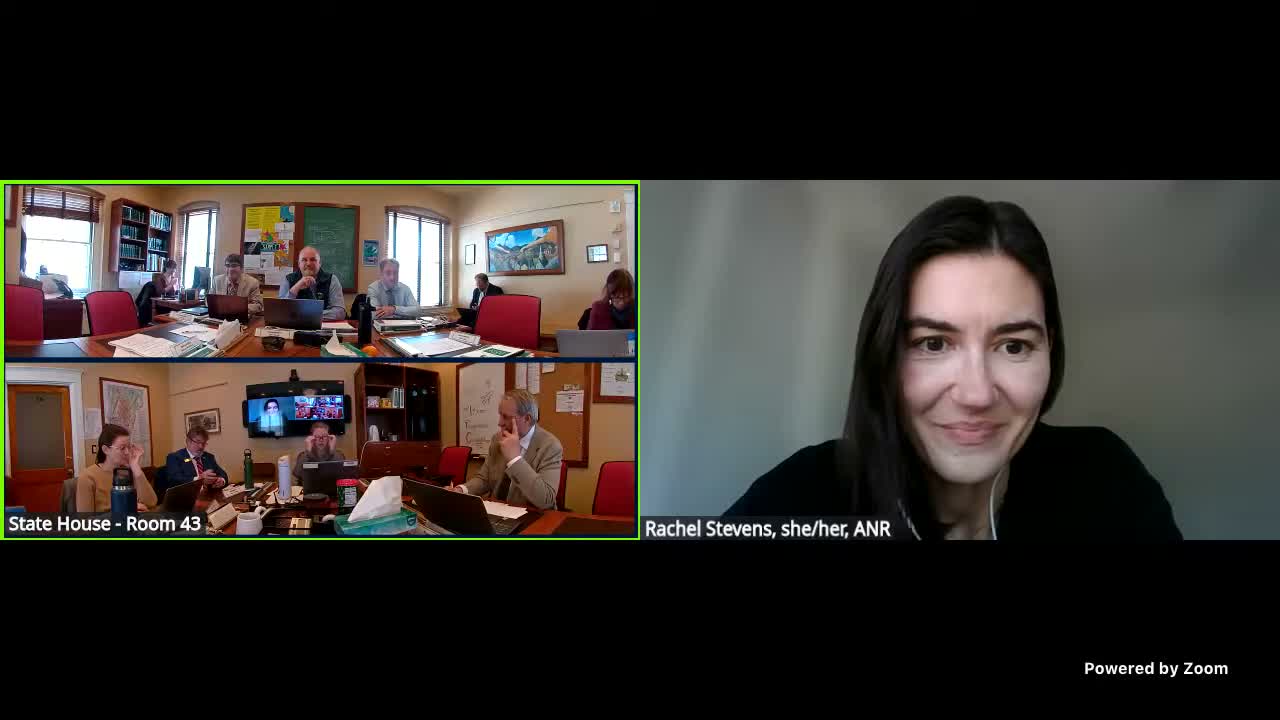
The Vermont House Transportation Committee heard detailed testimony April 20 from Department of Environmental Conservation staff who said changes to the state’s vehicle emissions inspection frequency would require technical analysis and federal review before any policy change could take effect.
Deirdre Ritzer, Mobile Sources section chief at the DEC’s Air Quality and Climate Division, and Rachel Stevens, the division’s attorney, told the committee that federal rules assume annual testing unless a state demonstrates—through modeling—that a less frequent schedule would still meet required emissions performance standards. "If the performance standard can be met by moving to every other year, then the agency would need to amend its state implementation plan and seek approval from the U.S. EPA," Stevens said.
Why it matters: inspectors’ test frequency affects how often vehicles with malfunctioning emissions controls are identified and repaired. DEC staff warned that a longer interval between inspections would likely increase emissions of ozone precursors, air toxics, nitrogen oxides, particulate matter and carbon monoxide.
DEC gave the committee program context and recent data. Ritzer said electronic data collection and management introduced in 2017 corresponded with a sharp drop in failure rates: "the failure rate, for emissions inspection has dropped from that initial 16% in 2017, down to 4%, which is what we see today." Committee members queried whether earlier legislative changes—specifically a 2019 law that narrowed the model years subject to inspection to roughly 2011–2026—had driven the decline in failures; witnesses said that narrowing reduced the tested population but did not explain the rapid drop that followed electronic testing and more pre-inspection repairs.
Stevens also flagged legal constraints. She cited a recent court decision in New Hampshire that enjoined a legislature from terminating an inspection program without first seeking EPA approval, using the case to underscore the need to follow the federal SIP amendment and review process before changing test frequency. "The court issued a preliminary injunction, stopping New Hampshire from doing that," she said, calling the case relevant to any state-level change.
The witnesses said EPA has identified deficiencies in Vermont’s program, largely around enforcement and the state’s ability to demonstrate that inspection rules are being enforced. Those outstanding issues with the Department of Motor Vehicles could complicate or delay any EPA approval even if technical modeling showed compliance.
Committee members compared Vermont’s program to other states: DEC staff said 28 states plus Washington, D.C., have inspections; among those, 11 use annual frequency, 13 use biennial frequency and five mix frequency by vehicle age or type. Connecticut and Rhode Island use biennial tests in New England; Connecticut’s program ties inspection results to registration denial, a stronger enforcement mechanism DEC staff said Vermont does not currently use.
No formal action was taken. The chair said the panel would need to reschedule a follow-up meeting to allow staff to complete technical work and corrections with DMV; the hearing was adjourned so members could attend other committee business.
The committee asked DEC to return for a follow-up session; the chair said staff would reach out to schedule the next appearance.
Deirdre Ritzer, Mobile Sources section chief at the DEC’s Air Quality and Climate Division, and Rachel Stevens, the division’s attorney, told the committee that federal rules assume annual testing unless a state demonstrates—through modeling—that a less frequent schedule would still meet required emissions performance standards. "If the performance standard can be met by moving to every other year, then the agency would need to amend its state implementation plan and seek approval from the U.S. EPA," Stevens said.
Why it matters: inspectors’ test frequency affects how often vehicles with malfunctioning emissions controls are identified and repaired. DEC staff warned that a longer interval between inspections would likely increase emissions of ozone precursors, air toxics, nitrogen oxides, particulate matter and carbon monoxide.
DEC gave the committee program context and recent data. Ritzer said electronic data collection and management introduced in 2017 corresponded with a sharp drop in failure rates: "the failure rate, for emissions inspection has dropped from that initial 16% in 2017, down to 4%, which is what we see today." Committee members queried whether earlier legislative changes—specifically a 2019 law that narrowed the model years subject to inspection to roughly 2011–2026—had driven the decline in failures; witnesses said that narrowing reduced the tested population but did not explain the rapid drop that followed electronic testing and more pre-inspection repairs.
Stevens also flagged legal constraints. She cited a recent court decision in New Hampshire that enjoined a legislature from terminating an inspection program without first seeking EPA approval, using the case to underscore the need to follow the federal SIP amendment and review process before changing test frequency. "The court issued a preliminary injunction, stopping New Hampshire from doing that," she said, calling the case relevant to any state-level change.
The witnesses said EPA has identified deficiencies in Vermont’s program, largely around enforcement and the state’s ability to demonstrate that inspection rules are being enforced. Those outstanding issues with the Department of Motor Vehicles could complicate or delay any EPA approval even if technical modeling showed compliance.
Committee members compared Vermont’s program to other states: DEC staff said 28 states plus Washington, D.C., have inspections; among those, 11 use annual frequency, 13 use biennial frequency and five mix frequency by vehicle age or type. Connecticut and Rhode Island use biennial tests in New England; Connecticut’s program ties inspection results to registration denial, a stronger enforcement mechanism DEC staff said Vermont does not currently use.
No formal action was taken. The chair said the panel would need to reschedule a follow-up meeting to allow staff to complete technical work and corrections with DMV; the hearing was adjourned so members could attend other committee business.
The committee asked DEC to return for a follow-up session; the chair said staff would reach out to schedule the next appearance.
View the Full Meeting & All Its Details
This article offers just a summary. Unlock complete video, transcripts, and insights as a Founder Member.
✓
Watch full, unedited meeting videos
✓
Search every word spoken in unlimited transcripts
✓
AI summaries & real-time alerts (all government levels)
✓
Permanent access to expanding government content
30-day money-back guarantee
