Fairbanks mayor tells House panel bill will fix 'orphaned' roads and let boroughs align service-area boundaries
April 23, 2026 | 2026 Legislature Alaska, Alaska
This article was created by AI summarizing key points discussed. AI makes mistakes, so for full details and context, please refer to the video of the full meeting. Please report any errors so we can fix them. Report an error »
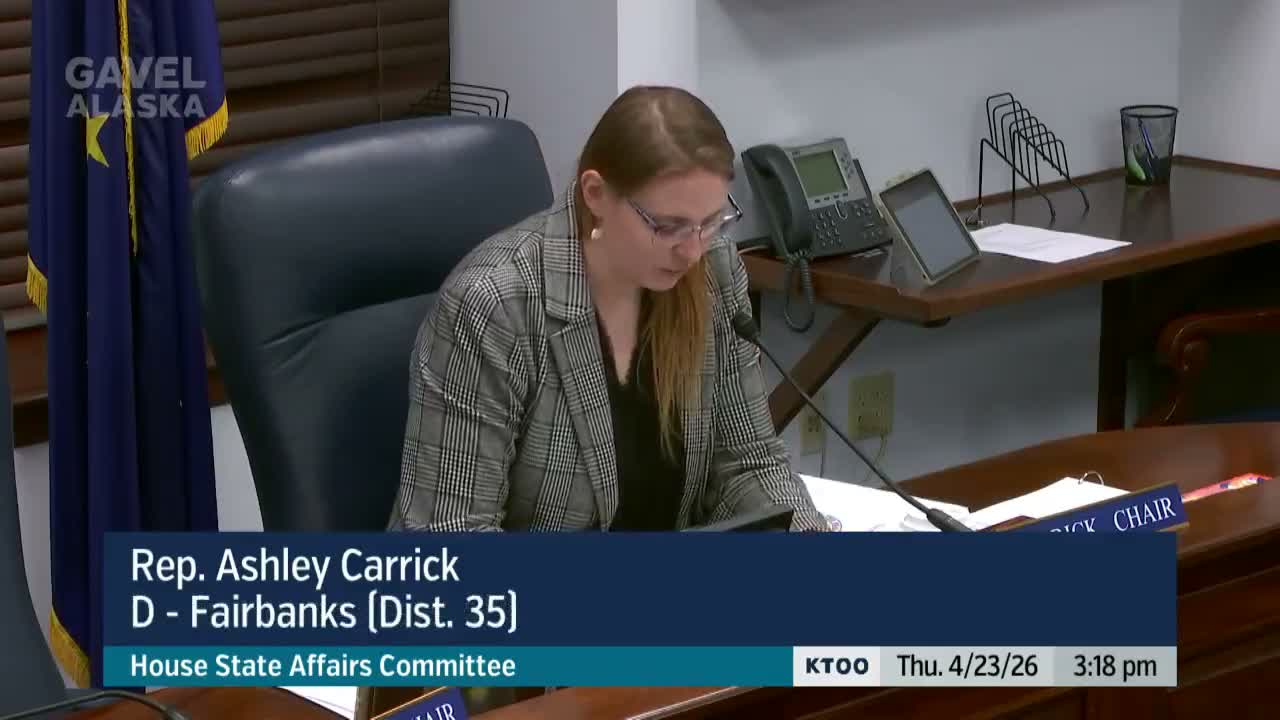
Mayor Grier Hopkins told the Alaska House State Affairs Committee that House Bill 379 is a targeted fix to an "administrative" problem that has left some Alaskans without basic road maintenance. "We have 103 road service areas in the Fairbanks North Star Borough," Hopkins said, and those districts cover roughly two-thirds of the borough's road mileage outside cities and state roads. He said the current process — which often requires two concurrent elections, one in the annexing area and one in the existing service area — routinely prevents neighborhoods that want service from joining an existing area.
Stewart Relay, staff to Chair Kerrick, explained the bill's statutory change: HB379 would add a subsection to AS 29.35.450 allowing second-class boroughs to abolish, replace, alter or consolidate service areas created after the bill's effective date. Relay read the measure's sectional and confirmed the bill's effective date would be July 1, 2026. "Importantly, House Bill 379 preserves voter approval as the default rule for major changes to service areas," Relay said during his presentation.
Hopkins described how the current two-election rule can defeat expansions: in several recent efforts, the annexing neighborhood voted to join but the existing service area voted against accepting the new properties. The result, Hopkins said, are "orphaned roads" that rely on volunteer maintenance or receive no contractor maintenance at all. He framed HB379 as a way for boroughs to adopt local codes that produce workable, locally controlled solutions for future service areas without disturbing existing ones.
Committee members did not pose substantive questions to the mayor during the hearing; the chair opened public testimony and heard none. The committee set HB379 aside for a subsequent hearing next week so members can review the bill materials and any forthcoming analysis.
The committee is expected to revisit HB379 early next week for additional consideration.
Stewart Relay, staff to Chair Kerrick, explained the bill's statutory change: HB379 would add a subsection to AS 29.35.450 allowing second-class boroughs to abolish, replace, alter or consolidate service areas created after the bill's effective date. Relay read the measure's sectional and confirmed the bill's effective date would be July 1, 2026. "Importantly, House Bill 379 preserves voter approval as the default rule for major changes to service areas," Relay said during his presentation.
Hopkins described how the current two-election rule can defeat expansions: in several recent efforts, the annexing neighborhood voted to join but the existing service area voted against accepting the new properties. The result, Hopkins said, are "orphaned roads" that rely on volunteer maintenance or receive no contractor maintenance at all. He framed HB379 as a way for boroughs to adopt local codes that produce workable, locally controlled solutions for future service areas without disturbing existing ones.
Committee members did not pose substantive questions to the mayor during the hearing; the chair opened public testimony and heard none. The committee set HB379 aside for a subsequent hearing next week so members can review the bill materials and any forthcoming analysis.
The committee is expected to revisit HB379 early next week for additional consideration.
View the Full Meeting & All Its Details
This article offers just a summary. Unlock complete video, transcripts, and insights as a Founder Member.
✓
Watch full, unedited meeting videos
✓
Search every word spoken in unlimited transcripts
✓
AI summaries & real-time alerts (all government levels)
✓
Permanent access to expanding government content
30-day money-back guarantee
