Panel hears bill to raise state employee per diem; lawmakers consider tying rates to federal schedule
April 23, 2026 | 2026 Legislature Alaska, Alaska
This article was created by AI summarizing key points discussed. AI makes mistakes, so for full details and context, please refer to the video of the full meeting. Please report any errors so we can fix them. Report an error »
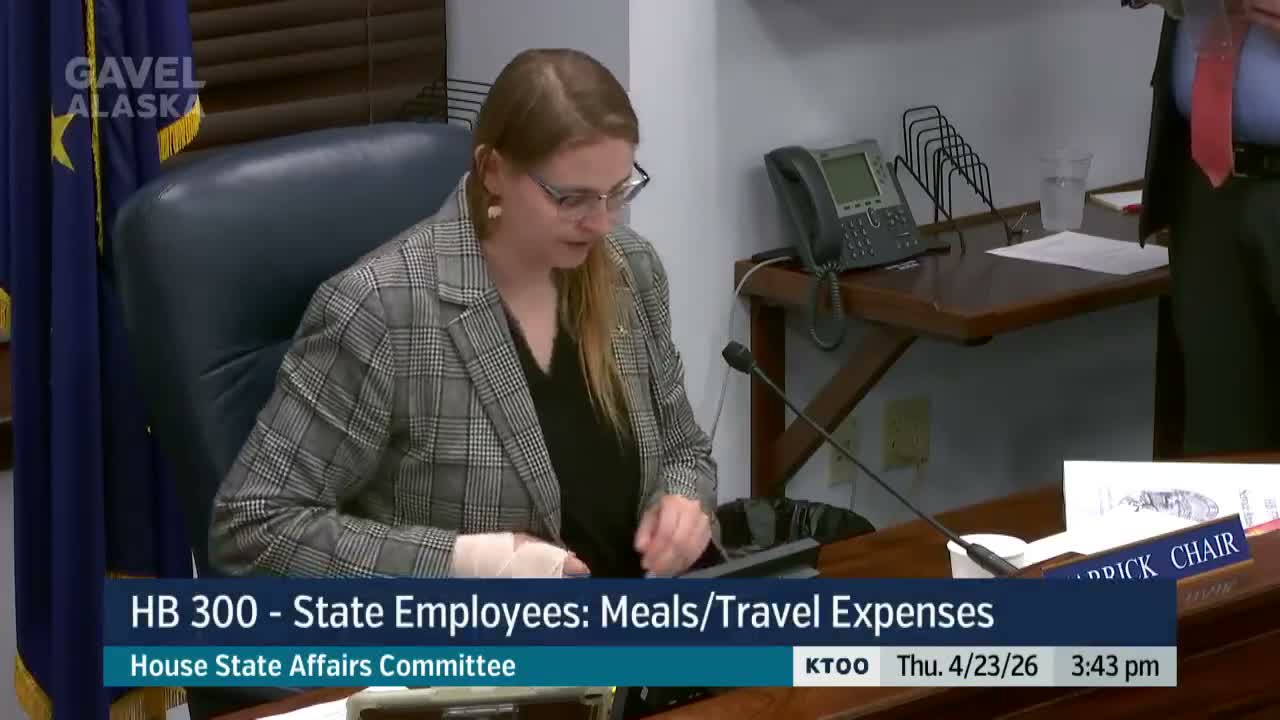
Representative Sarah Hannon told the House State Affairs Committee that House Bill 300 would update statutorily set in-state per diem rates that have not changed since 2010. "The current meals and incidental per diem rates for state employees for traveling in-state for work has not changed since 2010," Hannon said. She said HB300 would raise the short-term rate from $60 to $82 per day and the long-term per diem from $33.33 to $45, and require that every three years the rates be adjusted for inflation using the Alaska Urban Consumer Price Index.
Public witnesses supported the measure. Scott Lee, a 29-year Department of Transportation employee, described the high cost of food and supplies in remote Alaska and told the committee he could not live on $33 a day during longer assignments. "A sandwich and a cooler at the tribal store cost $12," Lee said, arguing that per diem increases and indexing would help employees avoid subsidizing state operations out of pocket. Flynn Casey, a Juneau resident and state employee, said she collected 43 digital signatures in support and cited a 40% rise in the Alaska urban CPI since 2010. Jesse Sloan, president of a supervisory unit representing about 2,500 state supervisors, said HB300 "is the most significant improvement to state employee per diem in a generation," while noting it is not full parity with federal rates.
Committee members pressed the sponsor about alternatives. Representative McCabe said tying state per diem to federal tables (IRS/DOD/GSA locality rates) "makes a whole lot of sense" and offered to propose that amendment; Hannon said she would be open to increasing the bill's figures or tying rates to federal schedules. Staff told members that fiscal notes are generated after the first hearing; the sponsor expected multiple fiscal notes from agencies, plus notes from the university and courts.
The committee closed public testimony and set HB300 aside to return early next week; members indicated they will set an amendment deadline so the committee can act the following Thursday.
Public witnesses supported the measure. Scott Lee, a 29-year Department of Transportation employee, described the high cost of food and supplies in remote Alaska and told the committee he could not live on $33 a day during longer assignments. "A sandwich and a cooler at the tribal store cost $12," Lee said, arguing that per diem increases and indexing would help employees avoid subsidizing state operations out of pocket. Flynn Casey, a Juneau resident and state employee, said she collected 43 digital signatures in support and cited a 40% rise in the Alaska urban CPI since 2010. Jesse Sloan, president of a supervisory unit representing about 2,500 state supervisors, said HB300 "is the most significant improvement to state employee per diem in a generation," while noting it is not full parity with federal rates.
Committee members pressed the sponsor about alternatives. Representative McCabe said tying state per diem to federal tables (IRS/DOD/GSA locality rates) "makes a whole lot of sense" and offered to propose that amendment; Hannon said she would be open to increasing the bill's figures or tying rates to federal schedules. Staff told members that fiscal notes are generated after the first hearing; the sponsor expected multiple fiscal notes from agencies, plus notes from the university and courts.
The committee closed public testimony and set HB300 aside to return early next week; members indicated they will set an amendment deadline so the committee can act the following Thursday.
View the Full Meeting & All Its Details
This article offers just a summary. Unlock complete video, transcripts, and insights as a Founder Member.
✓
Watch full, unedited meeting videos
✓
Search every word spoken in unlimited transcripts
✓
AI summaries & real-time alerts (all government levels)
✓
Permanent access to expanding government content
30-day money-back guarantee
