House finance hears $2.3 billion deferred maintenance backlog, OMB pauses major FY26 allocations
April 22, 2026 | 2026 Legislature Alaska, Alaska
This article was created by AI summarizing key points discussed. AI makes mistakes, so for full details and context, please refer to the video of the full meeting. Please report any errors so we can fix them. Report an error »
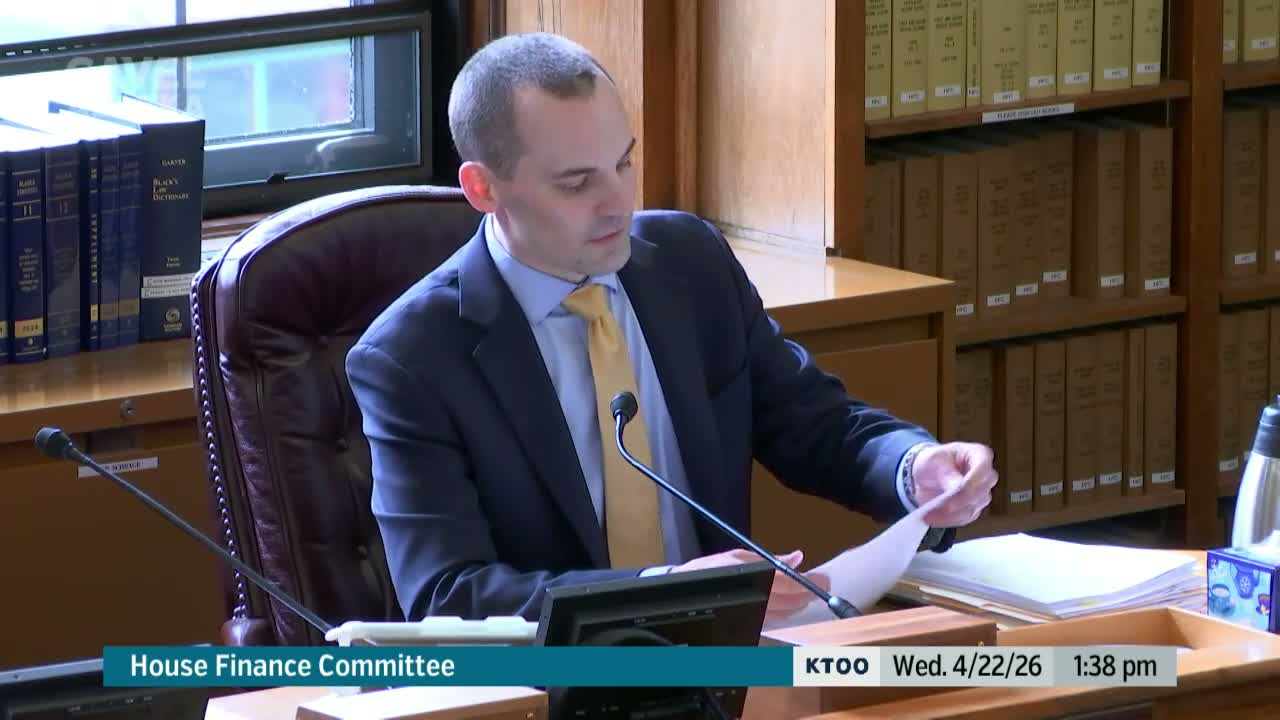
The House Finance Committee heard a briefing April 22 from the Office of Management and Budget and the Department of Transportation and Public Facilities on the state's deferred maintenance backlog and the process used to prioritize projects.
For the record, Lacey Sanders, director of the Office of Management and Budget, told the committee that the state's most recent backlog lists show roughly $766,000,000 for state agencies (excluding the university) and an additional $1,540,000,000 for the University of Alaska, bringing the combined statewide backlog to about $2,300,000,000. "Deferred maintenance projects are mostly items that entities cannot address through preventative maintenance and generally are greater than $25,000," Sanders said.
Why it matters: committee members said the totals are large enough to affect the state's ability to maintain critical facilities, with the university accounting for a disproportionate share of needs. Sanders said the university has estimated a $60,000,000 annual need for renewal and replacement work and that university-specific methodology questions should be answered by the university itself.
OMB explained the funding source commonly used for deferred maintenance: earnings routed from the Amaretta Hess settlement into the Alaska Capital Income Fund. Sanders said OMB and the Division of Finance found the fund largely obligated and paused significant FY2026 allocations while they reconcile actual deposits with prior appropriations. "We have held off this year on significant allocations of funding to departments," she said, noting a small residual appropriation of about $500,000 had been made from returned balances.
DOT&PF staff described the Facilities Council's prioritization rubric, which creates a project index value by combining three factors: a mission-alignment index, a facility systems factor (envelope, mechanical, life/safety, etc.) and a need/urgency score. Christopher Hodgen said the agency-level review and repeated vetting are intended to surface the most critical projects; DOT internal condition assessments showed a 2% of replacement-value contribution as a reasonable preventative-maintenance target.
Committee members pressed for more transparency and modeling: Representative Galvin asked whether OMB has projected the cost of not funding the backlog; Sanders and DOT said no comprehensive forecast exists because inflation, discovered rot and other unanticipated needs make long-range modeling difficult. Members also sought an accounting of prior deposits and allocations; Sanders agreed to provide a summary of deposits and outflows to the committee.
Legislative discretion: members asked whether the legislature can override the administration's prioritized list. Sanders said the legislature has appropriation power and may direct funds to specific projects; she cited the Senate's capital budget direction of about $13,000,000 toward the Mount Edgecumbe High School project, which she said reduces flexible funds available to address statewide deferred maintenance or emergencies.
The committee requested follow-up materials, including the Facilities Council ranking lists and an accounting of the Alaska Capital Income Fund deposits and outflows; no vote or appropriation was made during the briefing. The committee then moved to the next agenda item.
For the record, Lacey Sanders, director of the Office of Management and Budget, told the committee that the state's most recent backlog lists show roughly $766,000,000 for state agencies (excluding the university) and an additional $1,540,000,000 for the University of Alaska, bringing the combined statewide backlog to about $2,300,000,000. "Deferred maintenance projects are mostly items that entities cannot address through preventative maintenance and generally are greater than $25,000," Sanders said.
Why it matters: committee members said the totals are large enough to affect the state's ability to maintain critical facilities, with the university accounting for a disproportionate share of needs. Sanders said the university has estimated a $60,000,000 annual need for renewal and replacement work and that university-specific methodology questions should be answered by the university itself.
OMB explained the funding source commonly used for deferred maintenance: earnings routed from the Amaretta Hess settlement into the Alaska Capital Income Fund. Sanders said OMB and the Division of Finance found the fund largely obligated and paused significant FY2026 allocations while they reconcile actual deposits with prior appropriations. "We have held off this year on significant allocations of funding to departments," she said, noting a small residual appropriation of about $500,000 had been made from returned balances.
DOT&PF staff described the Facilities Council's prioritization rubric, which creates a project index value by combining three factors: a mission-alignment index, a facility systems factor (envelope, mechanical, life/safety, etc.) and a need/urgency score. Christopher Hodgen said the agency-level review and repeated vetting are intended to surface the most critical projects; DOT internal condition assessments showed a 2% of replacement-value contribution as a reasonable preventative-maintenance target.
Committee members pressed for more transparency and modeling: Representative Galvin asked whether OMB has projected the cost of not funding the backlog; Sanders and DOT said no comprehensive forecast exists because inflation, discovered rot and other unanticipated needs make long-range modeling difficult. Members also sought an accounting of prior deposits and allocations; Sanders agreed to provide a summary of deposits and outflows to the committee.
Legislative discretion: members asked whether the legislature can override the administration's prioritized list. Sanders said the legislature has appropriation power and may direct funds to specific projects; she cited the Senate's capital budget direction of about $13,000,000 toward the Mount Edgecumbe High School project, which she said reduces flexible funds available to address statewide deferred maintenance or emergencies.
The committee requested follow-up materials, including the Facilities Council ranking lists and an accounting of the Alaska Capital Income Fund deposits and outflows; no vote or appropriation was made during the briefing. The committee then moved to the next agenda item.
Don't Miss a Word: See the Full Meeting!
Go beyond summaries. Unlock every video, transcript, and key insight with a Founder Membership.
✓
Get instant access to full meeting videos
✓
Search and clip any phrase from complete transcripts
✓
Receive AI-powered summaries & custom alerts
✓
Enjoy lifetime, unrestricted access to government data
30-day money-back guarantee
