Retired educator tells task force Alaska charters evolved into important local options but face facility and support gaps
April 22, 2026 | 2026 Legislature Alaska, Alaska
This article was created by AI summarizing key points discussed. AI makes mistakes, so for full details and context, please refer to the video of the full meeting. Please report any errors so we can fix them. Report an error »
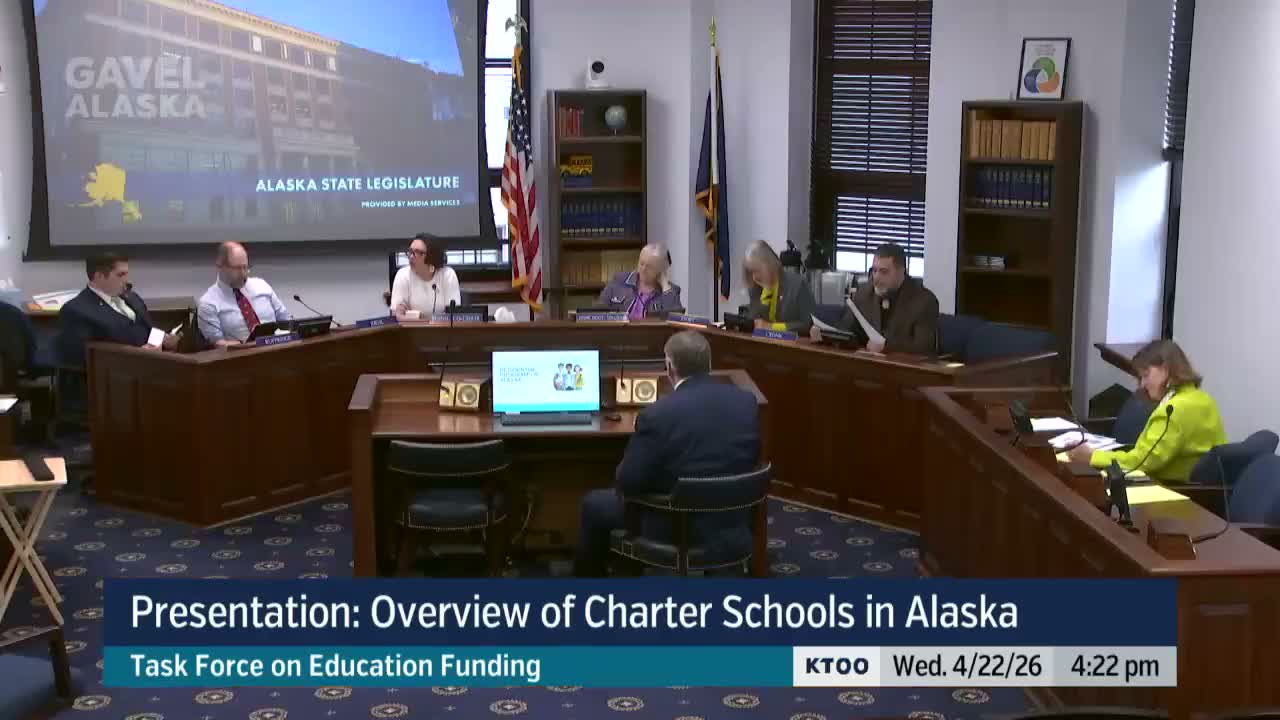
Todd Heinemann, a retired educator who worked decades in Alaska charter schools, told the joint legislative task force that the charter‑school model has brought instructional variety and strong family‑school relationships to communities but still faces facility and funding constraints.
Heinemann summarized the statute timeline—Charter School Act passage in 1995, permit increases and contract extensions in 2001 and later changes through 2010 and 2014—and said Alaska charters differ from many Lower‑48 models because they are authorized through local districts and are not for‑profit. “This connection with the school boards differentiates Alaska's charter schools from most charter schools in the Lower 48,” Heinemann said.
Why it matters: Lawmakers asked whether the current 4% indirect rate for district services to charters (down from 10% in an earlier era) covers administrative costs, including HR and special‑education legal work. Representative Story asked whether a 4% indirect rate is adequate given district responsibilities: Heinemann replied he had no specific statewide data but had heard anecdotally that 4% is a struggle to meet all administrative costs.
Heinemann also raised facilities concerns using his experience in Nome and Homer, where some charters operate in non‑classroom spaces or split buildings, creating operational challenges and risks if district building plans change.
Task force follow‑up: Members asked what supports the Department of Education and Early Development provides to communities seeking to form charters; Heinemann recommended the state identify a single point of contact who can provide consistent technical guidance and legal support to prospective applicants.
Sources: Todd Heinemann presentation and Q&A (SEG 983–SEG 1087); follow‑up questions from Senator Tobin and Representative Story (SEG 1092–SEG 1136).
Heinemann summarized the statute timeline—Charter School Act passage in 1995, permit increases and contract extensions in 2001 and later changes through 2010 and 2014—and said Alaska charters differ from many Lower‑48 models because they are authorized through local districts and are not for‑profit. “This connection with the school boards differentiates Alaska's charter schools from most charter schools in the Lower 48,” Heinemann said.
Why it matters: Lawmakers asked whether the current 4% indirect rate for district services to charters (down from 10% in an earlier era) covers administrative costs, including HR and special‑education legal work. Representative Story asked whether a 4% indirect rate is adequate given district responsibilities: Heinemann replied he had no specific statewide data but had heard anecdotally that 4% is a struggle to meet all administrative costs.
Heinemann also raised facilities concerns using his experience in Nome and Homer, where some charters operate in non‑classroom spaces or split buildings, creating operational challenges and risks if district building plans change.
Task force follow‑up: Members asked what supports the Department of Education and Early Development provides to communities seeking to form charters; Heinemann recommended the state identify a single point of contact who can provide consistent technical guidance and legal support to prospective applicants.
Sources: Todd Heinemann presentation and Q&A (SEG 983–SEG 1087); follow‑up questions from Senator Tobin and Representative Story (SEG 1092–SEG 1136).
View the Full Meeting & All Its Details
This article offers just a summary. Unlock complete video, transcripts, and insights as a Founder Member.
✓
Watch full, unedited meeting videos
✓
Search every word spoken in unlimited transcripts
✓
AI summaries & real-time alerts (all government levels)
✓
Permanent access to expanding government content
30-day money-back guarantee
