House committee advances bill to extend victim‑counseling confidentiality to tribal governments
April 23, 2026 | 2026 Legislature Alaska, Alaska
This article was created by AI summarizing key points discussed. AI makes mistakes, so for full details and context, please refer to the video of the full meeting. Please report any errors so we can fix them. Report an error »
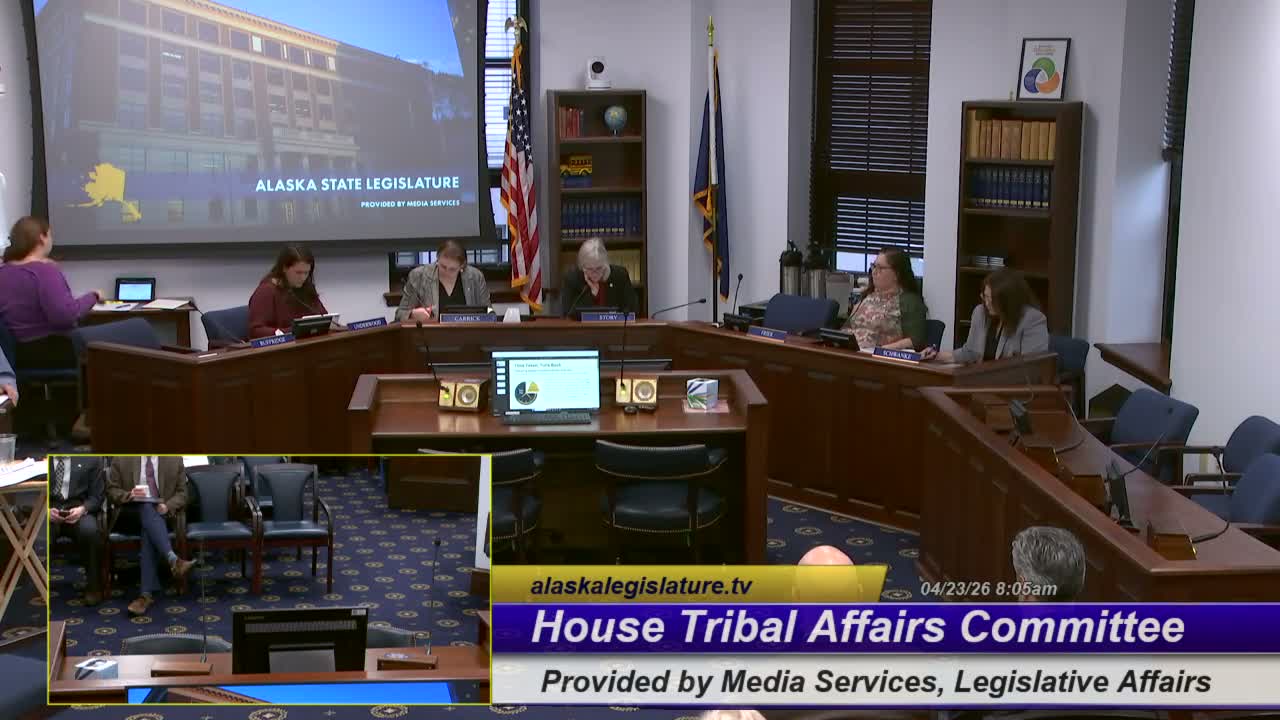
The House Tribal Affairs Committee voted April 23 to report HB 384, a bill that would add the word “tribal” to the statutory definition of a victim counseling center and extend the confidentiality protections in AS 18.66.250 to advocates employed by tribal governments.
Supporters told the committee that the change is a narrow, cost‑neutral fix to a legal gap that leaves survivors and tribal advocates vulnerable. “Without privilege protection, everything is discoverable,” said Tammy Truett Giroux, executive director of the Alaska Native Women’s Resource Center, describing how subpoenas can make safety plans and sensitive disclosures available to an abuser’s lawyer. “Survivors learn their disclosures to tribal advocates are unprotected and stop seeking help.”
Rick Haskins Garcia, director of law, policy and tribal justice for the Alaska Native Women’s Resource Center, told the panel that many tribal justice systems are still being built and that advocates frequently rely on state courts. He said the lack of statutory privilege can create a chilling effect that weakens documentation and advocacy. “Tribal advocates who cannot promise confidentiality will create a chilling ripple effect across all Alaska, state and tribal alike,” Haskins Garcia said.
Committee staff explained the legal mechanism: the chapter protects communications with victim counselors, and victim counselors are defined as employees or supervised volunteers of a victim counseling center. Dylan Hitchcock Lopez, staff to Rep. Gray, said changing the definition of “victim counseling center” to include tribal governments would cause those protections to “flow through the whole chapter.”
Several tribal leaders and advocates backed the bill during public testimony. Chief Michael Williams described the realities of small, rural communities where privacy is limited and tribal advocates are often the first — and sometimes only — point of contact for survivors. Other testifiers urged the committee to harmonize the change with federal authorities and existing victim‑service structures.
After a brief discussion, Representative Schwanke moved that the committee report HB 384 with individual recommendations and attach no fiscal note. Representative Ruffridge briefly objected then withdrew the objection; Vice Chair Story said, seeing no further objection, the bill has passed the committee and paperwork was signed to report the bill out.
Next steps: HB 384 will be reported out of House Tribal Affairs and proceed through the Legislature for further committee consideration.
Supporters told the committee that the change is a narrow, cost‑neutral fix to a legal gap that leaves survivors and tribal advocates vulnerable. “Without privilege protection, everything is discoverable,” said Tammy Truett Giroux, executive director of the Alaska Native Women’s Resource Center, describing how subpoenas can make safety plans and sensitive disclosures available to an abuser’s lawyer. “Survivors learn their disclosures to tribal advocates are unprotected and stop seeking help.”
Rick Haskins Garcia, director of law, policy and tribal justice for the Alaska Native Women’s Resource Center, told the panel that many tribal justice systems are still being built and that advocates frequently rely on state courts. He said the lack of statutory privilege can create a chilling effect that weakens documentation and advocacy. “Tribal advocates who cannot promise confidentiality will create a chilling ripple effect across all Alaska, state and tribal alike,” Haskins Garcia said.
Committee staff explained the legal mechanism: the chapter protects communications with victim counselors, and victim counselors are defined as employees or supervised volunteers of a victim counseling center. Dylan Hitchcock Lopez, staff to Rep. Gray, said changing the definition of “victim counseling center” to include tribal governments would cause those protections to “flow through the whole chapter.”
Several tribal leaders and advocates backed the bill during public testimony. Chief Michael Williams described the realities of small, rural communities where privacy is limited and tribal advocates are often the first — and sometimes only — point of contact for survivors. Other testifiers urged the committee to harmonize the change with federal authorities and existing victim‑service structures.
After a brief discussion, Representative Schwanke moved that the committee report HB 384 with individual recommendations and attach no fiscal note. Representative Ruffridge briefly objected then withdrew the objection; Vice Chair Story said, seeing no further objection, the bill has passed the committee and paperwork was signed to report the bill out.
Next steps: HB 384 will be reported out of House Tribal Affairs and proceed through the Legislature for further committee consideration.
View the Full Meeting & All Its Details
This article offers just a summary. Unlock complete video, transcripts, and insights as a Founder Member.
✓
Watch full, unedited meeting videos
✓
Search every word spoken in unlimited transcripts
✓
AI summaries & real-time alerts (all government levels)
✓
Permanent access to expanding government content
30-day money-back guarantee
