House Finance Committee advances bill to add registered interior designers to board, report moves forward without objection
April 23, 2026 | 2026 Legislature Alaska, Alaska
This article was created by AI summarizing key points discussed. AI makes mistakes, so for full details and context, please refer to the video of the full meeting. Please report any errors so we can fix them. Report an error »
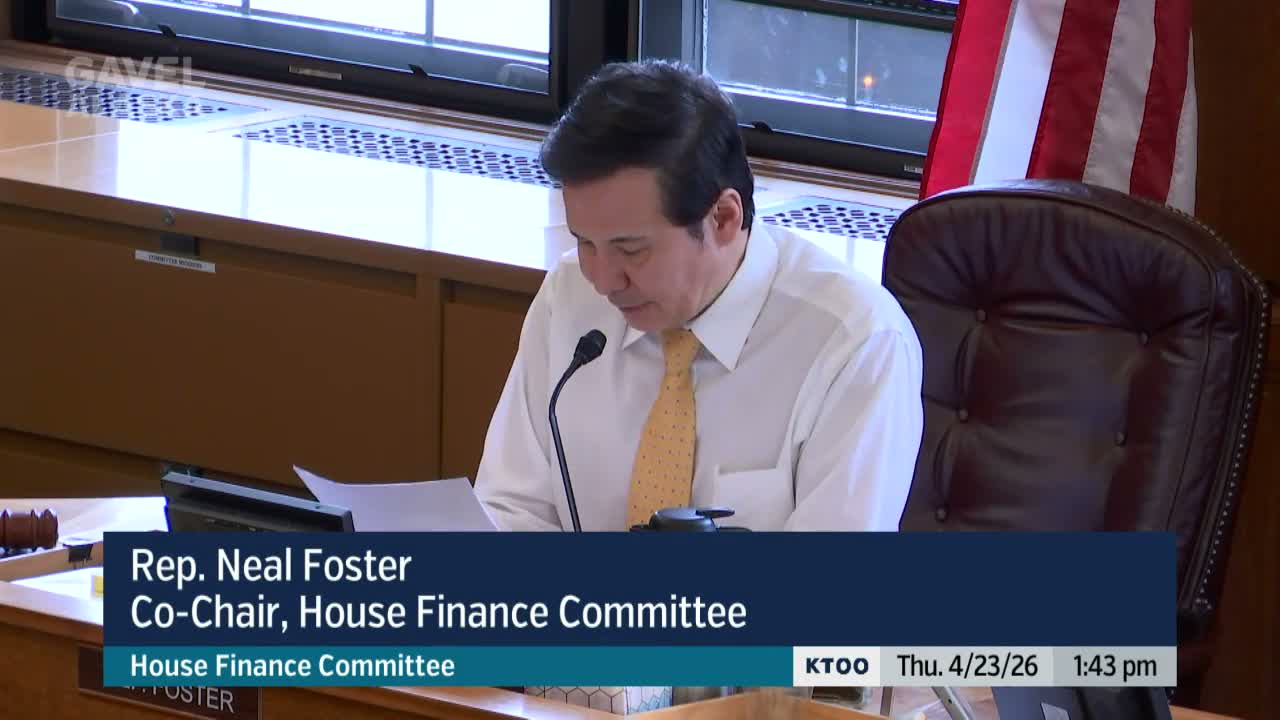
Co‑Chair Foster called the House Finance Committee to order and opened the first hearing on House Bill 314, which would extend the state board that regulates architects, engineers, land surveyors and related professions and add a registration pathway for interior designers.
Sponsor Representative Mike Prox (House District 33) told the committee HB314 is a revised version of last year’s Senate Bill 54 and said the bill removes or revises provisions that prompted the governor’s veto. "We met with the administration and we think we have resolved those concerns," Prox said, noting the bill keeps the board at 11 members, narrows a proposed delegation affecting DOT design‑build contracts, and adjusts language about certified wastewater installers so it aligns with administration concerns.
Chris Curtis, the state legislative auditor, testified the division’s 2024 sunset audit was "clean" and recommended an eight‑year extension. Curtis warned that if the board were not extended, licensing duties would transfer to the Division of Corporations, Business and Professional Licensing and the state could lose volunteer expertise used for regulation drafting and investigations.
Architect Charles Bettisworth, testifying in support, described how interior designers contribute to safety and infection‑control decisions on projects such as foster‑care facilities and medical clinics and urged passage to create a pathway for qualified interior designers to be registered in Alaska. "With respect to the role of interior designers, I will recount some of my professional experience where the expertise of interior designers has been crucial," Bettisworth said.
Sylvan Robb, director of the Division of Corporations, Business and Professional Licensing, summarized the fiscal note (control code METEH). She said the collective first‑year cost is $242,900, with an FY27 appropriation request of $175,600 and ongoing annual costs of about $228,200 in FY28–FY32, funded by receipt‑supported licensing fees to pay for one new licensing examiner plus travel and administrative costs.
Gene McCabe, director of the Division of Water, told the committee the department’s portion of the bill carries a $0 fiscal impact because the one change referencing the Division aligns with existing regulations and requires no procedural or personnel changes.
Riley Nye, staff to Representative Prox, walked the committee through the sectional analysis: the bill extends the ALS board termination date to June 30, 2033; adds "registered interior designer" to statute and to the certificate of authorization definitions; replaces one civil‑engineer seat with a registered interior designer; creates exemptions (including allowing certified wastewater installers to design conventional on‑site wastewater systems under a 1,500‑gallon‑per‑day threshold); and staggers effective dates, including retroactivity for the board extension.
Committee members pressed on representation: Representative Josephson, Bynum and others questioned whether moving an engineering seat to an interior designer would underrepresent professions that make up the majority of registrants; Prox acknowledged some pushback but said sponsors prioritized passage and left appointment language broad to ease finding board members. Representative Bynum warned the board had already entered its sunset wind‑down and stressed the need to act quickly to avoid disruption.
Representative Brooks moved to report HB314 (work order 4‑LS1490A) out of House Finance "with individual recommendations and attached fiscal notes." Seeing no objection, Co‑Chair Foster announced the bill moves out of committee. Members were asked to sign the committee report. Representative Prox closed by thanking the committee and saying the sponsor would continue work on any deficiencies during the interim.
The committee recessed briefly before taking up the next bill.
Sponsor Representative Mike Prox (House District 33) told the committee HB314 is a revised version of last year’s Senate Bill 54 and said the bill removes or revises provisions that prompted the governor’s veto. "We met with the administration and we think we have resolved those concerns," Prox said, noting the bill keeps the board at 11 members, narrows a proposed delegation affecting DOT design‑build contracts, and adjusts language about certified wastewater installers so it aligns with administration concerns.
Chris Curtis, the state legislative auditor, testified the division’s 2024 sunset audit was "clean" and recommended an eight‑year extension. Curtis warned that if the board were not extended, licensing duties would transfer to the Division of Corporations, Business and Professional Licensing and the state could lose volunteer expertise used for regulation drafting and investigations.
Architect Charles Bettisworth, testifying in support, described how interior designers contribute to safety and infection‑control decisions on projects such as foster‑care facilities and medical clinics and urged passage to create a pathway for qualified interior designers to be registered in Alaska. "With respect to the role of interior designers, I will recount some of my professional experience where the expertise of interior designers has been crucial," Bettisworth said.
Sylvan Robb, director of the Division of Corporations, Business and Professional Licensing, summarized the fiscal note (control code METEH). She said the collective first‑year cost is $242,900, with an FY27 appropriation request of $175,600 and ongoing annual costs of about $228,200 in FY28–FY32, funded by receipt‑supported licensing fees to pay for one new licensing examiner plus travel and administrative costs.
Gene McCabe, director of the Division of Water, told the committee the department’s portion of the bill carries a $0 fiscal impact because the one change referencing the Division aligns with existing regulations and requires no procedural or personnel changes.
Riley Nye, staff to Representative Prox, walked the committee through the sectional analysis: the bill extends the ALS board termination date to June 30, 2033; adds "registered interior designer" to statute and to the certificate of authorization definitions; replaces one civil‑engineer seat with a registered interior designer; creates exemptions (including allowing certified wastewater installers to design conventional on‑site wastewater systems under a 1,500‑gallon‑per‑day threshold); and staggers effective dates, including retroactivity for the board extension.
Committee members pressed on representation: Representative Josephson, Bynum and others questioned whether moving an engineering seat to an interior designer would underrepresent professions that make up the majority of registrants; Prox acknowledged some pushback but said sponsors prioritized passage and left appointment language broad to ease finding board members. Representative Bynum warned the board had already entered its sunset wind‑down and stressed the need to act quickly to avoid disruption.
Representative Brooks moved to report HB314 (work order 4‑LS1490A) out of House Finance "with individual recommendations and attached fiscal notes." Seeing no objection, Co‑Chair Foster announced the bill moves out of committee. Members were asked to sign the committee report. Representative Prox closed by thanking the committee and saying the sponsor would continue work on any deficiencies during the interim.
The committee recessed briefly before taking up the next bill.
View the Full Meeting & All Its Details
This article offers just a summary. Unlock complete video, transcripts, and insights as a Founder Member.
✓
Watch full, unedited meeting videos
✓
Search every word spoken in unlimited transcripts
✓
AI summaries & real-time alerts (all government levels)
✓
Permanent access to expanding government content
30-day money-back guarantee
