Rep. Vance introduces bill to let small-scale Alaska fishermen process and sell catch directly
April 23, 2026 | 2026 Legislature Alaska, Alaska
This article was created by AI summarizing key points discussed. AI makes mistakes, so for full details and context, please refer to the video of the full meeting. Please report any errors so we can fix them. Report an error »
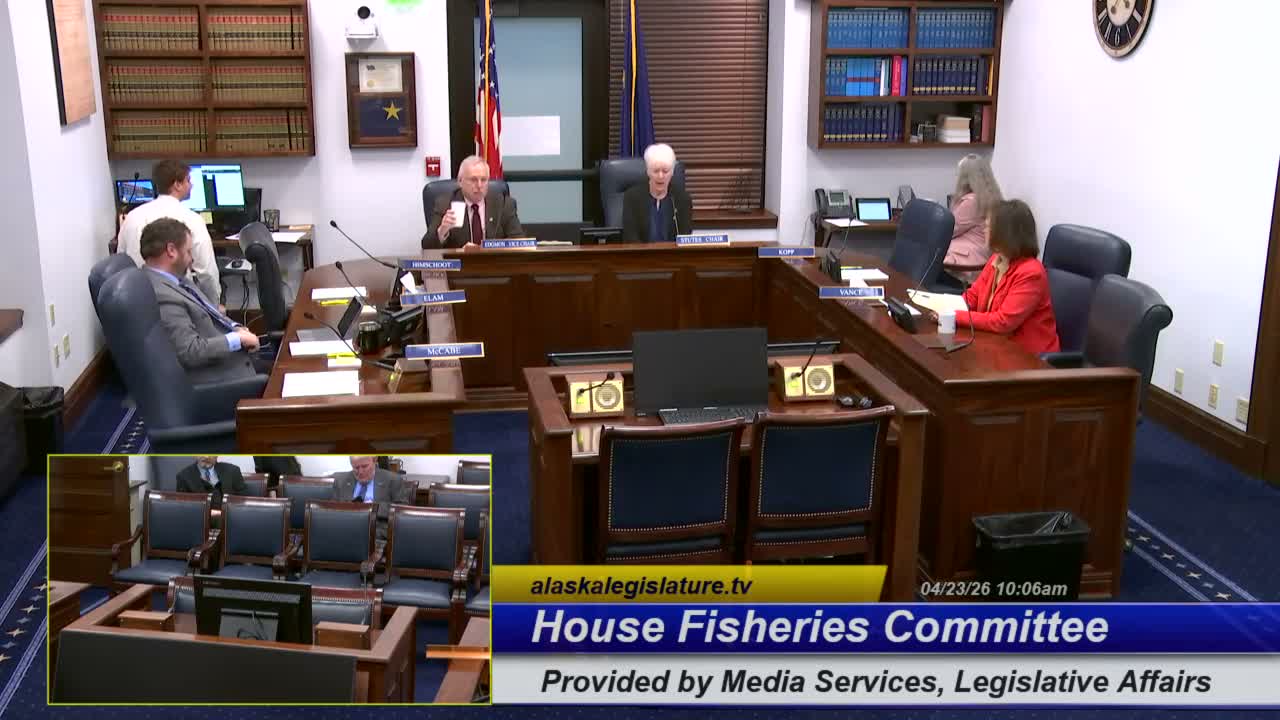
Representative Sarah Vance introduced House Bill 356, the Alaska Coastal Micro Fisheries Act, on April 23 at a House Special Committee on Fisheries hearing in Juneau, saying the measure aims to "make it easier for small Alaskan fishermen to stay in business and make a living." The bill would amend AS 17.20 to distinguish limited onboard or shore-side, small-scale processing from industrial processing and create a regulatory pathway for "microfishery" operations.
Vance told the committee the bill would allow qualifying fishermen to clean, fillet and package up to 5,000 pounds of fish without being classified as a full processing plant, require Department of Environmental Conservation (DEC) permits to be decided within 30 days, and reduce permit fees to $100 for qualifying operators. "This is not deregulation; it is right-sizing regulation," Vance said, adding the measure preserves DEC authority to enforce sanitation standards and to develop implementing regulations.
Members pressed the sponsor on several specifics. Vice Chair Bryce Edgmon and Representative Elam noted the bill uses the term "microfishery" without a statutory definition; Vance said the phrase is intended to describe smaller, family-run operations and that the numeric thresholds in the draft are a starting point. Representative Kopp flagged an apparent inconsistency between sections that reference vessels "under 50 feet" in one provision and "not to exceed 65 feet" in another; adviser Naresh Shrestha told the committee the numbers were initially chosen to capture smaller vessels and can be refined during drafting.
Committee members also asked whether tenders (vessels that transport catch) could be captured by the language and whether the bill would exempt any federal food-safety standards. Representative McCabe raised concern that the bill's phrase "fishery resources" might be read to include tendering activity; Vance said the intent is to benefit direct harvesters, not tenders. Representative Kopp emphasized the bill "does not exempt them from the Federal Seafood Safety Act," a point the sponsor agreed with, saying DEC must first determine vessels meet federal standards before waiving additional state requirements.
On species scope and sanitation, Vance said the bill intentionally uses broad language so DEC can apply federal guidance and regional expertise to determine which species present a "low risk" of spreading pests or disease and what onboard or shore-side sanitary measures are appropriate. The fiscal note, she said, anticipates DEC will need environmental health officer review for permit applications and inspections to ensure compliance.
Members generally praised the bill as a workable starting point and urged fine-tuning on vessel-size thresholds, the scope of exempted sanitation requirements, and practical enforcement given DEC staffing and travel constraints. Vance invited fishermen and stakeholders to provide input by email to the committee and her office as the bill is refined.
The committee set the legislation aside for further work; no vote was taken. The bill’s next steps will depend on staff drafting changes, DEC guidance, and stakeholder input.
Vance told the committee the bill would allow qualifying fishermen to clean, fillet and package up to 5,000 pounds of fish without being classified as a full processing plant, require Department of Environmental Conservation (DEC) permits to be decided within 30 days, and reduce permit fees to $100 for qualifying operators. "This is not deregulation; it is right-sizing regulation," Vance said, adding the measure preserves DEC authority to enforce sanitation standards and to develop implementing regulations.
Members pressed the sponsor on several specifics. Vice Chair Bryce Edgmon and Representative Elam noted the bill uses the term "microfishery" without a statutory definition; Vance said the phrase is intended to describe smaller, family-run operations and that the numeric thresholds in the draft are a starting point. Representative Kopp flagged an apparent inconsistency between sections that reference vessels "under 50 feet" in one provision and "not to exceed 65 feet" in another; adviser Naresh Shrestha told the committee the numbers were initially chosen to capture smaller vessels and can be refined during drafting.
Committee members also asked whether tenders (vessels that transport catch) could be captured by the language and whether the bill would exempt any federal food-safety standards. Representative McCabe raised concern that the bill's phrase "fishery resources" might be read to include tendering activity; Vance said the intent is to benefit direct harvesters, not tenders. Representative Kopp emphasized the bill "does not exempt them from the Federal Seafood Safety Act," a point the sponsor agreed with, saying DEC must first determine vessels meet federal standards before waiving additional state requirements.
On species scope and sanitation, Vance said the bill intentionally uses broad language so DEC can apply federal guidance and regional expertise to determine which species present a "low risk" of spreading pests or disease and what onboard or shore-side sanitary measures are appropriate. The fiscal note, she said, anticipates DEC will need environmental health officer review for permit applications and inspections to ensure compliance.
Members generally praised the bill as a workable starting point and urged fine-tuning on vessel-size thresholds, the scope of exempted sanitation requirements, and practical enforcement given DEC staffing and travel constraints. Vance invited fishermen and stakeholders to provide input by email to the committee and her office as the bill is refined.
The committee set the legislation aside for further work; no vote was taken. The bill’s next steps will depend on staff drafting changes, DEC guidance, and stakeholder input.
View the Full Meeting & All Its Details
This article offers just a summary. Unlock complete video, transcripts, and insights as a Founder Member.
✓
Watch full, unedited meeting videos
✓
Search every word spoken in unlimited transcripts
✓
AI summaries & real-time alerts (all government levels)
✓
Permanent access to expanding government content
30-day money-back guarantee
