Fort Pierce commission accepts FY2025 audit; auditors report improved net position, flag receivables and property‑tax paperwork
April 20, 2026 | Fort Pierce, St. Lucie County, Florida
This article was created by AI summarizing key points discussed. AI makes mistakes, so for full details and context, please refer to the video of the full meeting. Please report any errors so we can fix them. Report an error »
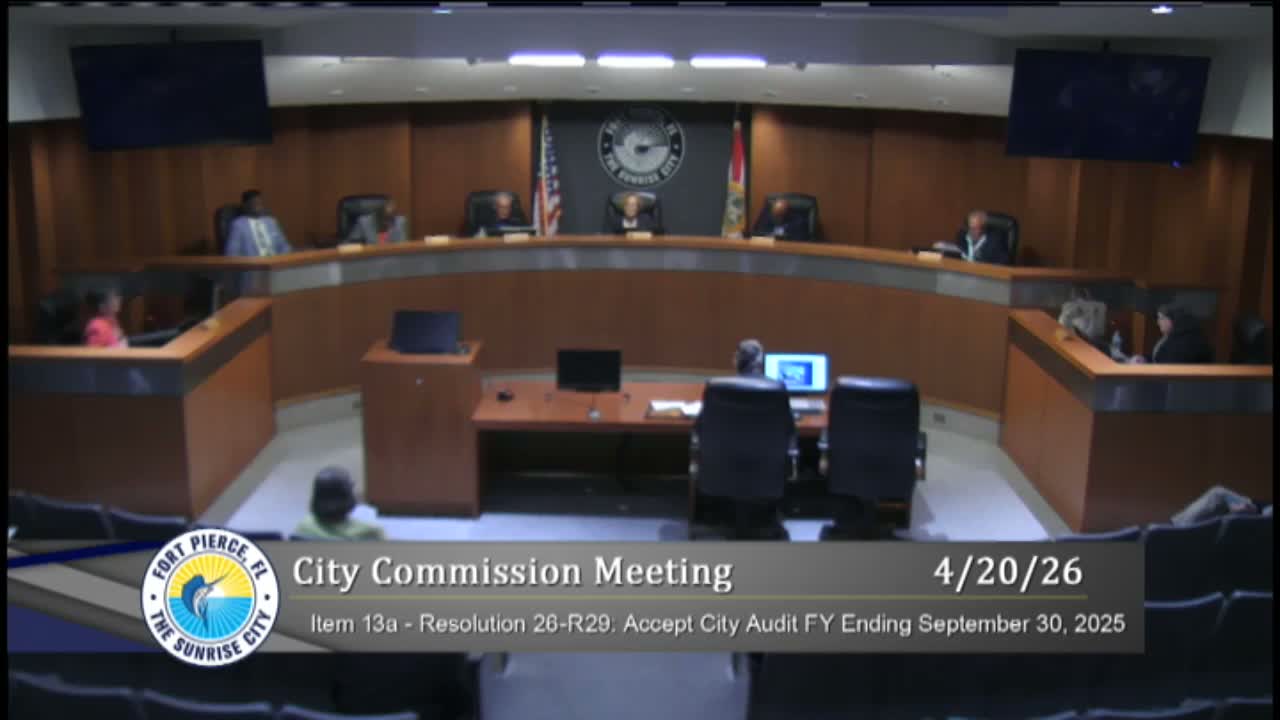
The City of Fort Pierce commission voted unanimously April 20 to accept the city's FY2025 comprehensive annual financial report following a presentation by outside auditor Mark Barnes.
Barnes, of DeBartla, Mayo, McBee, Hartley and Barnes, told the commission the city’s cash and investments rose by about $5.8 million, current liabilities decreased by about $6.3 million and long‑term liabilities by $4.3 million, producing an overall net position increase of about $7.6 million compared with the prior year. Capital investment increased roughly $2 million, and major capital outlays for the year included about $5 million for public‑safety radios and cameras, the auditor said.
Why it matters: commissioners said the audit shows a stronger balance sheet, but they pressed staff about areas that could mask vulnerabilities — chiefly timing and classification of American Rescue Plan (ARP) funds, outstanding receivables, and whether the city is paying property taxes on parcels that should be tax‑exempt.
Commission discussion and follow-ups
Commissioners and the auditor reviewed several fund‑level results. The solid‑waste fund produced positive net cash flows and transferred $500,000 to the general fund, Barnes said. Stormwater reported net cash flows of about $3.1 million, largely because of capital transfers; the golf course posted an increased operating loss ($295,000 this year versus $217,000 the prior year), while the marina remained roughly breakeven on operations and transferred $275,000 to the general fund. The Sunrise Theater and the city’s adoption center showed significant operating shortfalls; the adoption center’s reported operating loss was $819,000 for the year.
Commissioner questions focused on details and next steps: several commissioners asked staff to provide clearer, department‑level dashboards for budget planning and to monitor early indicators such as landfill fees, fuel and equipment costs that could affect the solid‑waste and stormwater funds. On the golf course, commissioners urged a review of concession revenue and membership strategies to reduce operating losses.
Property tax payment issue and receivables
A commissioner reported finding a property tax bill of about $18,000 for a parcel where a commercial building had been demolished years earlier. Auditor Barnes said the audit team identified a $4 million adjustment to beginning fund balances tied to donated land that had not been removed from records; he recommended that finance staff match property‑appraiser records against the city's fixed‑asset list to identify any other erroneous tax payments.
The commission directed staff to pursue a deeper review of receivables and of city‑owned parcels that may be incorrectly taxed and to report back with findings and corrective options.
What’s next: The commission formally accepted the audit (recorded as Resolution 26‑R29 on the agenda). Commissioners requested follow‑up briefings on stormwater receivables, the adoption center’s finances and a forensic review of property‑tax payments where exemptions may apply.
Barnes, of DeBartla, Mayo, McBee, Hartley and Barnes, told the commission the city’s cash and investments rose by about $5.8 million, current liabilities decreased by about $6.3 million and long‑term liabilities by $4.3 million, producing an overall net position increase of about $7.6 million compared with the prior year. Capital investment increased roughly $2 million, and major capital outlays for the year included about $5 million for public‑safety radios and cameras, the auditor said.
Why it matters: commissioners said the audit shows a stronger balance sheet, but they pressed staff about areas that could mask vulnerabilities — chiefly timing and classification of American Rescue Plan (ARP) funds, outstanding receivables, and whether the city is paying property taxes on parcels that should be tax‑exempt.
Commission discussion and follow-ups
Commissioners and the auditor reviewed several fund‑level results. The solid‑waste fund produced positive net cash flows and transferred $500,000 to the general fund, Barnes said. Stormwater reported net cash flows of about $3.1 million, largely because of capital transfers; the golf course posted an increased operating loss ($295,000 this year versus $217,000 the prior year), while the marina remained roughly breakeven on operations and transferred $275,000 to the general fund. The Sunrise Theater and the city’s adoption center showed significant operating shortfalls; the adoption center’s reported operating loss was $819,000 for the year.
Commissioner questions focused on details and next steps: several commissioners asked staff to provide clearer, department‑level dashboards for budget planning and to monitor early indicators such as landfill fees, fuel and equipment costs that could affect the solid‑waste and stormwater funds. On the golf course, commissioners urged a review of concession revenue and membership strategies to reduce operating losses.
Property tax payment issue and receivables
A commissioner reported finding a property tax bill of about $18,000 for a parcel where a commercial building had been demolished years earlier. Auditor Barnes said the audit team identified a $4 million adjustment to beginning fund balances tied to donated land that had not been removed from records; he recommended that finance staff match property‑appraiser records against the city's fixed‑asset list to identify any other erroneous tax payments.
The commission directed staff to pursue a deeper review of receivables and of city‑owned parcels that may be incorrectly taxed and to report back with findings and corrective options.
What’s next: The commission formally accepted the audit (recorded as Resolution 26‑R29 on the agenda). Commissioners requested follow‑up briefings on stormwater receivables, the adoption center’s finances and a forensic review of property‑tax payments where exemptions may apply.
View the Full Meeting & All Its Details
This article offers just a summary. Unlock complete video, transcripts, and insights as a Founder Member.
✓
Watch full, unedited meeting videos
✓
Search every word spoken in unlimited transcripts
✓
AI summaries & real-time alerts (all government levels)
✓
Permanent access to expanding government content
30-day money-back guarantee
