Commission accepts two Phase 1 historic‑resource reports, finds 1617 Olive and 204 E. Alamar not eligible
April 23, 2026 | Santa Barbara City, Santa Barbara County, California
This article was created by AI summarizing key points discussed. AI makes mistakes, so for full details and context, please refer to the video of the full meeting. Please report any errors so we can fix them. Report an error »
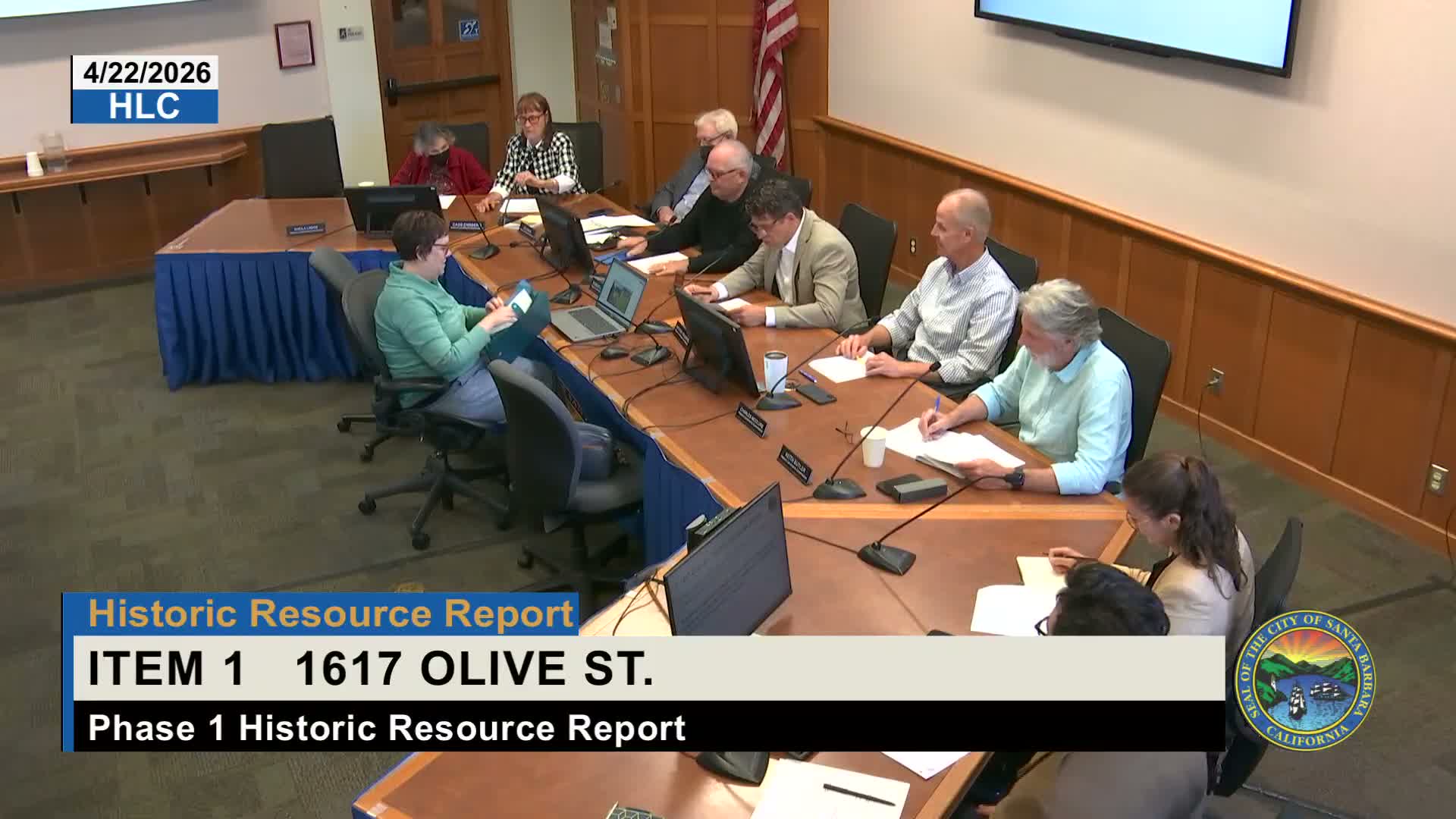
The Santa Barbara Historic Landmarks Commission voted on April 22 to accept two Phase 1 historic‑resource reports prepared by Long Historic Preservation Services and to concur with the consultant’s conclusions that the properties are not eligible for designation.
For 1617 Olive Street, Amber Long told the commission the duplex, built circa 1936 and attributed to architect Alex D'Alfonso, has lost or altered key character‑defining features (notably window replacements and porch modifications) and does not retain the level of integrity needed for local, state, or federal listing. Long said archival research did not substantiate a strong associative significance and that the property’s stylistic mix meant it was not a strong example of Art Moderne in the city.
Commission discussion focused on available archival plans, the presence of a distinctive five‑part circular window (noted as surviving), and whether later alterations obscured significance. Following questions and a brief discussion the commission moved and approved acceptance of the Phase 1 report and its conclusion that 1617 Olive Street is not eligible.
For 204 East Alamar Avenue, Long described a 1947 minimal‑traditional residence that has been substantially altered by second‑story additions and window replacements. The consultant concluded the alterations obscure any potential to yield historic information or retain a distinguishable visual identity. Commissioners asked about the building’s role as a model home in historical advertisements and Long said there was not enough archival evidence linking the original developer to broader significance. The commission voted to accept the Phase 1 report and its findings.
Votes at a glance
- 1617 Olive Street: Motion to accept Phase 1 report and conclusions (passed by roll call).
- 204 East Alamar Avenue: Motion to accept Phase 1 report and conclusions (passed by roll call).
Next steps: Acceptance of Phase 1 reports means staff and applicants may proceed with any future project permitting steps informed by the consultant’s findings; no further designation action was taken at this hearing.
For 1617 Olive Street, Amber Long told the commission the duplex, built circa 1936 and attributed to architect Alex D'Alfonso, has lost or altered key character‑defining features (notably window replacements and porch modifications) and does not retain the level of integrity needed for local, state, or federal listing. Long said archival research did not substantiate a strong associative significance and that the property’s stylistic mix meant it was not a strong example of Art Moderne in the city.
Commission discussion focused on available archival plans, the presence of a distinctive five‑part circular window (noted as surviving), and whether later alterations obscured significance. Following questions and a brief discussion the commission moved and approved acceptance of the Phase 1 report and its conclusion that 1617 Olive Street is not eligible.
For 204 East Alamar Avenue, Long described a 1947 minimal‑traditional residence that has been substantially altered by second‑story additions and window replacements. The consultant concluded the alterations obscure any potential to yield historic information or retain a distinguishable visual identity. Commissioners asked about the building’s role as a model home in historical advertisements and Long said there was not enough archival evidence linking the original developer to broader significance. The commission voted to accept the Phase 1 report and its findings.
Votes at a glance
- 1617 Olive Street: Motion to accept Phase 1 report and conclusions (passed by roll call).
- 204 East Alamar Avenue: Motion to accept Phase 1 report and conclusions (passed by roll call).
Next steps: Acceptance of Phase 1 reports means staff and applicants may proceed with any future project permitting steps informed by the consultant’s findings; no further designation action was taken at this hearing.
View the Full Meeting & All Its Details
This article offers just a summary. Unlock complete video, transcripts, and insights as a Founder Member.
✓
Watch full, unedited meeting videos
✓
Search every word spoken in unlimited transcripts
✓
AI summaries & real-time alerts (all government levels)
✓
Permanent access to expanding government content
30-day money-back guarantee
