Colorado House Education Committee hears sponsors on cradle‑to‑career grant proposal; lays bill over for amendments
April 22, 2026 | 2026 Legislature CO, Colorado
This article was created by AI summarizing key points discussed. AI makes mistakes, so for full details and context, please refer to the video of the full meeting. Please report any errors so we can fix them. Report an error »
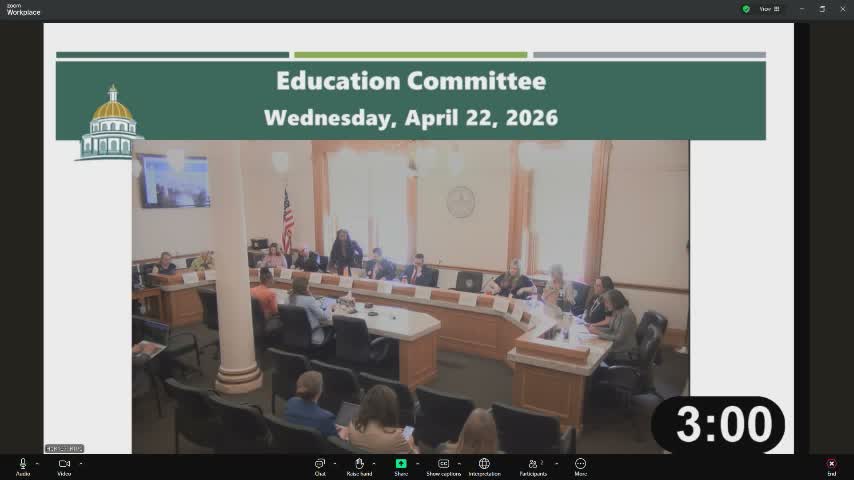
House Education Committee members spent more than an hour probing sponsors and agency staff over a proposed cradle‑to‑career grant program that would be administered by the Colorado Department of Human Services and funded primarily by gifts, grants and donations.
The bill’s sponsors said the program would create place‑based, coordinated services to improve prenatal and early‑childhood outcomes, strengthen educational attainment and connect families to workforce supports. A sponsor described the measure as an effort to “support coordinated community‑based services that help families move toward economic mobility and reduce poverty.” The sponsors asked the committee to lay the measure over to allow work on amendments.
Lawmakers repeatedly raised two central concerns: how the program would be funded and whether the new grant structure would duplicate or displace existing programs. Representative Hartzook and others questioned why the state would create another grant layer instead of streamlining existing funding. The sponsors said existing programs could apply and that the bill is meant to target and supplement initiatives focused on economic mobility, not to replace them.
The committee called up the fiscal analyst to clarify the bill’s funding mechanics. John Armstrong said the bill and its fiscal note are explicit that "the General Assembly shall not appropriate general fund purpose money for the purposes of" the program, and that implementation is contingent on receiving sufficient gifts, grants and donations. Armstrong added that the fiscal note models both administrative costs and an expectation of roughly nine hundred thousand dollars in initial cash funds and that, under the bill’s effective‑date language, money raised below the modeled threshold would be refunded rather than used to implement the program.
Members also pressed whether small and rural organizations would be able to compete for grants that require a community economic‑mobility needs assessment and comprehensive proposal. Dr. Megan Stid, director of the Division of Community Programs at CDHS, said the department would provide training and technical assistance, design RFAs to compare similar applicants, include people with lived experience in evaluation, and use term‑limited positions and contract monitoring for administration. She told the committee that the department has experience operating statewide youth grant programs and would rely on an advisory council to define eligibility, set funding levels and vet applications.
Several members asked why the Colorado Department of Education and other agencies were not described more prominently in the bill’s governance. Sponsors said CDE took part in stakeholder discussions during Senate drafting and that the bill creates an advisory council that specifically includes slots for educators and higher‑education and workforce experts to set standards and oversight.
Committee members also asked whether the program could be used for prenatal services that might touch on abortion funding. A sponsor said Senate amendments made on the other chamber’s side sought to exclude abortion funding; Dr. Stid said it was not the department’s intent to use funds for abortion services, but the committee did not complete a statutory cross‑check during the hearing.
After extensive questioning about definitions, community boundaries, evaluation measures, and the FTEs modeled in the fiscal note, the sponsor asked that the committee lay the bill over with the amendment phase open so stakeholders and agencies could refine funding language, eligibility definitions and oversight structures. The committee granted the request and laid the bill over.
What happens next: Committee members said the measure will return with amendments; sponsors and CDHS officials said they are open to more conversations about how to define service areas, how to ensure rural access, and how the advisory council and RFA process will work.
The bill’s sponsors said the program would create place‑based, coordinated services to improve prenatal and early‑childhood outcomes, strengthen educational attainment and connect families to workforce supports. A sponsor described the measure as an effort to “support coordinated community‑based services that help families move toward economic mobility and reduce poverty.” The sponsors asked the committee to lay the measure over to allow work on amendments.
Lawmakers repeatedly raised two central concerns: how the program would be funded and whether the new grant structure would duplicate or displace existing programs. Representative Hartzook and others questioned why the state would create another grant layer instead of streamlining existing funding. The sponsors said existing programs could apply and that the bill is meant to target and supplement initiatives focused on economic mobility, not to replace them.
The committee called up the fiscal analyst to clarify the bill’s funding mechanics. John Armstrong said the bill and its fiscal note are explicit that "the General Assembly shall not appropriate general fund purpose money for the purposes of" the program, and that implementation is contingent on receiving sufficient gifts, grants and donations. Armstrong added that the fiscal note models both administrative costs and an expectation of roughly nine hundred thousand dollars in initial cash funds and that, under the bill’s effective‑date language, money raised below the modeled threshold would be refunded rather than used to implement the program.
Members also pressed whether small and rural organizations would be able to compete for grants that require a community economic‑mobility needs assessment and comprehensive proposal. Dr. Megan Stid, director of the Division of Community Programs at CDHS, said the department would provide training and technical assistance, design RFAs to compare similar applicants, include people with lived experience in evaluation, and use term‑limited positions and contract monitoring for administration. She told the committee that the department has experience operating statewide youth grant programs and would rely on an advisory council to define eligibility, set funding levels and vet applications.
Several members asked why the Colorado Department of Education and other agencies were not described more prominently in the bill’s governance. Sponsors said CDE took part in stakeholder discussions during Senate drafting and that the bill creates an advisory council that specifically includes slots for educators and higher‑education and workforce experts to set standards and oversight.
Committee members also asked whether the program could be used for prenatal services that might touch on abortion funding. A sponsor said Senate amendments made on the other chamber’s side sought to exclude abortion funding; Dr. Stid said it was not the department’s intent to use funds for abortion services, but the committee did not complete a statutory cross‑check during the hearing.
After extensive questioning about definitions, community boundaries, evaluation measures, and the FTEs modeled in the fiscal note, the sponsor asked that the committee lay the bill over with the amendment phase open so stakeholders and agencies could refine funding language, eligibility definitions and oversight structures. The committee granted the request and laid the bill over.
What happens next: Committee members said the measure will return with amendments; sponsors and CDHS officials said they are open to more conversations about how to define service areas, how to ensure rural access, and how the advisory council and RFA process will work.
Don't Miss a Word: See the Full Meeting!
Go beyond summaries. Unlock every video, transcript, and key insight with a Founder Membership.
✓
Get instant access to full meeting videos
✓
Search and clip any phrase from complete transcripts
✓
Receive AI-powered summaries & custom alerts
✓
Enjoy lifetime, unrestricted access to government data
30-day money-back guarantee
