Groton policy committee hears that unpaid student meal balances top $55,200, discusses policy and budget options
April 22, 2026 | Groton School District, School Districts, Connecticut
This article was created by AI summarizing key points discussed. AI makes mistakes, so for full details and context, please refer to the video of the full meeting. Please report any errors so we can fix them. Report an error »
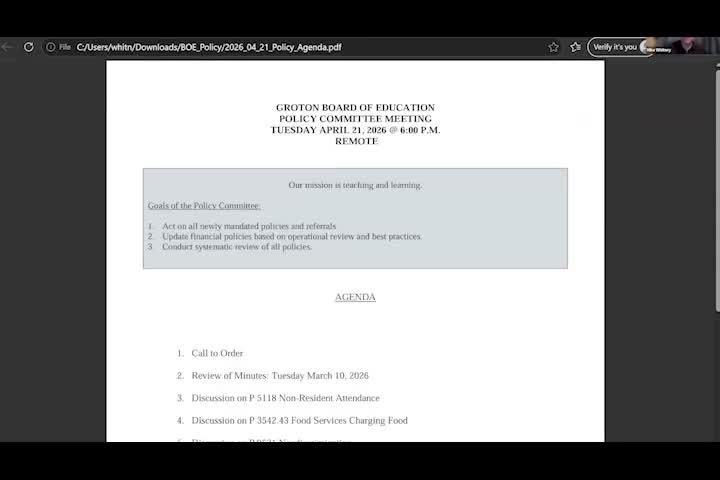
The Groton Board of Education policy committee spent a large portion of its April 21 meeting on the district's food-services charging policy and rising unpaid meal balances. Ernie Goshminder, who led the presentation for food services, told the committee that unpaid student meal balances reached $55,200 for three schools and could rise further by the end of the school year.
"As of today, it was 55,200," Goshminder said, explaining that the figure covers two elementary schools and a high school. He described repeated collection attempts and the operational burden on the food-services team, calling the trend "a big problem" as staff still must purchase food, pay employees and maintain equipment while negative balances grow.
Committee members discussed the tools currently used to reduce arrears: SchoolCafe automated alerts, ParentSquare messaging, weekly negative-balance mailings (where contact information is valid), and online payment options. Goshminder confirmed families can apply for free or reduced-price meals multiple times during the year if their income situation changes, and emphasized that an approved meal application would cover the remainder of the school year.
Board members explored other options: promoting SchoolCafe's autopay feature, publicizing the option more clearly when parents sign up, targeted fundraising and community donations, and legislative outreach for sustainable funding of universal breakfasts or lunches. "I personally... don't feel that students should have to pay for lunch," said Sean, a committee member, while noting the committee needs to define how the district will address the cost without overburdening other budgets.
Legal and regulatory limits shaped the discussion. Committee members and staff noted that federal regulations prevent using some nonprofit school-fund accounts to cover unpaid student meals, and that state/federal rules prohibit shaming students for unpaid balances. Goshminder described the year-end rollover process in which negative balances are wiped and the board issues a check for what is owed.
The committee asked staff to refine policy language and report back with feasible policy-level actions and potential budget options before the next meeting. The district indicated it is continuing outreach to state legislators and the USDA about long-term solutions.
What comes next: Staff will circulate updated policy language incorporating operational steps (notifications, payments, and dissemination) and outline options for board consideration, including outreach to legislators about program funding.
"As of today, it was 55,200," Goshminder said, explaining that the figure covers two elementary schools and a high school. He described repeated collection attempts and the operational burden on the food-services team, calling the trend "a big problem" as staff still must purchase food, pay employees and maintain equipment while negative balances grow.
Committee members discussed the tools currently used to reduce arrears: SchoolCafe automated alerts, ParentSquare messaging, weekly negative-balance mailings (where contact information is valid), and online payment options. Goshminder confirmed families can apply for free or reduced-price meals multiple times during the year if their income situation changes, and emphasized that an approved meal application would cover the remainder of the school year.
Board members explored other options: promoting SchoolCafe's autopay feature, publicizing the option more clearly when parents sign up, targeted fundraising and community donations, and legislative outreach for sustainable funding of universal breakfasts or lunches. "I personally... don't feel that students should have to pay for lunch," said Sean, a committee member, while noting the committee needs to define how the district will address the cost without overburdening other budgets.
Legal and regulatory limits shaped the discussion. Committee members and staff noted that federal regulations prevent using some nonprofit school-fund accounts to cover unpaid student meals, and that state/federal rules prohibit shaming students for unpaid balances. Goshminder described the year-end rollover process in which negative balances are wiped and the board issues a check for what is owed.
The committee asked staff to refine policy language and report back with feasible policy-level actions and potential budget options before the next meeting. The district indicated it is continuing outreach to state legislators and the USDA about long-term solutions.
What comes next: Staff will circulate updated policy language incorporating operational steps (notifications, payments, and dissemination) and outline options for board consideration, including outreach to legislators about program funding.
View the Full Meeting & All Its Details
This article offers just a summary. Unlock complete video, transcripts, and insights as a Founder Member.
✓
Watch full, unedited meeting videos
✓
Search every word spoken in unlimited transcripts
✓
AI summaries & real-time alerts (all government levels)
✓
Permanent access to expanding government content
30-day money-back guarantee
