House committee approves PUC reauthorization bill with amendments, sends measure to Finance 9–4
April 23, 2026 | 2026 Legislature CO, Colorado
This article was created by AI summarizing key points discussed. AI makes mistakes, so for full details and context, please refer to the video of the full meeting. Please report any errors so we can fix them. Report an error »
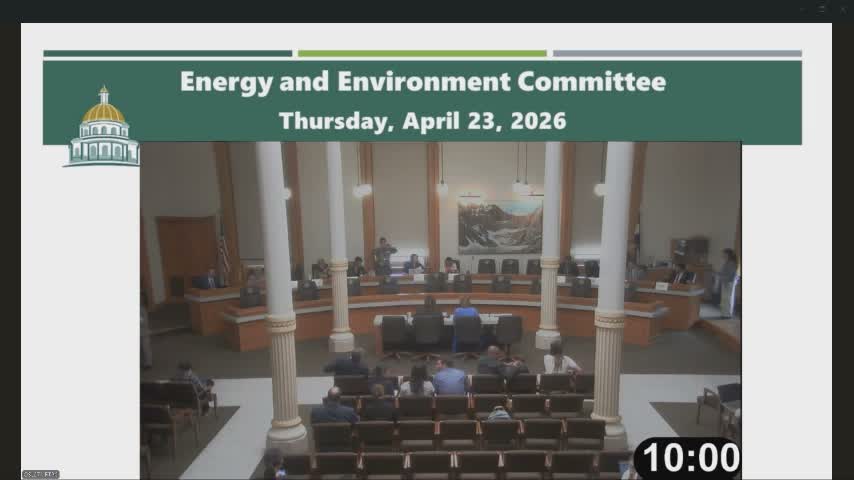
Majority Leader Duran and Representative Wilford led the House Energy & Environment Committee through a lengthy hearing and amendment phase on House Bill 1326, the five‑part package to reauthorize the Colorado Public Utilities Commission and make regulatory updates. After testimony from agency officials, utilities, trade groups and dozens of stakeholder witnesses, the committee adopted a set of sponsor amendments and voted 9–4 to forward the amended bill to the Finance Committee.
The bill would continue the PUC’s statutory existence and make multiple changes across energy, transportation, telecommunications, water and pipeline safety law. Sponsors described the measure as the product of the PUC sunset review and dozens of stakeholder meetings. Majority Leader Duran told the committee the bill seeks to “modernize” commission operations while protecting ratepayers; Representative Wilford delivered a section‑by‑section explanation and identified a package of technical and policy amendments offered that day.
Key policy elements discussed include: an option allowing qualifying utilities to opt out of certain renewable energy standard (RES) percentage obligations if they file an approved clean energy plan; expanded authority in limited cases for the PUC to direct securitization financing under the Colorado Energy Impact Bond Act for very large capital investments; authorization for the PUC to require third‑party administrators for certain customer‑facing programs when the commission finds it in the ratepayer interest; and new reporting and safety requirements for transportation network companies (TNCs), including annual incident reporting and facial‑recognition checks for driver verification.
State technical witnesses supported many bill goals. Rebecca White, director of the Public Utilities Commission, described securitization as a “powerful financing tool” that has been used in Colorado for wildfire mitigation and coal plant retirements and said the commission should have discretion to consider it for very large projects. Joseph Pereira, director of the Office of the Utility Consumer Advocate, said his office supports reauthorization and affordability measures in the bill but urged preserving consumer protections. Keith Hay of the Colorado Energy Office said the office supports the bill’s intent to protect affordability while meeting the state’s clean energy goals.
Opponents raised several recurring concerns. Energy Outreach Colorado warned that shifting broad policy authority to the PUC could reduce consumer voice; community groups and labor organizations objected to the third‑party administration authority as written, saying it could displace utility jobs and create unclear contracting and oversight arrangements; multiple local governments and planning groups objected to Section 13 (as introduced), which would expand the PUC appeal pathway for certain local land‑use denials, arguing it could override local land‑use authority and impose legal costs on counties. Utilities and business groups urged guardrails around securitization and stressed the need for regulatory predictability that supports investment.
During the amendment phase, the sponsors offered a package of changes that the committee adopted by voice or unanimous consent. Notable floor‑level changes approved in committee included creating an M docket to study how to streamline and coordinate energy planning proceedings (Amendment L003); converting the telecom fee structure to a filing‑fee model (L005); clarifying RES opt‑out language (L006); adding reporting and inmate complaint information requirements for correctional facilities and prison phone providers (L007); shortening the PUC continuation from the initially proposed 11 years to seven years (L008); requiring utilities to provide interconnection disclosures to support access to certain federal tax credits (L009); removing the bill’s proposed open‑meetings exemption so commissioner deliberations remain public (L011); and other clean‑up adjustments (L012).
Representative Wolford moved the committee recommendation to send HB 1326, as amended, to the Finance Committee. The committee recorded a roll‑call vote: Representatives Jason Eckert, De Graaf, Goldstein, Jackson, Joseph, Pasco, Smith, Wilford and Majority Leader Duran voted yes; Representatives Baron, Slaw, Boog and one other voted no or “respectfully no.” The clerk recorded the final tally as 9‑4 and the committee sent the amended bill to Finance with a favorable recommendation.
What’s next: HB 1326 will go to the House Finance Committee for further consideration. Sponsors told the committee they plan to continue stakeholder negotiations and may offer additional amendments on second and third reading. The committee hearing closed after the final vote.
Quotes from the hearing:
“Given the scale and complexity of this bill, we respectfully ask that any additional amendments be discussed with us offline rather than brought forward today,” Majority Leader Duran said during the opening.
“It is a very powerful financing tool,” Rebecca White, the PUC director, said of securitization, “and because of its significance, it really only is eligible for certain, very large assets.”
The hearing included a long public record of organizations urging more consumer protections, clarity on third‑party administration, and stronger local‑government safeguards before the General Assembly finalizes the reauthorization.
The bill would continue the PUC’s statutory existence and make multiple changes across energy, transportation, telecommunications, water and pipeline safety law. Sponsors described the measure as the product of the PUC sunset review and dozens of stakeholder meetings. Majority Leader Duran told the committee the bill seeks to “modernize” commission operations while protecting ratepayers; Representative Wilford delivered a section‑by‑section explanation and identified a package of technical and policy amendments offered that day.
Key policy elements discussed include: an option allowing qualifying utilities to opt out of certain renewable energy standard (RES) percentage obligations if they file an approved clean energy plan; expanded authority in limited cases for the PUC to direct securitization financing under the Colorado Energy Impact Bond Act for very large capital investments; authorization for the PUC to require third‑party administrators for certain customer‑facing programs when the commission finds it in the ratepayer interest; and new reporting and safety requirements for transportation network companies (TNCs), including annual incident reporting and facial‑recognition checks for driver verification.
State technical witnesses supported many bill goals. Rebecca White, director of the Public Utilities Commission, described securitization as a “powerful financing tool” that has been used in Colorado for wildfire mitigation and coal plant retirements and said the commission should have discretion to consider it for very large projects. Joseph Pereira, director of the Office of the Utility Consumer Advocate, said his office supports reauthorization and affordability measures in the bill but urged preserving consumer protections. Keith Hay of the Colorado Energy Office said the office supports the bill’s intent to protect affordability while meeting the state’s clean energy goals.
Opponents raised several recurring concerns. Energy Outreach Colorado warned that shifting broad policy authority to the PUC could reduce consumer voice; community groups and labor organizations objected to the third‑party administration authority as written, saying it could displace utility jobs and create unclear contracting and oversight arrangements; multiple local governments and planning groups objected to Section 13 (as introduced), which would expand the PUC appeal pathway for certain local land‑use denials, arguing it could override local land‑use authority and impose legal costs on counties. Utilities and business groups urged guardrails around securitization and stressed the need for regulatory predictability that supports investment.
During the amendment phase, the sponsors offered a package of changes that the committee adopted by voice or unanimous consent. Notable floor‑level changes approved in committee included creating an M docket to study how to streamline and coordinate energy planning proceedings (Amendment L003); converting the telecom fee structure to a filing‑fee model (L005); clarifying RES opt‑out language (L006); adding reporting and inmate complaint information requirements for correctional facilities and prison phone providers (L007); shortening the PUC continuation from the initially proposed 11 years to seven years (L008); requiring utilities to provide interconnection disclosures to support access to certain federal tax credits (L009); removing the bill’s proposed open‑meetings exemption so commissioner deliberations remain public (L011); and other clean‑up adjustments (L012).
Representative Wolford moved the committee recommendation to send HB 1326, as amended, to the Finance Committee. The committee recorded a roll‑call vote: Representatives Jason Eckert, De Graaf, Goldstein, Jackson, Joseph, Pasco, Smith, Wilford and Majority Leader Duran voted yes; Representatives Baron, Slaw, Boog and one other voted no or “respectfully no.” The clerk recorded the final tally as 9‑4 and the committee sent the amended bill to Finance with a favorable recommendation.
What’s next: HB 1326 will go to the House Finance Committee for further consideration. Sponsors told the committee they plan to continue stakeholder negotiations and may offer additional amendments on second and third reading. The committee hearing closed after the final vote.
Quotes from the hearing:
“Given the scale and complexity of this bill, we respectfully ask that any additional amendments be discussed with us offline rather than brought forward today,” Majority Leader Duran said during the opening.
“It is a very powerful financing tool,” Rebecca White, the PUC director, said of securitization, “and because of its significance, it really only is eligible for certain, very large assets.”
The hearing included a long public record of organizations urging more consumer protections, clarity on third‑party administration, and stronger local‑government safeguards before the General Assembly finalizes the reauthorization.
View the Full Meeting & All Its Details
This article offers just a summary. Unlock complete video, transcripts, and insights as a Founder Member.
✓
Watch full, unedited meeting videos
✓
Search every word spoken in unlimited transcripts
✓
AI summaries & real-time alerts (all government levels)
✓
Permanent access to expanding government content
30-day money-back guarantee
