CityLink budget projects $4.8M; council questions paratransit cost growth and $2M general‑fund transfer
April 20, 2026 | Edmond, Oklahoma County, Oklahoma
This article was created by AI summarizing key points discussed. AI makes mistakes, so for full details and context, please refer to the video of the full meeting. Please report any errors so we can fix them. Report an error »
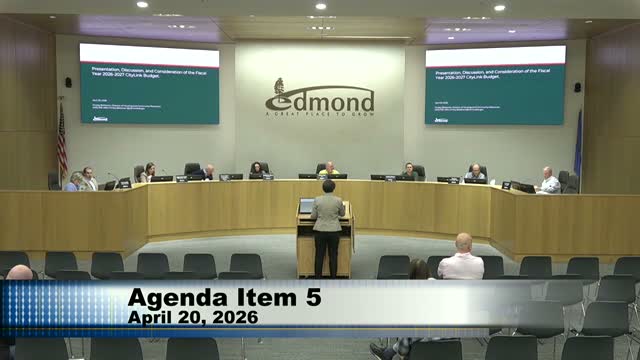
CityLink’s director, Christy Batterson, presented a proposed FY27 budget of about $4.8 million and walked the council through service history, ridership trends and funding sources. Batterson said CityLink is a fare‑free system and that the operation is a subrecipient in the regional FTA funding process; staff expects about $1.1 million in Section 5307 federal formula funding and roughly $2 million in general‑fund transfers to subsidize operations.
Batterson highlighted paratransit growth: paratransit rides have risen from roughly 3,000 at startup to a projected ~20,000 this year. She said paratransit is the most expensive mode to operate and that vehicles are reaching end of life, requiring capital replacements. The operating contract with RATPDev USA uses revenue hours as the pricing basis.
Council members ran preliminary subsidy calculations during the workshop. One calculation noted a $32 per‑ride subsidy if outside funding were removed; the mayor later corrected an annualization error and said an “all‑in” figure showed about $30.85 per ride and that the city’s direct contribution (excluding other revenues) is about $16.45 per ride under a different accounting frame. Batterson agreed comparative benchmarks vary across peer cities and said she would supply per‑ride and revenue‑hour comparisons.
Council discussed options to lower the transfer requirement — for example, reducing Route 6 to a single bus (estimated savings about $180,000) or reducing frequency on selected routes — and flagged the risk that reducing the city match would lower grant competitiveness. Staff noted CityLink used CARES and ARPA reserves during the pandemic and that reserves were drawn this year to cover costs.
Council did not adopt changes at the workshop; they asked staff for comparative cost-per-ride data, clearer reserve accounting, and options that balance service levels with a sustainable subsidy.
Batterson highlighted paratransit growth: paratransit rides have risen from roughly 3,000 at startup to a projected ~20,000 this year. She said paratransit is the most expensive mode to operate and that vehicles are reaching end of life, requiring capital replacements. The operating contract with RATPDev USA uses revenue hours as the pricing basis.
Council members ran preliminary subsidy calculations during the workshop. One calculation noted a $32 per‑ride subsidy if outside funding were removed; the mayor later corrected an annualization error and said an “all‑in” figure showed about $30.85 per ride and that the city’s direct contribution (excluding other revenues) is about $16.45 per ride under a different accounting frame. Batterson agreed comparative benchmarks vary across peer cities and said she would supply per‑ride and revenue‑hour comparisons.
Council discussed options to lower the transfer requirement — for example, reducing Route 6 to a single bus (estimated savings about $180,000) or reducing frequency on selected routes — and flagged the risk that reducing the city match would lower grant competitiveness. Staff noted CityLink used CARES and ARPA reserves during the pandemic and that reserves were drawn this year to cover costs.
Council did not adopt changes at the workshop; they asked staff for comparative cost-per-ride data, clearer reserve accounting, and options that balance service levels with a sustainable subsidy.
View the Full Meeting & All Its Details
This article offers just a summary. Unlock complete video, transcripts, and insights as a Founder Member.
✓
Watch full, unedited meeting videos
✓
Search every word spoken in unlimited transcripts
✓
AI summaries & real-time alerts (all government levels)
✓
Permanent access to expanding government content
30-day money-back guarantee
