Council reviews pavement strategies, staff recommends keeping current overlay practice and monitoring bond-funded repairs
April 20, 2026 | Richardson, Dallas County, Texas
This article was created by AI summarizing key points discussed. AI makes mistakes, so for full details and context, please refer to the video of the full meeting. Please report any errors so we can fix them. Report an error »
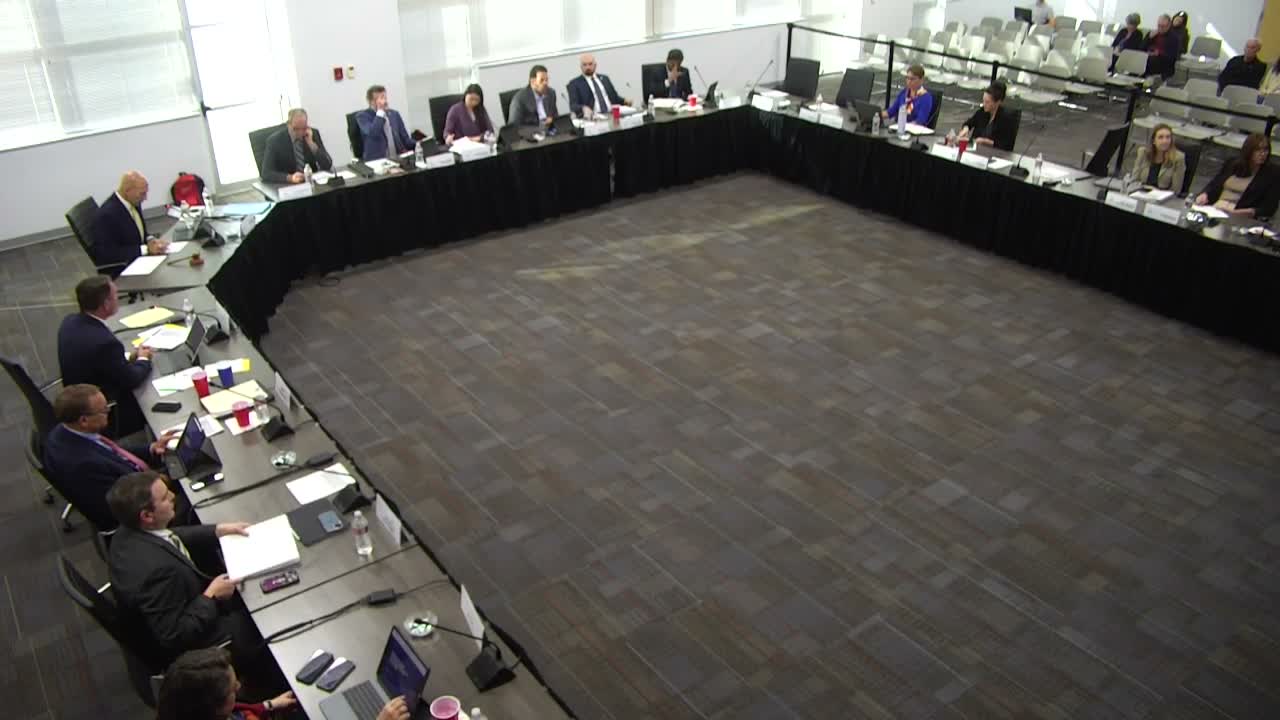
Richardson — Assistant City Manager Charles Gough and Assistant Director Katie Baron briefed the City Council on pavement-management strategies, presenting the city's Pavement Condition Index (PCI) framework, funding picture and options for asphalt overlays and concrete panel replacement.
Gough told the council the city's network includes a large length of streets (as stated in the presentation) and that pavement types include primarily concrete, concrete with asphalt overlay (about 12% of the network), and a small amount of full-depth asphalt. He explained the PCI scoring range (100 to 0) and said the 2020 snapshot used in prior planning showed roughly one-third of streets in the "good" category, most in "fair," and a small percentage in "poor." Those PCI levels help determine whether to use preventive maintenance, preservation and rehabilitation or full reconstruction.
Gough outlined two overlay approaches: the traditional mill-and-overlay and a newer thin-bonded overlay used in nearby Plano. He noted the thin approach has shorter application windows, fewer qualified contractors and higher upfront per-mile cost in the bids he reviewed — staff estimated a possible $1.1 million per mile for some thin-bonded approaches versus roughly $500,000 per mile for certain traditional overlays on major multi-lane sections. "It's a little bit unproven," Gough said of the thin-bonded option and recommended waiting a few years to evaluate Plano's results and the effect of Richardson's 2026 bond-funded panel replacements before expanding an asphalt overlay program to additional streets.
Gough also summarized funding: the 2026 bond program includes roughly $90 million for street-and-alley projects and about $25 million specifically for concrete panel replacement; staff expects $5 million per year in localized panel-replacement from the bond program as part of an overall rehab strategy. He recommended maintaining current mill-and-overlay work on streets where asphalt already exists and using localized panel replacement and targeted preservation on fair streets rather than a broad, immediate shift to thin-bonded overlays.
Council members pressed staff on cost-per-mile assumptions, drainage impacts from adding asphalt over concrete, contractor availability and life-expectancy assumptions for thin overlays. Katie Baron described technical trade-offs at curbs and milling edges that can affect bonding and longevity. Several council members urged more aggressive maintenance funding and long-term modeling to avoid repeatedly "chasing our tails." City staff said they will track effects of the bond-funded repairs and return to council with updated PCI assessments and cost-per-mile estimates.
What happens next: Staff will continue with current pavement programs, include $5 million per year in the 2026 bond program for localized concrete panel replacement, and return to the council with deeper analysis during the budget's streets "deep dive."
Gough told the council the city's network includes a large length of streets (as stated in the presentation) and that pavement types include primarily concrete, concrete with asphalt overlay (about 12% of the network), and a small amount of full-depth asphalt. He explained the PCI scoring range (100 to 0) and said the 2020 snapshot used in prior planning showed roughly one-third of streets in the "good" category, most in "fair," and a small percentage in "poor." Those PCI levels help determine whether to use preventive maintenance, preservation and rehabilitation or full reconstruction.
Gough outlined two overlay approaches: the traditional mill-and-overlay and a newer thin-bonded overlay used in nearby Plano. He noted the thin approach has shorter application windows, fewer qualified contractors and higher upfront per-mile cost in the bids he reviewed — staff estimated a possible $1.1 million per mile for some thin-bonded approaches versus roughly $500,000 per mile for certain traditional overlays on major multi-lane sections. "It's a little bit unproven," Gough said of the thin-bonded option and recommended waiting a few years to evaluate Plano's results and the effect of Richardson's 2026 bond-funded panel replacements before expanding an asphalt overlay program to additional streets.
Gough also summarized funding: the 2026 bond program includes roughly $90 million for street-and-alley projects and about $25 million specifically for concrete panel replacement; staff expects $5 million per year in localized panel-replacement from the bond program as part of an overall rehab strategy. He recommended maintaining current mill-and-overlay work on streets where asphalt already exists and using localized panel replacement and targeted preservation on fair streets rather than a broad, immediate shift to thin-bonded overlays.
Council members pressed staff on cost-per-mile assumptions, drainage impacts from adding asphalt over concrete, contractor availability and life-expectancy assumptions for thin overlays. Katie Baron described technical trade-offs at curbs and milling edges that can affect bonding and longevity. Several council members urged more aggressive maintenance funding and long-term modeling to avoid repeatedly "chasing our tails." City staff said they will track effects of the bond-funded repairs and return to council with updated PCI assessments and cost-per-mile estimates.
What happens next: Staff will continue with current pavement programs, include $5 million per year in the 2026 bond program for localized concrete panel replacement, and return to the council with deeper analysis during the budget's streets "deep dive."
Don't Miss a Word: See the Full Meeting!
Go beyond summaries. Unlock every video, transcript, and key insight with a Founder Membership.
✓
Get instant access to full meeting videos
✓
Search and clip any phrase from complete transcripts
✓
Receive AI-powered summaries & custom alerts
✓
Enjoy lifetime, unrestricted access to government data
30-day money-back guarantee
