Assembly Committee advances bill creating licensure path for interior designers amid fierce debate
April 21, 2026 | California State Assembly, House, Legislative, California
This article was created by AI summarizing key points discussed. AI makes mistakes, so for full details and context, please refer to the video of the full meeting. Please report any errors so we can fix them. Report an error »
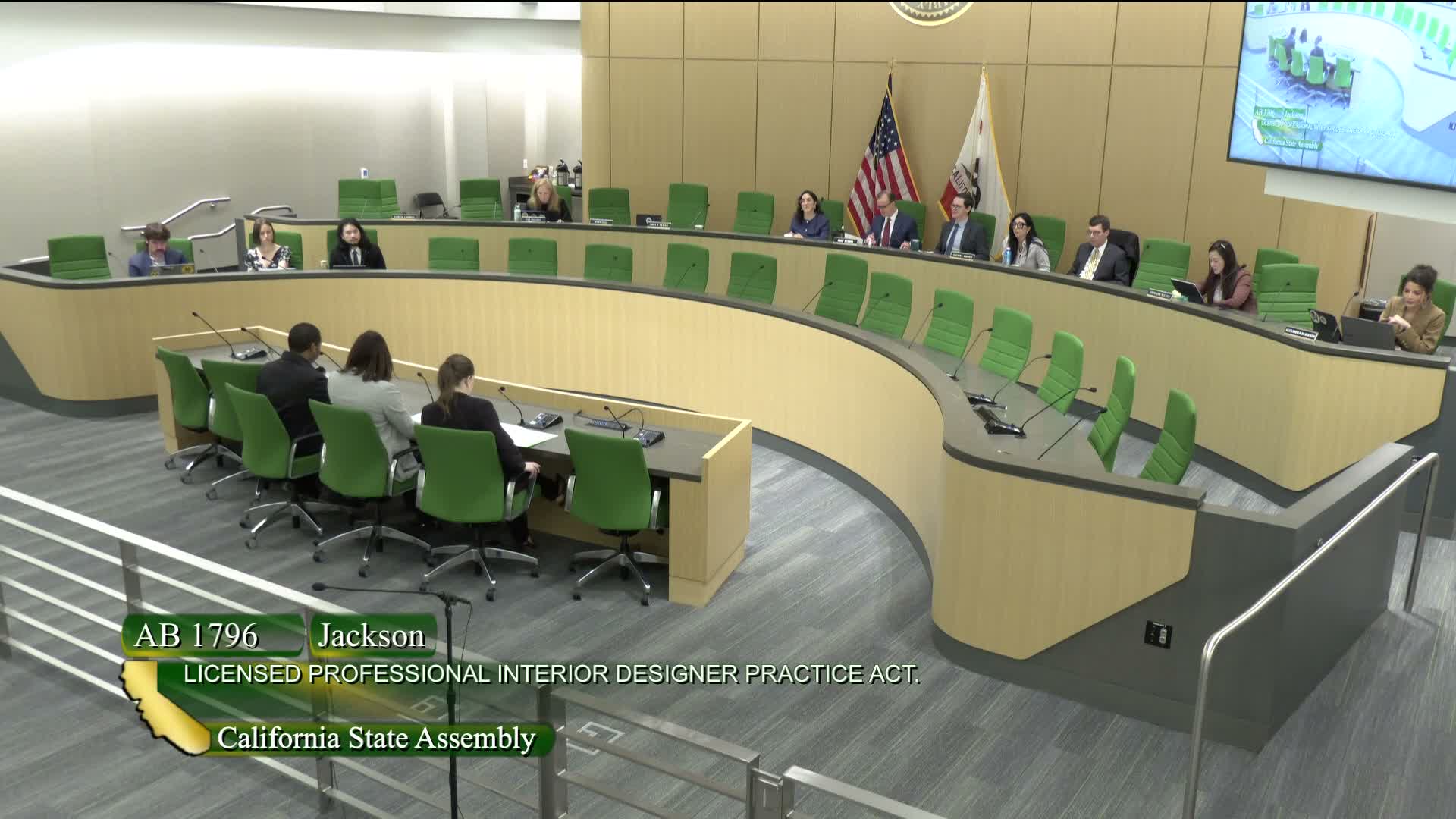
The Assembly Business and Professions Committee on Thursday advanced AB 17 96, a bill that would add a professional interior designer to the California Architects Board and create a licensure pathway for commercial interior designers. The committee voted to pass the measure to the Appropriations Committee for further consideration.
Assemblymember Jackson, the bill’s author, said the measure would fill a public‑safety gap by ensuring designers who work on code‑impacted commercial interiors meet consistent training and accountability standards. "Interior design is a public safety function," Jackson said, arguing licensure would establish minimum competency and accountability for work that affects egress, infection control and emergency response in public buildings.
Proponents — a broad coalition of practicing interior designers, professional associations and students — described licensing as a way to reduce project costs, simplify permitting, and create career pathways for historically underserved designers. Melissa Pacey, a licensed architect and commercial interior designer, told the committee that poor interior choices contribute to fires and injuries in public spaces and that a licensure pathway would help address those risks.
Opponents, led by the American Institute of Architects California and the California Legislative Coalition for Interior Designers, urged caution. Scott Terrell of AIA California said the bill would create overlapping regulatory tracks and consumer confusion by establishing a new license while leaving existing certification systems in place. "This would introduce more complexity and confusion for the public and the industry than clarity," Terrell said.
Catherine Hampton, president of the California Legislative Coalition for Interior Designers, warned the legislation would impose new costs and barriers without evidence of widespread consumer harm. "There is no consumer harm from interior design documented here today," she told lawmakers, urging them to reject the measure until a clearer problem statement and data exist.
Committee members expressed divided views but praised the exhaustive public testimony. Several members said they would support moving the bill now so negotiations and technical work can continue in appropriations, while urging the author to work with opponents to narrow scope and reduce potential costs for small practitioners.
The committee moved AB 17 96 to the Appropriations Committee, a procedural step that keeps the bill alive for more substantive negotiations and potential revisions. The bill’s backers said they will continue talks with architects, consumer‑protection groups and interior‑design professionals to refine the scope and address concerns about licensing thresholds and enforcement.
Outcome and next steps: AB 17 96 was adopted by the committee and referred to Appropriations; supporters and opponents said they plan to negotiate amendments before floor consideration.
Assemblymember Jackson, the bill’s author, said the measure would fill a public‑safety gap by ensuring designers who work on code‑impacted commercial interiors meet consistent training and accountability standards. "Interior design is a public safety function," Jackson said, arguing licensure would establish minimum competency and accountability for work that affects egress, infection control and emergency response in public buildings.
Proponents — a broad coalition of practicing interior designers, professional associations and students — described licensing as a way to reduce project costs, simplify permitting, and create career pathways for historically underserved designers. Melissa Pacey, a licensed architect and commercial interior designer, told the committee that poor interior choices contribute to fires and injuries in public spaces and that a licensure pathway would help address those risks.
Opponents, led by the American Institute of Architects California and the California Legislative Coalition for Interior Designers, urged caution. Scott Terrell of AIA California said the bill would create overlapping regulatory tracks and consumer confusion by establishing a new license while leaving existing certification systems in place. "This would introduce more complexity and confusion for the public and the industry than clarity," Terrell said.
Catherine Hampton, president of the California Legislative Coalition for Interior Designers, warned the legislation would impose new costs and barriers without evidence of widespread consumer harm. "There is no consumer harm from interior design documented here today," she told lawmakers, urging them to reject the measure until a clearer problem statement and data exist.
Committee members expressed divided views but praised the exhaustive public testimony. Several members said they would support moving the bill now so negotiations and technical work can continue in appropriations, while urging the author to work with opponents to narrow scope and reduce potential costs for small practitioners.
The committee moved AB 17 96 to the Appropriations Committee, a procedural step that keeps the bill alive for more substantive negotiations and potential revisions. The bill’s backers said they will continue talks with architects, consumer‑protection groups and interior‑design professionals to refine the scope and address concerns about licensing thresholds and enforcement.
Outcome and next steps: AB 17 96 was adopted by the committee and referred to Appropriations; supporters and opponents said they plan to negotiate amendments before floor consideration.
Don't Miss a Word: See the Full Meeting!
Go beyond summaries. Unlock every video, transcript, and key insight with a Founder Membership.
✓
Get instant access to full meeting videos
✓
Search and clip any phrase from complete transcripts
✓
Receive AI-powered summaries & custom alerts
✓
Enjoy lifetime, unrestricted access to government data
30-day money-back guarantee
