Columbia County approves rezoning despite neighbor’s access objection citing state law
April 22, 2026 | Columbia County, Georgia
This article was created by AI summarizing key points discussed. AI makes mistakes, so for full details and context, please refer to the video of the full meeting. Please report any errors so we can fix them. Report an error »
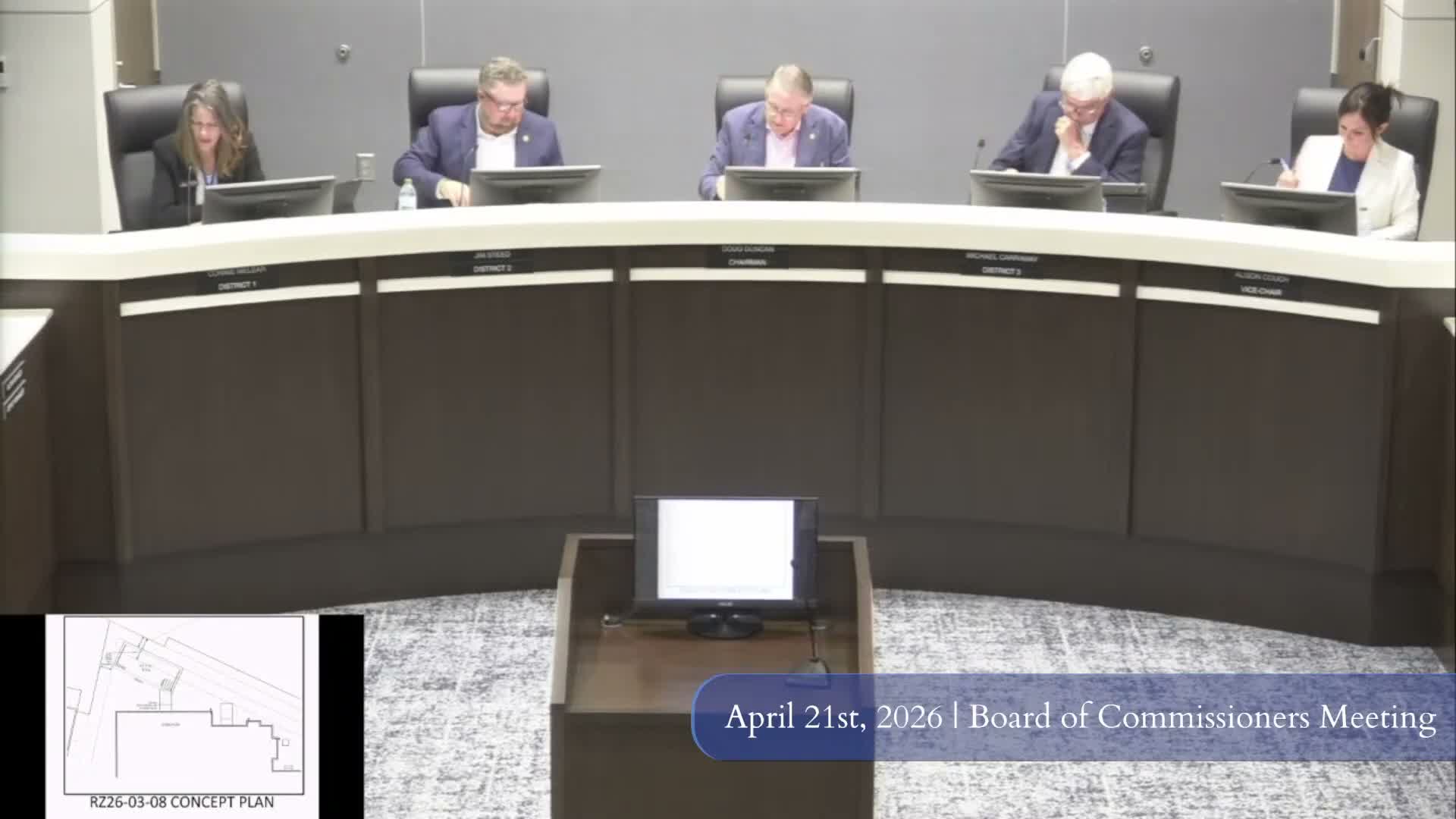
The Columbia County Board of Commissioners on April 21 approved a rezoning from M-1 to C-2 for property near the I‑20 Grovetown exit, but refused to add a requested condition requiring a curb cut to restore access to a neighboring two‑acre parcel.
Commissioner Malia moved the rezoning, describing it as subject to conditions in the March 19 planning commission report. Kurt Worthington, speaking for the applicant, asked the board to add an extra condition to allow a curb cut on the southern boundary to give vehicle access to a vacant parcel he described as an “eyesore” and a potential public safety concern for emergency access.
Opposing counsel Robert Titus of EMC Engineering told the board the neighbor had been compensated in a prior condemnation action and argued the county could not require a developer to cure a third party’s preexisting, compensated access problem. Titus cited state law and legal standards, saying, “a way of necessity cannot be granted if the owner voluntarily sold or closed their own access,” and that forcing interparcel connectivity to bail out a neighbor who had received settlement would be neither practical nor equitable.
Worthington responded that restoring access would serve emergency and public interests and that connections between commercial parcels are permitted under the county ordinance where practical. Commissioners questioned whether neighboring owners had agreed to the change; Worthington said negotiations were ongoing.
After discussion, Commissioner Malia reaffirmed the motion as originally presented and the board voted to approve the rezoning without the additional curb‑cut condition.
The hearing record shows competing legal and practical arguments but no formal requirement imposed on the developer to create the requested curb cut; the board’s vote adopted the zoning change subject to the planning report conditions but not the access condition. The decision leaves open that applicants and neighbors may pursue separate legal or administrative steps to secure access.
Commissioner Malia moved the rezoning, describing it as subject to conditions in the March 19 planning commission report. Kurt Worthington, speaking for the applicant, asked the board to add an extra condition to allow a curb cut on the southern boundary to give vehicle access to a vacant parcel he described as an “eyesore” and a potential public safety concern for emergency access.
Opposing counsel Robert Titus of EMC Engineering told the board the neighbor had been compensated in a prior condemnation action and argued the county could not require a developer to cure a third party’s preexisting, compensated access problem. Titus cited state law and legal standards, saying, “a way of necessity cannot be granted if the owner voluntarily sold or closed their own access,” and that forcing interparcel connectivity to bail out a neighbor who had received settlement would be neither practical nor equitable.
Worthington responded that restoring access would serve emergency and public interests and that connections between commercial parcels are permitted under the county ordinance where practical. Commissioners questioned whether neighboring owners had agreed to the change; Worthington said negotiations were ongoing.
After discussion, Commissioner Malia reaffirmed the motion as originally presented and the board voted to approve the rezoning without the additional curb‑cut condition.
The hearing record shows competing legal and practical arguments but no formal requirement imposed on the developer to create the requested curb cut; the board’s vote adopted the zoning change subject to the planning report conditions but not the access condition. The decision leaves open that applicants and neighbors may pursue separate legal or administrative steps to secure access.
View the Full Meeting & All Its Details
This article offers just a summary. Unlock complete video, transcripts, and insights as a Founder Member.
✓
Watch full, unedited meeting videos
✓
Search every word spoken in unlimited transcripts
✓
AI summaries & real-time alerts (all government levels)
✓
Permanent access to expanding government content
30-day money-back guarantee
