Committee hears bill to allow habeas relief where gender bias likely affected convictions
April 21, 2026 | California State Assembly, House, Legislative, California
This article was created by AI summarizing key points discussed. AI makes mistakes, so for full details and context, please refer to the video of the full meeting. Please report any errors so we can fix them. Report an error »
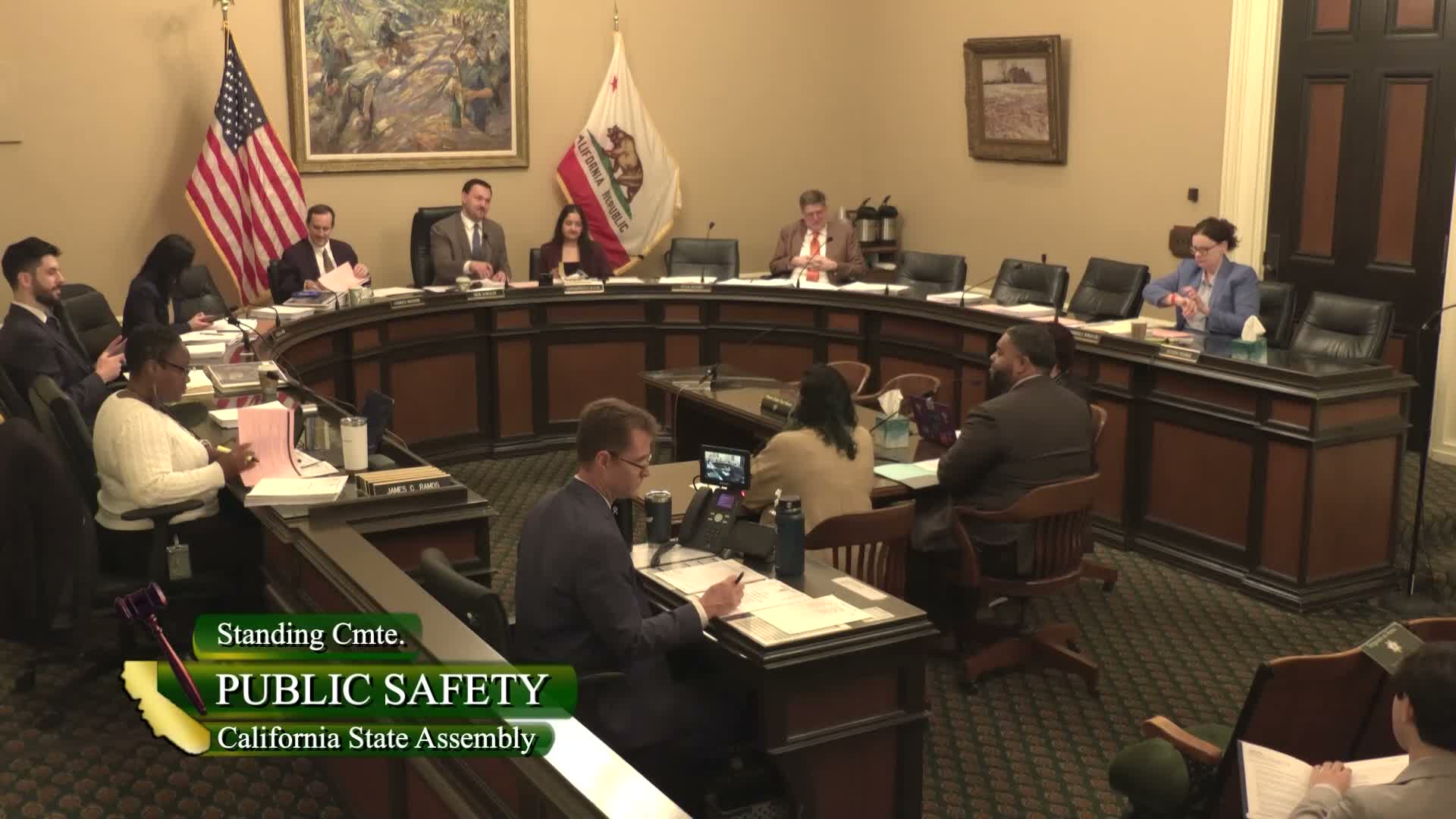
Assemblymember El Hawari introduced AB 20 14 to create a narrow post-conviction pathway allowing habeas petitions when gender-based stereotypes or arguments were used at trial and there is a reasonable probability the outcome would have been different without that bias. The committee heard the bill on the recommendation of the state's Penal Code Revision Committee, which described the change as a targeted, case-by-case remedy based on its 2025 annual report and a review of research showing gender stereotyping can skew jury interpretation and credibility assessments.
Kelly Savage Rodriguez, with the California Coalition for Women Prisoners, described her trial experience and testified that prosecutors relied on gendered narratives—attacking her as a ‘‘bad mother’’ and citing unrelated relationships and clothing choices—in ways she said were not probative of guilt. ‘‘Change has to happen. Please support this bill,’’ she told the committee.
Rick Owens, senior staff counsel for the committee on revision of the penal code, told members the current version of the bill is ‘‘purely a habeas corpus bill’’ and does not include an evidence-code provision requiring heightened scrutiny at trial: that earlier proposal was removed in amendments and the measure no longer keeps evidence out of trials. Owens said judges would still need to find a reasonable probability that the bias affected the overall result before granting relief.
Sam Haddad of the California District Attorneys Association said the bill’s original language raised serious legal and practical problems — including a presumption that certain categories of evidence have minimal probative value and vague, subjective definitions — and warned of increased litigation and risks of excluding otherwise relevant evidence. Committee members pressed both sides on the scope of the current amendments; the author and the penal code committee representative explained the habeas-only approach is intended to avoid altering trial admissibility rules.
Committee members broadly praised the testimony from survivors and advocates and acknowledged the difficulty of balancing the goal of combating bias with preserving relevant evidence. The chair said amendments had addressed a portion of the opposition’s concerns and indicated she would recommend the bill at the appropriate time. The committee did not vote on the measure today due to pending quorum and scheduling considerations; the author said she respectfully asked for members’ ‘‘I’’ votes when the bill is considered.
The bill was presented alongside testimony from civil-society groups and academic experts; members indicated they will continue technical conversations as the measure advances.
Kelly Savage Rodriguez, with the California Coalition for Women Prisoners, described her trial experience and testified that prosecutors relied on gendered narratives—attacking her as a ‘‘bad mother’’ and citing unrelated relationships and clothing choices—in ways she said were not probative of guilt. ‘‘Change has to happen. Please support this bill,’’ she told the committee.
Rick Owens, senior staff counsel for the committee on revision of the penal code, told members the current version of the bill is ‘‘purely a habeas corpus bill’’ and does not include an evidence-code provision requiring heightened scrutiny at trial: that earlier proposal was removed in amendments and the measure no longer keeps evidence out of trials. Owens said judges would still need to find a reasonable probability that the bias affected the overall result before granting relief.
Sam Haddad of the California District Attorneys Association said the bill’s original language raised serious legal and practical problems — including a presumption that certain categories of evidence have minimal probative value and vague, subjective definitions — and warned of increased litigation and risks of excluding otherwise relevant evidence. Committee members pressed both sides on the scope of the current amendments; the author and the penal code committee representative explained the habeas-only approach is intended to avoid altering trial admissibility rules.
Committee members broadly praised the testimony from survivors and advocates and acknowledged the difficulty of balancing the goal of combating bias with preserving relevant evidence. The chair said amendments had addressed a portion of the opposition’s concerns and indicated she would recommend the bill at the appropriate time. The committee did not vote on the measure today due to pending quorum and scheduling considerations; the author said she respectfully asked for members’ ‘‘I’’ votes when the bill is considered.
The bill was presented alongside testimony from civil-society groups and academic experts; members indicated they will continue technical conversations as the measure advances.
Don't Miss a Word: See the Full Meeting!
Go beyond summaries. Unlock every video, transcript, and key insight with a Founder Membership.
✓
Get instant access to full meeting videos
✓
Search and clip any phrase from complete transcripts
✓
Receive AI-powered summaries & custom alerts
✓
Enjoy lifetime, unrestricted access to government data
30-day money-back guarantee
