Palos Verdes Estates Council reviews $100 million CIP and flags major shortfalls
April 20, 2026 | Palos Verdes Estates City, Los Angeles County, California
This article was created by AI summarizing key points discussed. AI makes mistakes, so for full details and context, please refer to the video of the full meeting. Please report any errors so we can fix them. Report an error »
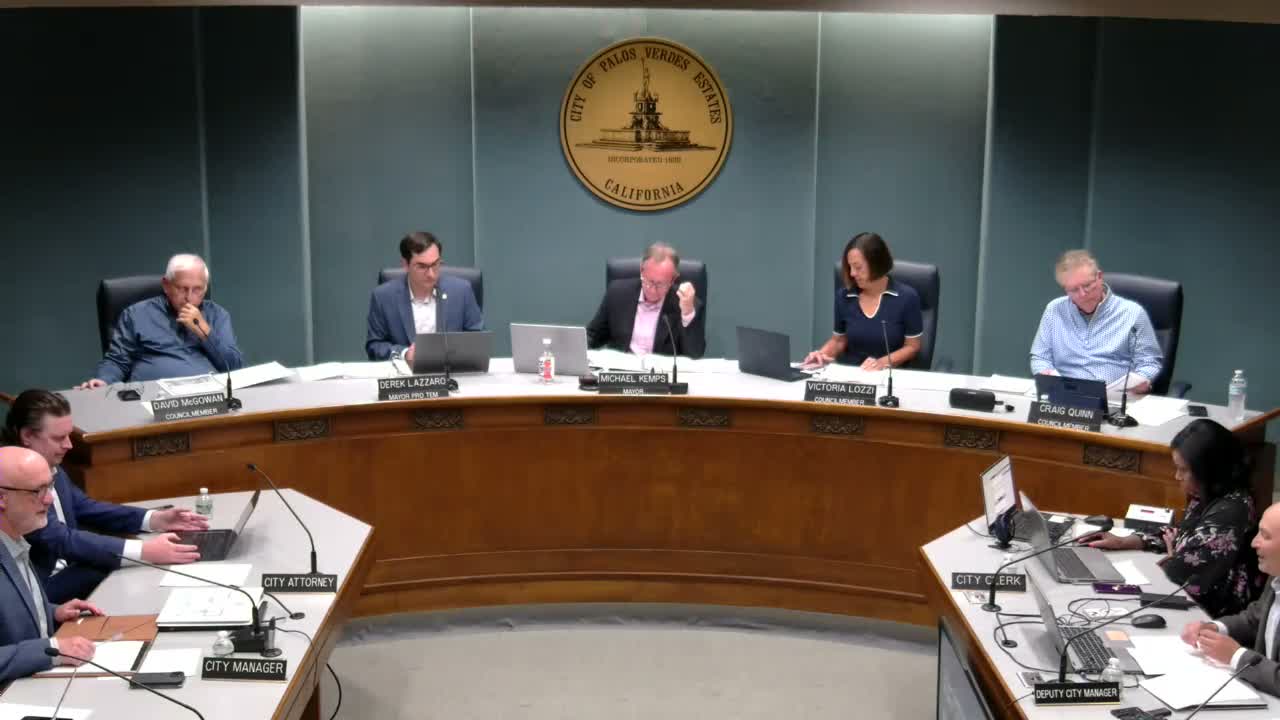
City staff presented a 10‑year Capital Improvement Program (CIP) at a special Palos Verdes Estates City Council workshop on April 20, 2026, saying the inventory lists 39 projects and carries a roughly $100,000,000 estimate for years 1–10. Oscar (staff member) told the council that the first five years are the most defined and that years six through ten are rough projections. "What we wanted you to take away from this is that this is a comprehensive inventory of everything that we consider is needs based, and relatively conservative, actually, list," Oscar said.
The staff presentation and council discussion made two funding realities clear: many projects are restricted to specific uses (for example, transportation funds) and a large portion of the list is currently unfunded. Oscar said restricted revenues are roughly $2,000,000 a year; the city’s Pavement Management Program recommends between $2,500,000 and $3,000,000 annually for streets, which staff said creates a shortfall on street maintenance alone.
Councilmember McGowan urged that the council communicate the magnitude of the funding gap to residents, noting that dividing roughly $80,000,000 of unfunded needs over 10 years implies roughly $8,000,000 a year in reserves to close the gap. Several councilmembers and staff recommended prioritizing projects with engineering studies or shovel‑ready status and pursuing grants where possible before committing general fund money.
Council members also identified smaller, low‑cost "moral victory" projects—irrigation fixes, locker‑room upgrades and other straightforward items—that staff said could be advanced when limited funding is available. Staff proposed creating an equipment replacement fund and estimated vehicle replacement needs at about $200,000–$250,000 a year; they said a tightened list and recommendation would be returned to the council for budget adoption.
The workshop produced no binding decisions. Staff said they will refine the CIP, tighten cost estimates where studies exist, pursue grant opportunities, and present specific funding recommendations during the FY 2026–27 budget process. The council adjourned to its next regular meeting.
The staff presentation and council discussion made two funding realities clear: many projects are restricted to specific uses (for example, transportation funds) and a large portion of the list is currently unfunded. Oscar said restricted revenues are roughly $2,000,000 a year; the city’s Pavement Management Program recommends between $2,500,000 and $3,000,000 annually for streets, which staff said creates a shortfall on street maintenance alone.
Councilmember McGowan urged that the council communicate the magnitude of the funding gap to residents, noting that dividing roughly $80,000,000 of unfunded needs over 10 years implies roughly $8,000,000 a year in reserves to close the gap. Several councilmembers and staff recommended prioritizing projects with engineering studies or shovel‑ready status and pursuing grants where possible before committing general fund money.
Council members also identified smaller, low‑cost "moral victory" projects—irrigation fixes, locker‑room upgrades and other straightforward items—that staff said could be advanced when limited funding is available. Staff proposed creating an equipment replacement fund and estimated vehicle replacement needs at about $200,000–$250,000 a year; they said a tightened list and recommendation would be returned to the council for budget adoption.
The workshop produced no binding decisions. Staff said they will refine the CIP, tighten cost estimates where studies exist, pursue grant opportunities, and present specific funding recommendations during the FY 2026–27 budget process. The council adjourned to its next regular meeting.
Don't Miss a Word: See the Full Meeting!
Go beyond summaries. Unlock every video, transcript, and key insight with a Founder Membership.
✓
Get instant access to full meeting videos
✓
Search and clip any phrase from complete transcripts
✓
Receive AI-powered summaries & custom alerts
✓
Enjoy lifetime, unrestricted access to government data
30-day money-back guarantee
