House committee advances bill to require parity for non‑opioid pain treatments
April 22, 2026 | 2026 Legislature CO, Colorado
This article was created by AI summarizing key points discussed. AI makes mistakes, so for full details and context, please refer to the video of the full meeting. Please report any errors so we can fix them. Report an error »
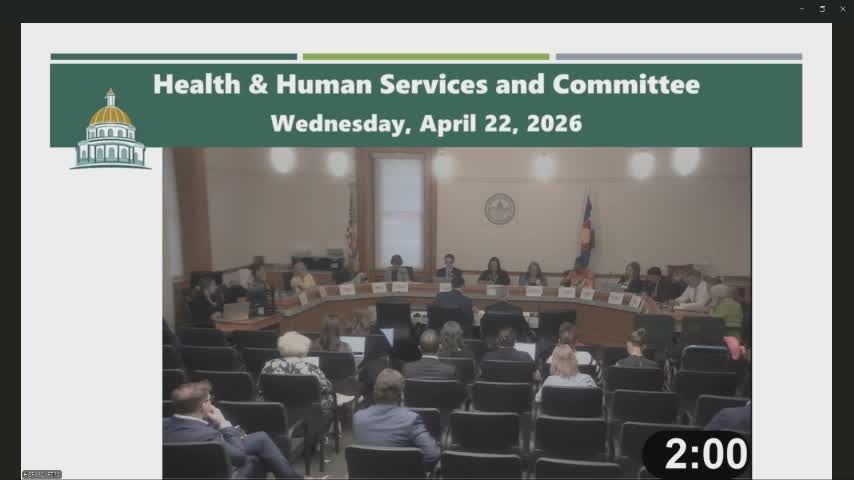
The House Health and Human Services Committee moved Senate Bill 006 to the Committee on Appropriations after debate over cost, access and market dynamics.
Sponsors said the measure corrects an access imbalance that makes some non‑opioid treatments harder to obtain than opioids. "Our system does not treat options of non‑opioid medications in the same manner as it treats opioids," Representative Taggart told the committee, adding that the bill would allow patients and clinicians to choose treatments "based on what's medically best for their patients, not what's easiest to attain." Co‑prime Representative Brown said the bill does not remove opioids as an option but requires parity where opioids appear on a formulary tier: "Wherever the opioids exist on a formulary, the plan would need to cover non‑opioid options at the same level, including the same utilization‑management requirements," Brown said.
Supporters pointed to an actuarial analysis commissioned by the Division of Insurance showing a projected average premium increase of about $0.45 per member per month (roughly $5 per year). Brown cited Milliman modeling the Division provided that estimated replacing 10% of new opioid prescriptions with non‑opioid alternatives could prevent substantial numbers of opioid‑use disorder cases and overdose deaths over time, and yield long‑term societal savings.
Health plans and pharmacy benefit managers urged caution. Kevin McFatridge of the Colorado Association of Health Plans said the actuarial analysis shows multi‑year premium impacts and warned that, as written, the bill could require coverage parity even when only a single brand product is available: "There is only one non‑opioid on the market today," he said, and noted the per‑pill price disparity cited by analysts. Patrick Boyle of the Pharmacy Care Management Association said a mandated monopoly for a single product risks higher prices and that payers would have limited negotiating leverage until competitors enter the market.
Clinicians and recovery advocates testified in support, describing cases where coverage design made opioids the administratively easier choice for post‑surgical pain and other conditions. Dr. Roland Flores, an acute pain specialist, said he has been blocked from prescribing IV acetaminophen because of coverage rules and that administrative hurdles can drive clinicians to use opioids even when a non‑opioid would be clinically preferable.
Committee members pressed sponsors on details: whether the bill requires a non‑opioid option in every formulary tier (sponsors said parity applies where opioids are present), how the statute would treat Medicaid and state employee plans (some were carved out in the current drafting), and whether the state should wait for more market entrants. Representative Bradley said he was concerned about the bill benefiting a single manufacturer; sponsors responded the statute is agnostic to manufacturer and anticipates additional products coming into the pipeline.
Vice Chair Leader moved the bill to Appropriations; the motion was seconded and the committee approved the referral on a roll call vote, recorded as 8 yes and 5 no. The bill will next be considered by the Appropriations Committee, where sponsors said they expect to continue stakeholdering on Medicaid, state plans and deferral language.
The committee hearing included multiple technical and fiscal follow‑ups; sponsors said they will work with insurers and PBMs to address consequences that could raise premiums or affect pharmacy reimbursement.
Sponsors said the measure corrects an access imbalance that makes some non‑opioid treatments harder to obtain than opioids. "Our system does not treat options of non‑opioid medications in the same manner as it treats opioids," Representative Taggart told the committee, adding that the bill would allow patients and clinicians to choose treatments "based on what's medically best for their patients, not what's easiest to attain." Co‑prime Representative Brown said the bill does not remove opioids as an option but requires parity where opioids appear on a formulary tier: "Wherever the opioids exist on a formulary, the plan would need to cover non‑opioid options at the same level, including the same utilization‑management requirements," Brown said.
Supporters pointed to an actuarial analysis commissioned by the Division of Insurance showing a projected average premium increase of about $0.45 per member per month (roughly $5 per year). Brown cited Milliman modeling the Division provided that estimated replacing 10% of new opioid prescriptions with non‑opioid alternatives could prevent substantial numbers of opioid‑use disorder cases and overdose deaths over time, and yield long‑term societal savings.
Health plans and pharmacy benefit managers urged caution. Kevin McFatridge of the Colorado Association of Health Plans said the actuarial analysis shows multi‑year premium impacts and warned that, as written, the bill could require coverage parity even when only a single brand product is available: "There is only one non‑opioid on the market today," he said, and noted the per‑pill price disparity cited by analysts. Patrick Boyle of the Pharmacy Care Management Association said a mandated monopoly for a single product risks higher prices and that payers would have limited negotiating leverage until competitors enter the market.
Clinicians and recovery advocates testified in support, describing cases where coverage design made opioids the administratively easier choice for post‑surgical pain and other conditions. Dr. Roland Flores, an acute pain specialist, said he has been blocked from prescribing IV acetaminophen because of coverage rules and that administrative hurdles can drive clinicians to use opioids even when a non‑opioid would be clinically preferable.
Committee members pressed sponsors on details: whether the bill requires a non‑opioid option in every formulary tier (sponsors said parity applies where opioids are present), how the statute would treat Medicaid and state employee plans (some were carved out in the current drafting), and whether the state should wait for more market entrants. Representative Bradley said he was concerned about the bill benefiting a single manufacturer; sponsors responded the statute is agnostic to manufacturer and anticipates additional products coming into the pipeline.
Vice Chair Leader moved the bill to Appropriations; the motion was seconded and the committee approved the referral on a roll call vote, recorded as 8 yes and 5 no. The bill will next be considered by the Appropriations Committee, where sponsors said they expect to continue stakeholdering on Medicaid, state plans and deferral language.
The committee hearing included multiple technical and fiscal follow‑ups; sponsors said they will work with insurers and PBMs to address consequences that could raise premiums or affect pharmacy reimbursement.
Don't Miss a Word: See the Full Meeting!
Go beyond summaries. Unlock every video, transcript, and key insight with a Founder Membership.
✓
Get instant access to full meeting videos
✓
Search and clip any phrase from complete transcripts
✓
Receive AI-powered summaries & custom alerts
✓
Enjoy lifetime, unrestricted access to government data
30-day money-back guarantee
