Committee backs HB 12‑88 to create jury‑selection working group; supporters cite inconsistent voir dire practices
April 22, 2026 | 2026 Legislature CO, Colorado
This article was created by AI summarizing key points discussed. AI makes mistakes, so for full details and context, please refer to the video of the full meeting. Please report any errors so we can fix them. Report an error »
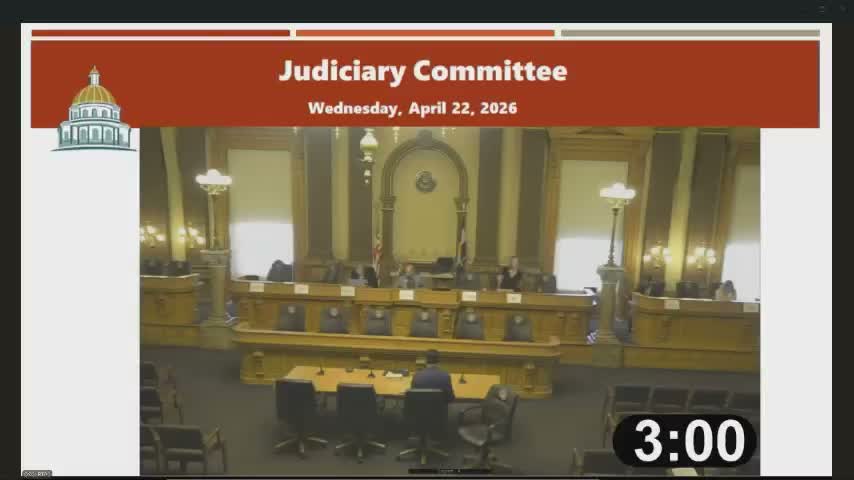
The Senate Judiciary Committee voted 5–2 on April 22 to advance House Bill 12‑88, which creates a working group in the Judicial Department to study jury selection practices and recommend statewide guidance to improve fairness and consistency in voir dire.
Sponsor Senator Wallace and co‑sponsors said the bill aims to address widely varying practices across Colorado courtrooms that can limit attorneys' and judges' ability to detect bias. The amended bill requires a judicial‑department working group composed of judges, attorneys and other stakeholders to study jury selection, issue a progress report by Dec. 1, 2026, and deliver recommendations that the Supreme Court would act on by June 15 (year specified in the amended text).
Rachel Mercer of the Denver Office of the Municipal Public Defender testified in support, telling the committee that jury selection time is inconsistent and often too short: "We usually get only about 10 minutes to question a group of 12 people," she said, arguing for standardized questionnaires and better use of written tools. Terry Scanlon, legislative liaison for Colorado Courts, said the courts support a deliberative stakeholder process and the strike‑below amendment. Kevin Cheney of the Colorado Trial Lawyers Association said the working‑group approach allows data‑driven reforms rather than a one‑size‑fits‑all mandate.
Sponsor Wallace moved the bill to the Committee of the Whole with a favorable recommendation. Miss Johnson called the roll; the motion passed 5–2. Dissenting votes were recorded from two members (names recorded as 'no' in the transcript). The committee did not adopt any additional committee amendments during the hearing.
Next steps: the working group will report progress by Dec. 1, 2026; sponsors said the Supreme Court would consider recommendations by the date specified in the amended text for implementation decisions.
Sponsor Senator Wallace and co‑sponsors said the bill aims to address widely varying practices across Colorado courtrooms that can limit attorneys' and judges' ability to detect bias. The amended bill requires a judicial‑department working group composed of judges, attorneys and other stakeholders to study jury selection, issue a progress report by Dec. 1, 2026, and deliver recommendations that the Supreme Court would act on by June 15 (year specified in the amended text).
Rachel Mercer of the Denver Office of the Municipal Public Defender testified in support, telling the committee that jury selection time is inconsistent and often too short: "We usually get only about 10 minutes to question a group of 12 people," she said, arguing for standardized questionnaires and better use of written tools. Terry Scanlon, legislative liaison for Colorado Courts, said the courts support a deliberative stakeholder process and the strike‑below amendment. Kevin Cheney of the Colorado Trial Lawyers Association said the working‑group approach allows data‑driven reforms rather than a one‑size‑fits‑all mandate.
Sponsor Wallace moved the bill to the Committee of the Whole with a favorable recommendation. Miss Johnson called the roll; the motion passed 5–2. Dissenting votes were recorded from two members (names recorded as 'no' in the transcript). The committee did not adopt any additional committee amendments during the hearing.
Next steps: the working group will report progress by Dec. 1, 2026; sponsors said the Supreme Court would consider recommendations by the date specified in the amended text for implementation decisions.
Don't Miss a Word: See the Full Meeting!
Go beyond summaries. Unlock every video, transcript, and key insight with a Founder Membership.
✓
Get instant access to full meeting videos
✓
Search and clip any phrase from complete transcripts
✓
Receive AI-powered summaries & custom alerts
✓
Enjoy lifetime, unrestricted access to government data
30-day money-back guarantee
