House committee advances bill to require five-year reviews of state rules
April 22, 2026 | 2026 Legislature CO, Colorado
This article was created by AI summarizing key points discussed. AI makes mistakes, so for full details and context, please refer to the video of the full meeting. Please report any errors so we can fix them. Report an error »
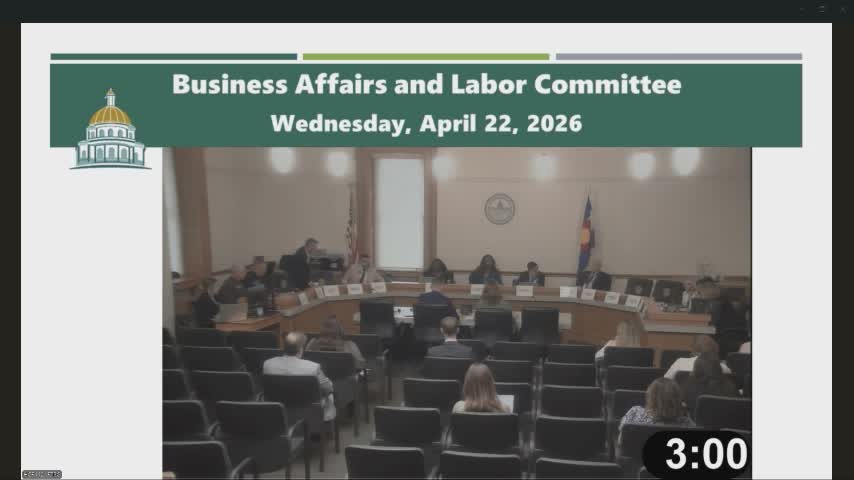
The House Business Affairs Committee on Monday advanced Senate Bill 137, a bipartisan measure that would require Colorado state agencies to review their existing rules at least once every five years and strengthen the criteria used in those reviews.
Sponsors and supporters said the bill is intended to reduce duplicative or outdated regulation while preserving consumer protections. "What our bill will do is ensure that those rules are reviewed every 5 years," Speaker McCluskey said in opening remarks, describing the change as a way to create "a more efficient government" that better serves consumers and businesses.
Patty Salazar, the executive director of the Department of Regulatory Agencies, told the committee the proposal builds on existing processes under the Colorado Administrative Procedure Act and integrates rule reviews into the SMART Act oversight schedule. Salazar said the bill would "set a floor so that all agencies are doing it no less than 5 years" and would direct agencies to transmit their regulatory agendas to the legislative audit committee to increase transparency.
Business groups, trade associations and regulated industries offered broad support at two witness panels. Lauren Furman, president and CEO of the Colorado Chamber of Commerce, said the chamber's members repeatedly cite the state regulatory environment as a top concern and that the bill "takes a very thoughtful approach to regularly reviewing existing rules." Representatives of the Colorado Association of Health Plans, the Colorado Hospital Association, the Colorado Association of Home Builders and the Colorado Restaurant Association also testified that overlapping or outdated rules increase administrative costs and uncertainty for employers and service providers.
Some witnesses supplied quantitative examples. Ted Liddy of the Colorado Association of Home Builders said regulatory costs can add roughly $93,870 to the price of a single-family home, representing a significant portion of development expenses. Minority Leader Caldwell noted research cited in testimony that, in some analyses, roughly 45% of the state's roughly 200,000 regulations were viewed as excessive or duplicative by certain business surveys.
Committee members asked how the five-year cadence was chosen and how much staff time the reviews would require. "We chose the time that we did not cause undue burden on any of the agencies with respect to their resources," Director Salazar replied, saying many programs already follow a five-year review cycle and the bill's fiscal note indicates no statewide adverse fiscal impact. Members asked whether more frequent reviews (for example, every three years) might be preferable for fast-moving programs; sponsors said the five-year floor balances regular oversight and resource constraints while still allowing agencies to review more often where appropriate.
The committee also called a representative from the Attorney General's office to clarify language about discovery and agency records after litigation experience involving a multi-state case. The AG's office said the bill language is intended to clarify the mechanism for third-party discovery when an agency holds information potentially relevant to an AG-led consumer protection case under Title 6.
Supporters stressed the bill is not intended to dismantle protections. "We are not here advocating for the elimination of programs, divisions, or agencies," Lauren Furman said, while arguing the measure would help ensure rules are "doing what they are intended to do".
After testimony and questions, Representative Gonzales moved to send SB 137 to the House Committee of the Whole with a favorable recommendation. The committee recorded a roll call vote with 12 in favor, none opposed and one member excused; the motion passed. The committee chair then adjourned the hearing.
The next step is consideration by the House Committee of the Whole; no additional amendments were adopted in the committee hearing.
Sponsors and supporters said the bill is intended to reduce duplicative or outdated regulation while preserving consumer protections. "What our bill will do is ensure that those rules are reviewed every 5 years," Speaker McCluskey said in opening remarks, describing the change as a way to create "a more efficient government" that better serves consumers and businesses.
Patty Salazar, the executive director of the Department of Regulatory Agencies, told the committee the proposal builds on existing processes under the Colorado Administrative Procedure Act and integrates rule reviews into the SMART Act oversight schedule. Salazar said the bill would "set a floor so that all agencies are doing it no less than 5 years" and would direct agencies to transmit their regulatory agendas to the legislative audit committee to increase transparency.
Business groups, trade associations and regulated industries offered broad support at two witness panels. Lauren Furman, president and CEO of the Colorado Chamber of Commerce, said the chamber's members repeatedly cite the state regulatory environment as a top concern and that the bill "takes a very thoughtful approach to regularly reviewing existing rules." Representatives of the Colorado Association of Health Plans, the Colorado Hospital Association, the Colorado Association of Home Builders and the Colorado Restaurant Association also testified that overlapping or outdated rules increase administrative costs and uncertainty for employers and service providers.
Some witnesses supplied quantitative examples. Ted Liddy of the Colorado Association of Home Builders said regulatory costs can add roughly $93,870 to the price of a single-family home, representing a significant portion of development expenses. Minority Leader Caldwell noted research cited in testimony that, in some analyses, roughly 45% of the state's roughly 200,000 regulations were viewed as excessive or duplicative by certain business surveys.
Committee members asked how the five-year cadence was chosen and how much staff time the reviews would require. "We chose the time that we did not cause undue burden on any of the agencies with respect to their resources," Director Salazar replied, saying many programs already follow a five-year review cycle and the bill's fiscal note indicates no statewide adverse fiscal impact. Members asked whether more frequent reviews (for example, every three years) might be preferable for fast-moving programs; sponsors said the five-year floor balances regular oversight and resource constraints while still allowing agencies to review more often where appropriate.
The committee also called a representative from the Attorney General's office to clarify language about discovery and agency records after litigation experience involving a multi-state case. The AG's office said the bill language is intended to clarify the mechanism for third-party discovery when an agency holds information potentially relevant to an AG-led consumer protection case under Title 6.
Supporters stressed the bill is not intended to dismantle protections. "We are not here advocating for the elimination of programs, divisions, or agencies," Lauren Furman said, while arguing the measure would help ensure rules are "doing what they are intended to do".
After testimony and questions, Representative Gonzales moved to send SB 137 to the House Committee of the Whole with a favorable recommendation. The committee recorded a roll call vote with 12 in favor, none opposed and one member excused; the motion passed. The committee chair then adjourned the hearing.
The next step is consideration by the House Committee of the Whole; no additional amendments were adopted in the committee hearing.
Don't Miss a Word: See the Full Meeting!
Go beyond summaries. Unlock every video, transcript, and key insight with a Founder Membership.
✓
Get instant access to full meeting videos
✓
Search and clip any phrase from complete transcripts
✓
Receive AI-powered summaries & custom alerts
✓
Enjoy lifetime, unrestricted access to government data
30-day money-back guarantee
