City unveils Resilient Austin Playbook to coordinate departmental resilience work
April 22, 2026 | Austin, Travis County, Texas
This article was created by AI summarizing key points discussed. AI makes mistakes, so for full details and context, please refer to the video of the full meeting. Please report any errors so we can fix them. Report an error »
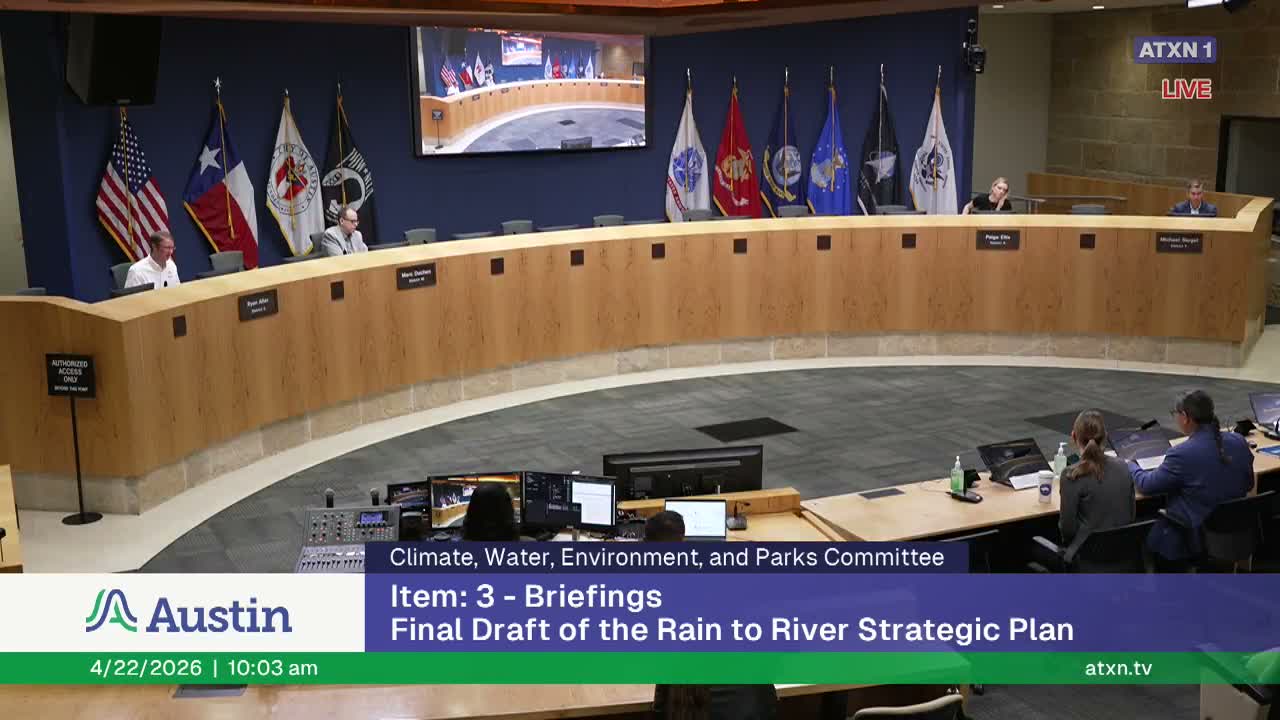
Zach Waller, director of Austin Climate Action & Resilience, introduced the Resilient Austin Playbook as a cross-departmental tool designed to coordinate resilience actions across more than 20 city departments. "Today we're excited to share the Resilient Austin Playbook," Waller said, stressing that the document is intended to align existing work rather than create a new budget.
Corinne Letourneau, founding principal of Resilient Cities Catalyst, said the playbook emerged from multi-year engagement and analysis and frames resilience as both sudden shocks and ongoing stresses: "Resilience is the capacity of community, local governments, and businesses to coordinate, prepare for, respond to, and recover from both sudden shocks... and ongoing stressors." She said the playbook aggregates existing initiatives, centers neighborhood impacts and prioritizes coordinated action that does not primarily require new funding.
Nut graf: The playbook organizes 47 actions into interconnected goals and proposes an accountability model (climate cabinet and delivery teams) to accelerate implementation. Staff emphasized the document's role as a coordination and accountability anchor, not a stand-alone capital plan.
Mark Coudair, Climate Resilience Manager, described the playbook's four aspirations and the delivery-team model that will fast-track high-priority, cross-department initiatives. He said potential near-term steps include annual reporting, a delivery-team "road map," and pilot "delivery teams" focused on priorities such as cooling/warming centers and infrastructure design.
Council members asked how the playbook prioritizes among shocks (floods, storms) and stressors (housing affordability, heat exposure) and how transportation planning would be coordinated with heat resilience and tree-planting efforts. Staff said the playbook's early implementation focuses on neighborhoods where stresses are greatest and on mechanisms to coordinate across departments and external partners such as CapMetro.
Ending: Staff said the playbook is published on the city website and will be used to guide interdepartmental coordination; they will return with progress reports and proposals to operationalize delivery teams and reporting structures.
Corinne Letourneau, founding principal of Resilient Cities Catalyst, said the playbook emerged from multi-year engagement and analysis and frames resilience as both sudden shocks and ongoing stresses: "Resilience is the capacity of community, local governments, and businesses to coordinate, prepare for, respond to, and recover from both sudden shocks... and ongoing stressors." She said the playbook aggregates existing initiatives, centers neighborhood impacts and prioritizes coordinated action that does not primarily require new funding.
Nut graf: The playbook organizes 47 actions into interconnected goals and proposes an accountability model (climate cabinet and delivery teams) to accelerate implementation. Staff emphasized the document's role as a coordination and accountability anchor, not a stand-alone capital plan.
Mark Coudair, Climate Resilience Manager, described the playbook's four aspirations and the delivery-team model that will fast-track high-priority, cross-department initiatives. He said potential near-term steps include annual reporting, a delivery-team "road map," and pilot "delivery teams" focused on priorities such as cooling/warming centers and infrastructure design.
Council members asked how the playbook prioritizes among shocks (floods, storms) and stressors (housing affordability, heat exposure) and how transportation planning would be coordinated with heat resilience and tree-planting efforts. Staff said the playbook's early implementation focuses on neighborhoods where stresses are greatest and on mechanisms to coordinate across departments and external partners such as CapMetro.
Ending: Staff said the playbook is published on the city website and will be used to guide interdepartmental coordination; they will return with progress reports and proposals to operationalize delivery teams and reporting structures.
Don't Miss a Word: See the Full Meeting!
Go beyond summaries. Unlock every video, transcript, and key insight with a Founder Membership.
✓
Get instant access to full meeting videos
✓
Search and clip any phrase from complete transcripts
✓
Receive AI-powered summaries & custom alerts
✓
Enjoy lifetime, unrestricted access to government data
30-day money-back guarantee
