Mono County reports nearly $370,000 in HMO fees since 2019; 2025 permits dip slightly
April 21, 2026 | Mono County, California
This article was created by AI summarizing key points discussed. AI makes mistakes, so for full details and context, please refer to the video of the full meeting. Please report any errors so we can fix them. Report an error »
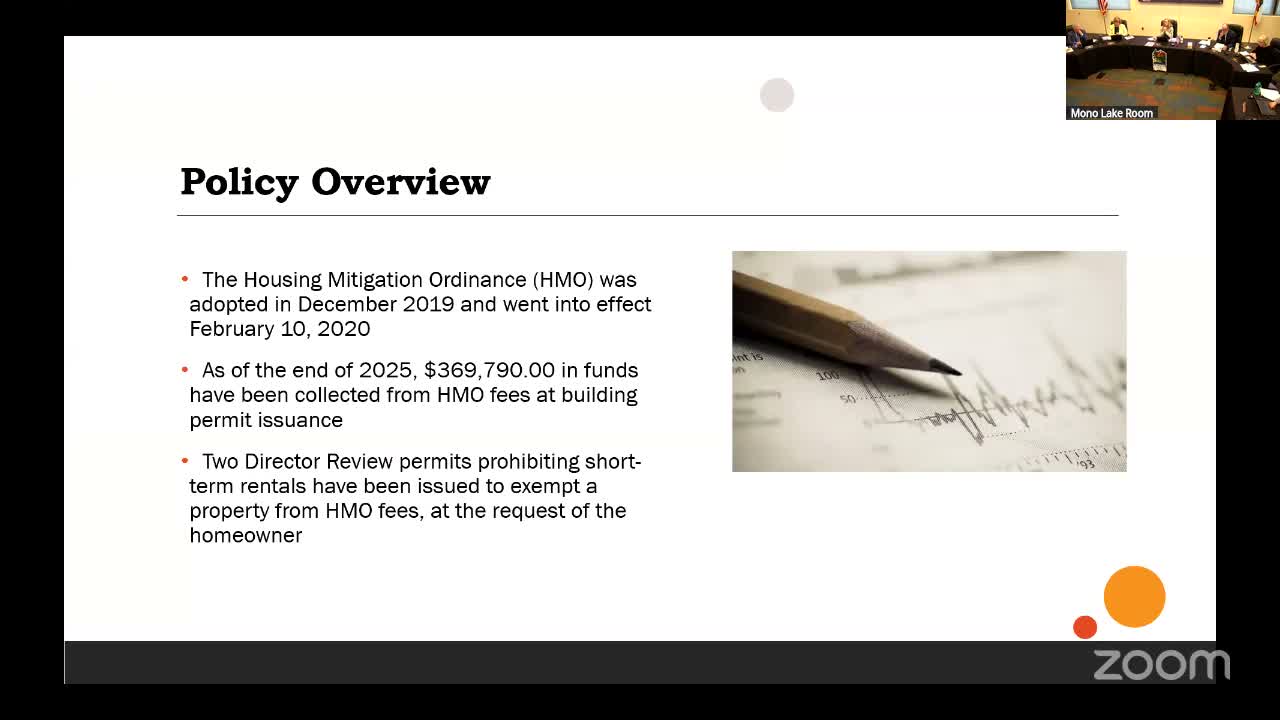
Michael Jones, Mono Countys permit technician, told the Housing Authority on April 21 that since the county adopted its housing mitigation ordinance in December 2019 it has collected "just under $370,000" in HMO fees assessed at permit issuance.
Jones presented a decade of permitting data and said 2025 saw 268 building permits, including 30 single-family home permits (14 manufactured and 16 conventional stick-built). He reported total permit valuation for 2025 at approximately $14,200,000, down from about $15,200,000 in 2024, and attributed year-to-year valuation changes in part to high local construction costs: "construction costs in the Eastern Sierra currently estimated at roughly $700 per square foot," he said.
Jones said historical spikes in permitting followed major reconstruction needs after the Round Fire (2015) and Mountain View Fire (2021), and that recent increases in 2024 and 2025 are linked to broader economic growth and expansion of the short-term rental market.
Board members asked how director-review exemptions (which waive HMO fees) are communicated to applicants. "We don't really have a lot of literature that's presented upfront regarding the housing mitigation ordinance," Jones replied, saying the exemption pathway often appears as an informal inquiry and that staff had updated the packet that morning.
Supervisors suggested adding an explicit checkbox to permit forms to capture intended use (primary residence, secondary residence, commercial) so the county can better estimate how many new units become primary homes versus second homes or short-term rentals. Jones said tracking ultimate occupancy would require cross-department coordination, including work with the assessor's office, and that staff would note the suggestion for next-year process improvements.
The presentation also included permitting fees and plan-check receipts, which totaled about $668,000 in 2025 versus $731,000 in 2024; staff noted a new fee schedule effective 07/01/2024 increased baseline receipts for both years and complicates simple year-over-year comparisons.
The board did not take formal action on these numbers; staff will post Joness slides online and said they will consider administrative changes to improve notice of exemption paths and explore data options to better track unit use.
Jones presented a decade of permitting data and said 2025 saw 268 building permits, including 30 single-family home permits (14 manufactured and 16 conventional stick-built). He reported total permit valuation for 2025 at approximately $14,200,000, down from about $15,200,000 in 2024, and attributed year-to-year valuation changes in part to high local construction costs: "construction costs in the Eastern Sierra currently estimated at roughly $700 per square foot," he said.
Jones said historical spikes in permitting followed major reconstruction needs after the Round Fire (2015) and Mountain View Fire (2021), and that recent increases in 2024 and 2025 are linked to broader economic growth and expansion of the short-term rental market.
Board members asked how director-review exemptions (which waive HMO fees) are communicated to applicants. "We don't really have a lot of literature that's presented upfront regarding the housing mitigation ordinance," Jones replied, saying the exemption pathway often appears as an informal inquiry and that staff had updated the packet that morning.
Supervisors suggested adding an explicit checkbox to permit forms to capture intended use (primary residence, secondary residence, commercial) so the county can better estimate how many new units become primary homes versus second homes or short-term rentals. Jones said tracking ultimate occupancy would require cross-department coordination, including work with the assessor's office, and that staff would note the suggestion for next-year process improvements.
The presentation also included permitting fees and plan-check receipts, which totaled about $668,000 in 2025 versus $731,000 in 2024; staff noted a new fee schedule effective 07/01/2024 increased baseline receipts for both years and complicates simple year-over-year comparisons.
The board did not take formal action on these numbers; staff will post Joness slides online and said they will consider administrative changes to improve notice of exemption paths and explore data options to better track unit use.
Don't Miss a Word: See the Full Meeting!
Go beyond summaries. Unlock every video, transcript, and key insight with a Founder Membership.
✓
Get instant access to full meeting videos
✓
Search and clip any phrase from complete transcripts
✓
Receive AI-powered summaries & custom alerts
✓
Enjoy lifetime, unrestricted access to government data
30-day money-back guarantee
