School psychologists outline threat- and risk-assessment procedures, report dozens of assessments this year
April 20, 2026 | MECKLENBURG CO PBLC SCHS, School Districts, Virginia
This article was created by AI summarizing key points discussed. AI makes mistakes, so for full details and context, please refer to the video of the full meeting. Please report any errors so we can fix them. Report an error »
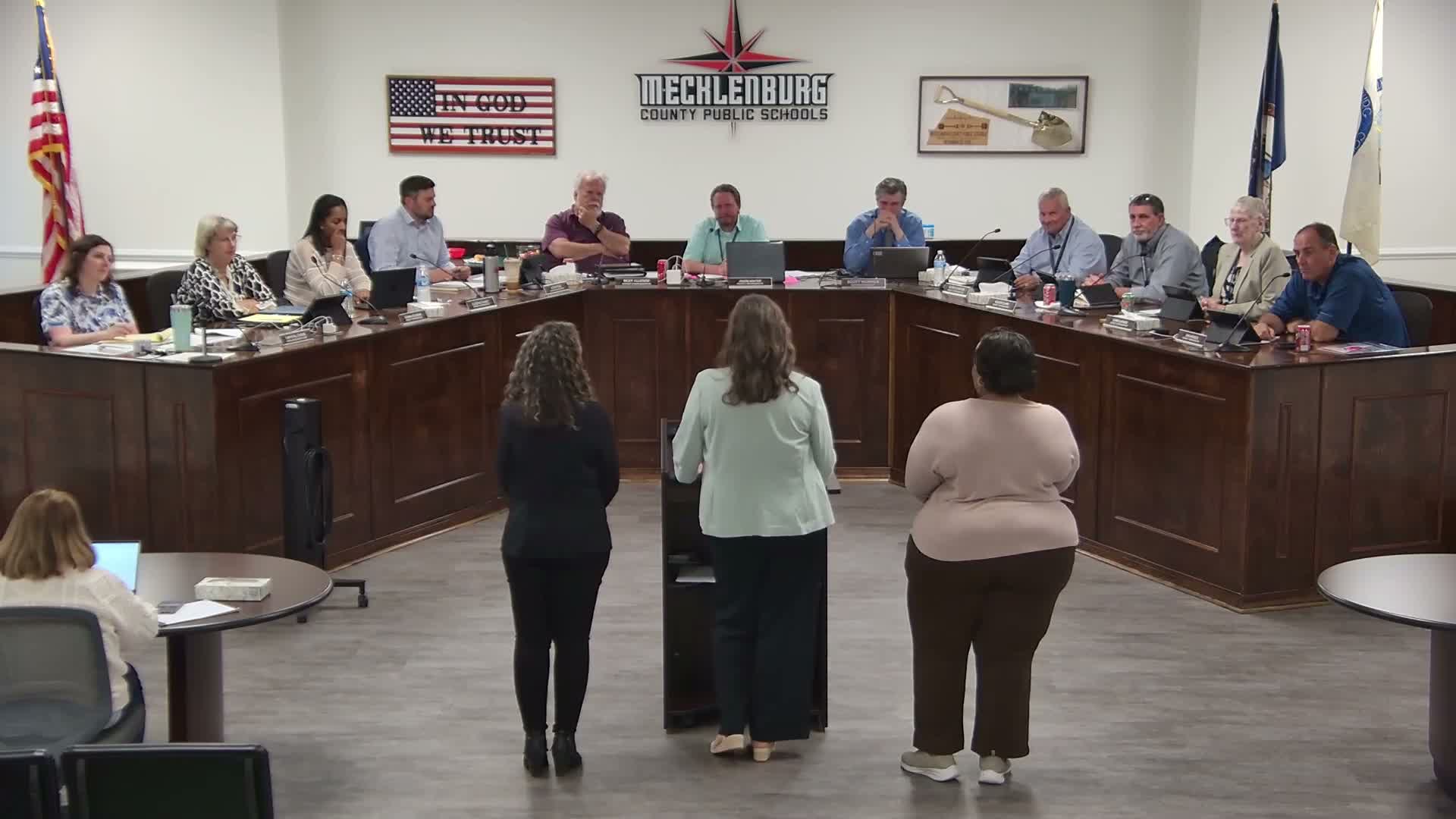
Crystal Walsh, a county school psychologist, told the Mecklenburg County Public Schools board that threat assessments are "a fact based systematic process" used to evaluate behaviors that might indicate a danger to students or staff and to determine appropriate interventions.
Walsh said Code of Virginia 22.1-79.0.4 requires local school boards to adopt policies establishing assessment teams and cited model guidance from state agencies. "The team is very specific legally who has to be under threat assessment team," she said, listing counselors, behavior-intervention teachers, instructional staff, administrators and school resource officers as members.
Walsh and team members stressed that threat assessment is intended for prevention rather than prediction. "There is no profile of a person who may pose a threat to a school," Walsh said, and the process focuses on observable behavior, gestures or communications. She described a school-based workflow: staff report a concern, two trained staff interview affected students, the team completes consistent paperwork adapted from DCJS forms, and the team meets to determine risk level and interventions.
The presenters provided counts for this school year: "South Hill Elementary has had 27; LaCrosse 17; Clark School 14; the middle school 14; and the high school 19," Walsh said, noting that many assessments are routine or low risk. She explained higher high-school totals were partly driven by a survey and an automated GoGuardian alert that led staff to "ping" and screen multiple students in one session. The presentation also covered risk assessments for self-harm, noting the district uses the Columbia suicide scale as part of consistent paperwork.
Walsh said parents are contacted after an assessment except in rare situations involving Department of Social Services consideration. For imminent-risk cases the district works with Southside Behavioral Health and, when appropriate, escorts students to the hospital for further evaluation. "We call the parents immediately," Walsh said, adding that the school provides a summary page to help families and clinicians understand next steps. Teams also follow up within 24 hours and check in the next school day.
Board members questioned sources of training and funding. Walsh said DCJS provided a train-the-trainer session so the district could internalize training and that the program receives no dedicated state funding. The superintendent and other board members praised the team for bringing the work to the board to increase public understanding and to underline the district's prevention-focused approach.
The board took no formal action on the presentation itself; the session closed with public acknowledgment of the work by counselors and behavior staff.
Walsh said Code of Virginia 22.1-79.0.4 requires local school boards to adopt policies establishing assessment teams and cited model guidance from state agencies. "The team is very specific legally who has to be under threat assessment team," she said, listing counselors, behavior-intervention teachers, instructional staff, administrators and school resource officers as members.
Walsh and team members stressed that threat assessment is intended for prevention rather than prediction. "There is no profile of a person who may pose a threat to a school," Walsh said, and the process focuses on observable behavior, gestures or communications. She described a school-based workflow: staff report a concern, two trained staff interview affected students, the team completes consistent paperwork adapted from DCJS forms, and the team meets to determine risk level and interventions.
The presenters provided counts for this school year: "South Hill Elementary has had 27; LaCrosse 17; Clark School 14; the middle school 14; and the high school 19," Walsh said, noting that many assessments are routine or low risk. She explained higher high-school totals were partly driven by a survey and an automated GoGuardian alert that led staff to "ping" and screen multiple students in one session. The presentation also covered risk assessments for self-harm, noting the district uses the Columbia suicide scale as part of consistent paperwork.
Walsh said parents are contacted after an assessment except in rare situations involving Department of Social Services consideration. For imminent-risk cases the district works with Southside Behavioral Health and, when appropriate, escorts students to the hospital for further evaluation. "We call the parents immediately," Walsh said, adding that the school provides a summary page to help families and clinicians understand next steps. Teams also follow up within 24 hours and check in the next school day.
Board members questioned sources of training and funding. Walsh said DCJS provided a train-the-trainer session so the district could internalize training and that the program receives no dedicated state funding. The superintendent and other board members praised the team for bringing the work to the board to increase public understanding and to underline the district's prevention-focused approach.
The board took no formal action on the presentation itself; the session closed with public acknowledgment of the work by counselors and behavior staff.
Don't Miss a Word: See the Full Meeting!
Go beyond summaries. Unlock every video, transcript, and key insight with a Founder Membership.
✓
Get instant access to full meeting videos
✓
Search and clip any phrase from complete transcripts
✓
Receive AI-powered summaries & custom alerts
✓
Enjoy lifetime, unrestricted access to government data
30-day money-back guarantee
