Capital Metro details public‑safety ambassador program and security‑technology expansion
April 20, 2026 | Austin, Travis County, Texas
This article was created by AI summarizing key points discussed. AI makes mistakes, so for full details and context, please refer to the video of the full meeting. Please report any errors so we can fix them. Report an error »
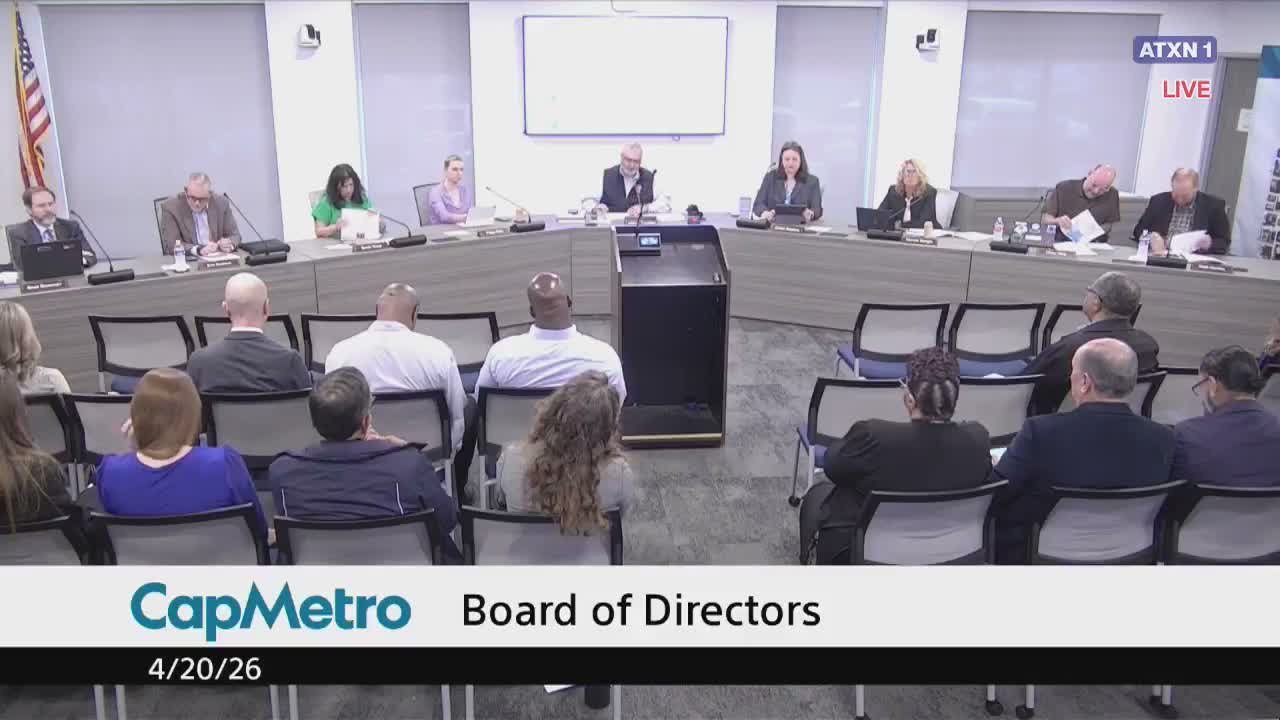
Senior Director Daryl Jamail told the board the Public Safety Ambassador Program — launched in 2021 — now operates three shifts with supervision and a manager and works alongside the transit police and community intervention specialists.
Jamail reported monthly averages for the past year: about 580 transit‑center security checks and 400 bus‑stop security checks per month; roughly 2,700 customer contacts per month during proactive sweeps; more than 150 employee‑initiated calls for public‑safety response per month; and about 15 referrals per month to community intervention specialists.
Jamail said ambassadors receive recurring training (including bomb‑recognition training from the Austin Police Department's explosive‑ordinance team, Department of Homeland Security first‑observer programming, and CPR/first aid) and that the program coordinates closely with the transit police to ensure the right resource responds to incidents.
On technology, Jamail said Capital Metro is enhancing video coverage and access control systems and noted maintenance demands will grow as the inventory increases. He reported roughly 930 facility cameras currently (estimated to approach 1,000 by year‑end) and about 5,800 vehicle cameras (estimated to approach 6,000). He also said staff are installing 67 additional rail‑crossing video cameras this year and are supporting camera deployments at rapid stations such as Pleasant Valley and Expo.
Board members asked whether vehicle cameras are monitored in real time and how long recordings are retained. Jamail said the control center can pull up live views and also access recorded video. He estimated a typical retention of about 30 days, while noting retention varies with how much the vehicle is in service and that recordings tied to incidents are preserved.
Quote: “We have the right resource for whatever the situation is that comes up on the system, whether it’s an ambassador, an intervention specialist, or a police officer,” Daryl Jamail said.
What happens next: Staff said they will continue planned installations, maintenance work and coordination with operations, vehicle maintenance and capital projects.
Jamail reported monthly averages for the past year: about 580 transit‑center security checks and 400 bus‑stop security checks per month; roughly 2,700 customer contacts per month during proactive sweeps; more than 150 employee‑initiated calls for public‑safety response per month; and about 15 referrals per month to community intervention specialists.
Jamail said ambassadors receive recurring training (including bomb‑recognition training from the Austin Police Department's explosive‑ordinance team, Department of Homeland Security first‑observer programming, and CPR/first aid) and that the program coordinates closely with the transit police to ensure the right resource responds to incidents.
On technology, Jamail said Capital Metro is enhancing video coverage and access control systems and noted maintenance demands will grow as the inventory increases. He reported roughly 930 facility cameras currently (estimated to approach 1,000 by year‑end) and about 5,800 vehicle cameras (estimated to approach 6,000). He also said staff are installing 67 additional rail‑crossing video cameras this year and are supporting camera deployments at rapid stations such as Pleasant Valley and Expo.
Board members asked whether vehicle cameras are monitored in real time and how long recordings are retained. Jamail said the control center can pull up live views and also access recorded video. He estimated a typical retention of about 30 days, while noting retention varies with how much the vehicle is in service and that recordings tied to incidents are preserved.
Quote: “We have the right resource for whatever the situation is that comes up on the system, whether it’s an ambassador, an intervention specialist, or a police officer,” Daryl Jamail said.
What happens next: Staff said they will continue planned installations, maintenance work and coordination with operations, vehicle maintenance and capital projects.
Don't Miss a Word: See the Full Meeting!
Go beyond summaries. Unlock every video, transcript, and key insight with a Founder Membership.
✓
Get instant access to full meeting videos
✓
Search and clip any phrase from complete transcripts
✓
Receive AI-powered summaries & custom alerts
✓
Enjoy lifetime, unrestricted access to government data
30-day money-back guarantee
