Assembly hearing advances package of bills aiming to limit state business with ICE and tax private detention operators
April 20, 2026 | California State Assembly, House, Legislative, California
This article was created by AI summarizing key points discussed. AI makes mistakes, so for full details and context, please refer to the video of the full meeting. Please report any errors so we can fix them. Report an error »
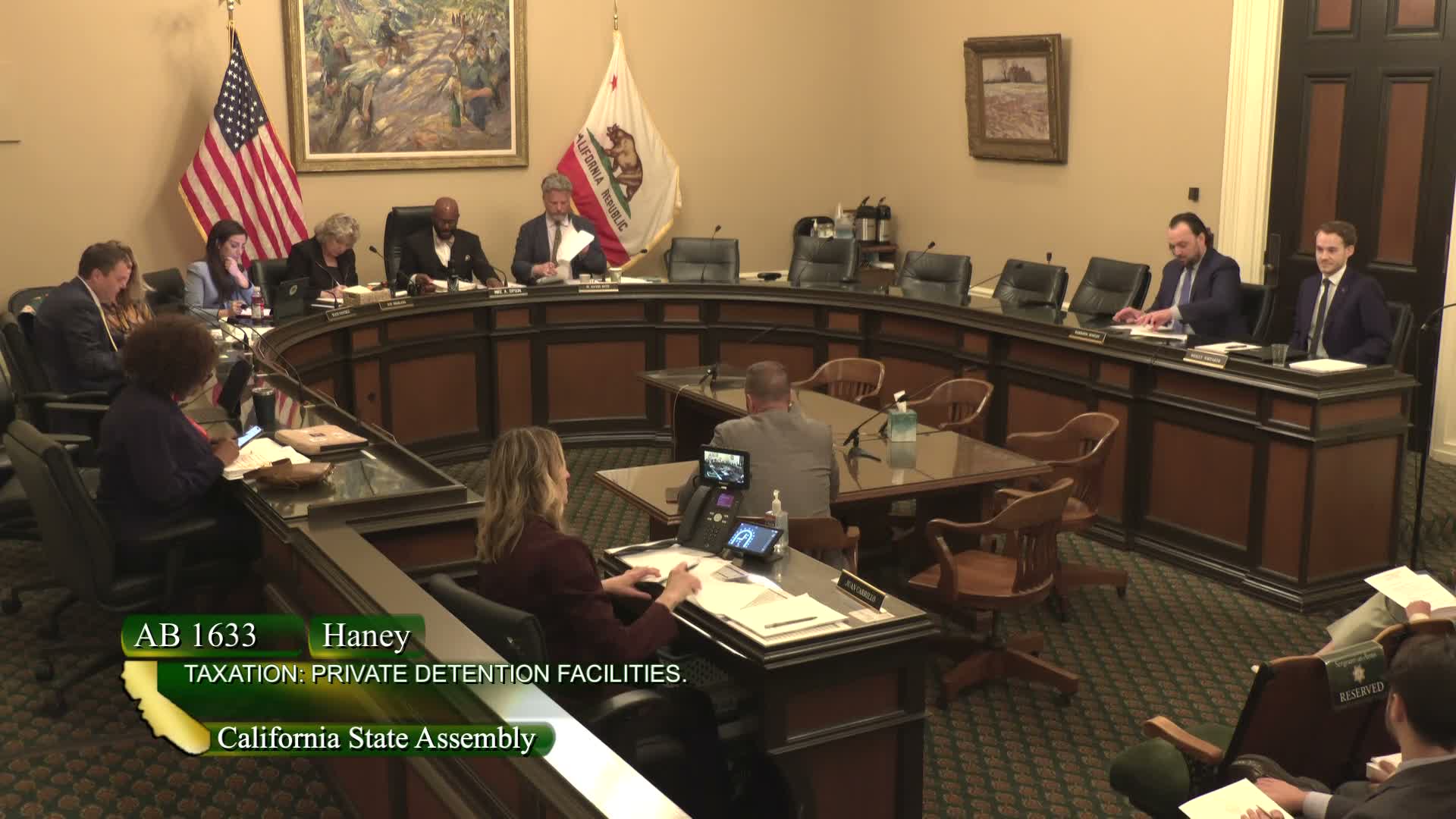
Assembly members and witnesses presented three related measures that would restrict California benefits to firms that contract with federal immigration enforcement and impose new taxes on private detention operators.
At the April hearing, author Ortega introduced AB 2465, saying the bill would bar California loans, grants, tax credits and investments to companies that profit from ICE detention contracts. Sponsor Tony Thurmond, State Superintendent of Public Instruction, described the bill as a values-based restriction on state funding: “This bill says that California money should not go to those companies that profit off of ICE detention centers,” he told the committee.
Shuming Chiu of the California Immigrant Policy Center and other immigrant-rights and labor witnesses said private contractors such as GEO Group and CoreCivic have recorded billions in revenue while detention centers face documented health and safety shortfalls. “We are proud to cosponsor AB 2465 because it ensures that our state's fiscal policies are consistent with other laws that protect California's resources,” Chiu said.
Assemblymember Lee presented AB 1675 with a similar effect on state tax breaks: companies doing business with ICE could lose California tax expenditures. Lee said revenue lost to the private detention industry could instead be redirected to immigrant legal aid and related services.
Assemblymember Haney presented AB 1633, which would impose a 50% gross‑receipts tax on for‑profit corporations operating private immigration detention facilities. Haney framed the tax as an accountability mechanism and said revenue would fund due‑process services. “If they're going to profit from detaining people in deplorable conditions, they should pay for the harm they're causing,” he said.
Opposition came primarily from business and trade representatives and some committee members who raised implementation and unintended‑consequence concerns. Alexis Rodriguez of the California Chamber of Commerce said the measures are too broad and unclear about which contracts would trigger loss of state benefits, citing examples such as IT vendors and disaster‑response contractors that work with DHS components. “Without clarification, we believe the terms of this bill would punish businesses with nonproblematic contracts and make it difficult to know if they are in violation,” Rodriguez told the committee.
Other witnesses warned that steep taxes could prompt operators to close in‑state facilities or shift detainees out of California, potentially increasing distances between detained people and legal counsel. David Bullock of a business coalition cautioned about legal and practical responses at the federal level if the measures pass.
Committee members pressed authors on scope and enforceability; authors acknowledged those concerns and said they would work with committee staff on clarifying amendments. The chair ultimately referred AB 2465 and AB 1675 to the committee’s suspense file for further work. AB 1633 was also placed in suspense after extended debate.
The hearing left the measures in play: sponsors argued the bills would align state fiscal policy with stated values and provide funding for immigration‑related services; opponents urged narrower definitions, clearer exemptions for routine government contractors, and consideration of county and federal implications. The committee did not adopt final policy language at the hearing; all three bills were referred for further consideration and potential amendment.
At the April hearing, author Ortega introduced AB 2465, saying the bill would bar California loans, grants, tax credits and investments to companies that profit from ICE detention contracts. Sponsor Tony Thurmond, State Superintendent of Public Instruction, described the bill as a values-based restriction on state funding: “This bill says that California money should not go to those companies that profit off of ICE detention centers,” he told the committee.
Shuming Chiu of the California Immigrant Policy Center and other immigrant-rights and labor witnesses said private contractors such as GEO Group and CoreCivic have recorded billions in revenue while detention centers face documented health and safety shortfalls. “We are proud to cosponsor AB 2465 because it ensures that our state's fiscal policies are consistent with other laws that protect California's resources,” Chiu said.
Assemblymember Lee presented AB 1675 with a similar effect on state tax breaks: companies doing business with ICE could lose California tax expenditures. Lee said revenue lost to the private detention industry could instead be redirected to immigrant legal aid and related services.
Assemblymember Haney presented AB 1633, which would impose a 50% gross‑receipts tax on for‑profit corporations operating private immigration detention facilities. Haney framed the tax as an accountability mechanism and said revenue would fund due‑process services. “If they're going to profit from detaining people in deplorable conditions, they should pay for the harm they're causing,” he said.
Opposition came primarily from business and trade representatives and some committee members who raised implementation and unintended‑consequence concerns. Alexis Rodriguez of the California Chamber of Commerce said the measures are too broad and unclear about which contracts would trigger loss of state benefits, citing examples such as IT vendors and disaster‑response contractors that work with DHS components. “Without clarification, we believe the terms of this bill would punish businesses with nonproblematic contracts and make it difficult to know if they are in violation,” Rodriguez told the committee.
Other witnesses warned that steep taxes could prompt operators to close in‑state facilities or shift detainees out of California, potentially increasing distances between detained people and legal counsel. David Bullock of a business coalition cautioned about legal and practical responses at the federal level if the measures pass.
Committee members pressed authors on scope and enforceability; authors acknowledged those concerns and said they would work with committee staff on clarifying amendments. The chair ultimately referred AB 2465 and AB 1675 to the committee’s suspense file for further work. AB 1633 was also placed in suspense after extended debate.
The hearing left the measures in play: sponsors argued the bills would align state fiscal policy with stated values and provide funding for immigration‑related services; opponents urged narrower definitions, clearer exemptions for routine government contractors, and consideration of county and federal implications. The committee did not adopt final policy language at the hearing; all three bills were referred for further consideration and potential amendment.
View the Full Meeting & All Its Details
This article offers just a summary. Unlock complete video, transcripts, and insights as a Founder Member.
✓
Watch full, unedited meeting videos
✓
Search every word spoken in unlimited transcripts
✓
AI summaries & real-time alerts (all government levels)
✓
Permanent access to expanding government content
30-day money-back guarantee
