Debate over Arkansas River Basin revegetation bill highlights tradeoffs; sponsors lay bill over for amendment review
April 20, 2026 | 2026 Legislature CO, Colorado
This article was created by AI summarizing key points discussed. AI makes mistakes, so for full details and context, please refer to the video of the full meeting. Please report any errors so we can fix them. Report an error »
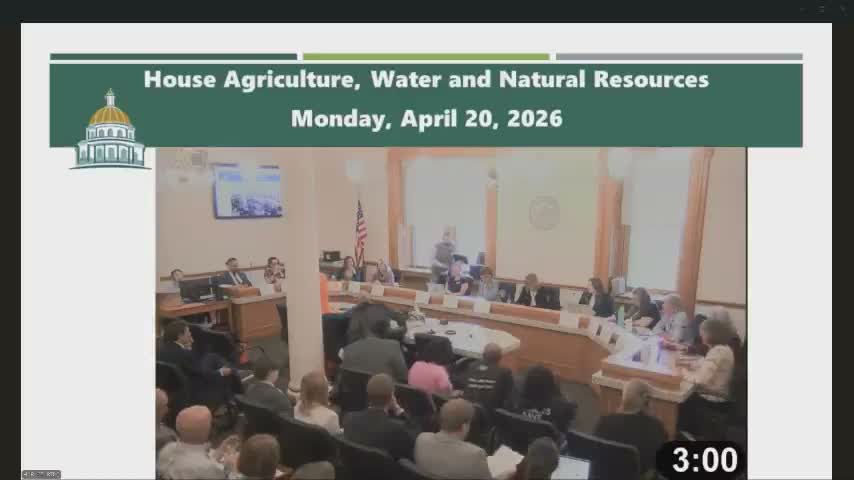
Representatives Winter and Morrow presented House Bill 26‑1340, a bill that would require site‑specific revegetation criteria and objective evaluation methods for parcels in Water Division 2 (the Arkansas River Basin) when irrigation is permanently removed. Sponsors said the bill responds to decades of 'buy and dry' that left tens of thousands of acres barren, creating dust, invasive weeds and elevated wildfire risk.
Representative Morrow outlined four core goals: set clear expectations; ensure accountability; provide compliance flexibility; and incorporate local input. The bill would require revegetation criteria and evaluation methodology to be included in a water‑court decree, allow dry‑land farming as a compliance pathway, create a five‑year maintenance period after establishment, and offer three compliance/incentive options (financial assurance such as bonds; limiting the amount of water available for new uses until reclamation succeeds; or adopting county 10‑41 permit terms into decrees).
Proponents — including Jack Goble (Lower Arkansas Valley Water Conservancy District), Catherine Carter (Lower Arkansas Valley Water Conservancy District special counsel), Jerry Knapp (technical revegetation expert), and county commissioners — argued the bill would codify practices that are often negotiated only after long and expensive litigation. Jack Goble presented data showing dramatic irrigated‑acre losses in parts of the Lower Arkansas Valley and said counties have been left with lingering soil and weed problems.
Opponents and amend proponents — the Colorado River District, the Colorado Farm Bureau, Aurora Water and legal counsel for agricultural associations — said amendments are needed. Criticisms included:
- The dry‑land farming pathway may be legally and technically vague and could be a loophole that reduces enforceability and shifts responsibility to landowners.
- The third‑party 'independent' verifier could be difficult to define and expensive; some asked that the bill allow a qualified third party but avoid overly prescriptive independence requirements.
- Provisions that allow county 10‑41 permit terms to bind water court decisions raised concerns about preserving the water court's traditional discretion to prevent injury to other water users.
Technical witnesses described revegetation methods and realistic timelines: Jerry Knapp explained that establishing native grasses in the Lower Arkansas Valley often requires irrigation to get seedlings through dry periods and that stands typically require multiple years (two to five) before being considered established; he supported a maintenance period to ensure durability.
Given substantial stakeholder changes introduced minutes before the hearing, sponsors asked for time to circulate amendments. The committee agreed and laid the bill over for action only until the next meeting, giving members time to review the revised language.
Key questions remain about the bill’s compliance enforcement, who pays for revegetation or verifiers, and how the water court would balance local permit terms with traditional water‑court injury analysis.
Representative Morrow outlined four core goals: set clear expectations; ensure accountability; provide compliance flexibility; and incorporate local input. The bill would require revegetation criteria and evaluation methodology to be included in a water‑court decree, allow dry‑land farming as a compliance pathway, create a five‑year maintenance period after establishment, and offer three compliance/incentive options (financial assurance such as bonds; limiting the amount of water available for new uses until reclamation succeeds; or adopting county 10‑41 permit terms into decrees).
Proponents — including Jack Goble (Lower Arkansas Valley Water Conservancy District), Catherine Carter (Lower Arkansas Valley Water Conservancy District special counsel), Jerry Knapp (technical revegetation expert), and county commissioners — argued the bill would codify practices that are often negotiated only after long and expensive litigation. Jack Goble presented data showing dramatic irrigated‑acre losses in parts of the Lower Arkansas Valley and said counties have been left with lingering soil and weed problems.
Opponents and amend proponents — the Colorado River District, the Colorado Farm Bureau, Aurora Water and legal counsel for agricultural associations — said amendments are needed. Criticisms included:
- The dry‑land farming pathway may be legally and technically vague and could be a loophole that reduces enforceability and shifts responsibility to landowners.
- The third‑party 'independent' verifier could be difficult to define and expensive; some asked that the bill allow a qualified third party but avoid overly prescriptive independence requirements.
- Provisions that allow county 10‑41 permit terms to bind water court decisions raised concerns about preserving the water court's traditional discretion to prevent injury to other water users.
Technical witnesses described revegetation methods and realistic timelines: Jerry Knapp explained that establishing native grasses in the Lower Arkansas Valley often requires irrigation to get seedlings through dry periods and that stands typically require multiple years (two to five) before being considered established; he supported a maintenance period to ensure durability.
Given substantial stakeholder changes introduced minutes before the hearing, sponsors asked for time to circulate amendments. The committee agreed and laid the bill over for action only until the next meeting, giving members time to review the revised language.
Key questions remain about the bill’s compliance enforcement, who pays for revegetation or verifiers, and how the water court would balance local permit terms with traditional water‑court injury analysis.
Don't Miss a Word: See the Full Meeting!
Go beyond summaries. Unlock every video, transcript, and key insight with a Founder Membership.
✓
Get instant access to full meeting videos
✓
Search and clip any phrase from complete transcripts
✓
Receive AI-powered summaries & custom alerts
✓
Enjoy lifetime, unrestricted access to government data
30-day money-back guarantee
