Finance committee forwards SB 141 to Appropriations after testimony on wildlife crossings and a fatal crash
April 20, 2026 | 2026 Legislature CO, Colorado
This article was created by AI summarizing key points discussed. AI makes mistakes, so for full details and context, please refer to the video of the full meeting. Please report any errors so we can fix them. Report an error »
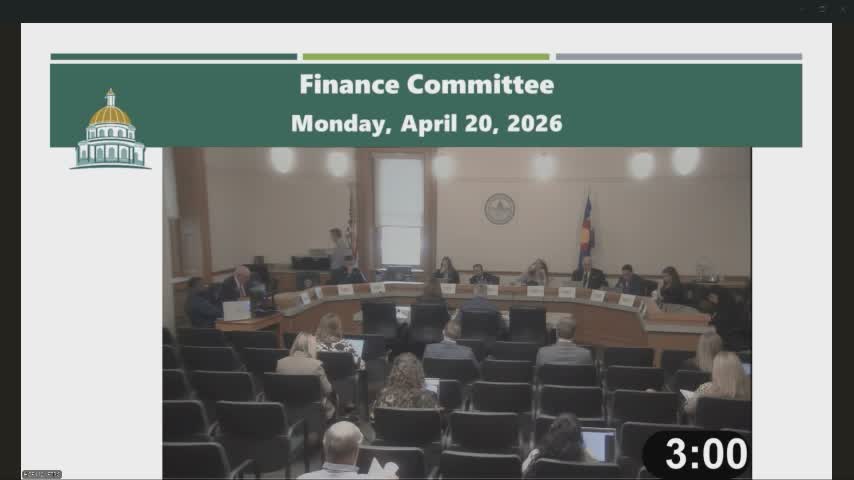
A Colorado House Finance Committee advanced Senate Bill 141 on a vote of 8–2, with one member excused, after hearing agency, nonprofit and citizen testimony that the bill would create a dedicated, voluntary vehicle-registration contribution to fund wildlife overpasses, underpasses and adjacent habitat conservation.
The bill would establish a Wildlife Collision Prevention Fund financed by an optional $5 contribution that motorists could elect when registering a vehicle, with 75% allocated to the Bridge and Tunnel Enterprise at the Colorado Department of Transportation (CDOT) for crossing infrastructure and 25% directed to Colorado Parks and Wildlife (CPW) for conservation of lands adjacent to crossings. Sponsors and witnesses said the dedicated revenue would let Colorado leverage federal grants at roughly a 4:1 or 5:1 rate for large crossing projects.
Sponsors and witnesses framed the bill as a public-safety and conservation measure with fiscal leverage. Representative Taggart, a co-prime sponsor, said the proposal would create a “new collision prevention fund with dedicated annual funding” and described the $5 option as “optional, I emphasize, optional,” for Colorado vehicle registrants. Emily Hathaway, testifying for CDOT, called SB 141 “strong bipartisan legislation” that would build data-driven infrastructure projects to save lives and said targeted crossings have reduced collisions in some corridors by more than 90%.
Witnesses cited statewide numbers repeatedly: the testimony noted approximately 7,500 reported wildlife–vehicle crashes in 2024 and historical figures of dozens of fatalities and thousands of injuries across the last decade-plus. Multiple witnesses and sponsors referenced an estimated annual economic toll of about $321,000,000 in collision costs in Colorado; Representative Taggart also cited an insurance-industry estimate of roughly $1.1 billion spent annually on wildlife-related claims.
Public testimony included Mary Rodriguez of Castle Rock, who said her father was killed in an October 2024 collision with a 700‑pound elk on U.S. Highway 85. Rodriguez told the committee that she and her family had petitioned for wildlife fencing and crossings in the affected corridor and urged passage of SB 141, saying, “Had there been wildlife mitigation systems in place, my dad may still be here today.”
Committee members pressed sponsors on design details: how funds would be siloed inside the Bridge and Tunnel Enterprise to prevent fungibility; how local authorities, CDOT and CPW would prioritize projects; and whether the contribution is best described as a fee or a donation. Sponsors and agency witnesses said the bill specifies local input and prioritized, data-driven selection and that the 75/25 split is intended to fund both the physical crossing structures and habitat conservation adjacent to them. The Department of Natural Resources (DNR) witness described a fix to the Keep Colorado Wild pass administration that the bill would make, allowing residents to re‑choose the Keep Colorado Wild pass at registration each year.
The committee motion to send SB 141 to the Committee on Appropriations passed on a roll call; the Clerk recorded the tally as 8 yes, 2 no, 1 excused. The bill will next be considered by the Appropriations Committee.
Supporters said reliable, sustained state funding is necessary to capture federal matching dollars and keep building crossings in high-risk corridors; opponents raised process concerns about classification and long-term oversight of the revenue stream.
The committee recorded several requests for fiscal follow-up. No amendments were adopted during the Finance Committee hearing.
The Finance Committee advanced SB 141 to the Appropriations Committee on a recorded vote of 8 to 2 with one excused.
The bill would establish a Wildlife Collision Prevention Fund financed by an optional $5 contribution that motorists could elect when registering a vehicle, with 75% allocated to the Bridge and Tunnel Enterprise at the Colorado Department of Transportation (CDOT) for crossing infrastructure and 25% directed to Colorado Parks and Wildlife (CPW) for conservation of lands adjacent to crossings. Sponsors and witnesses said the dedicated revenue would let Colorado leverage federal grants at roughly a 4:1 or 5:1 rate for large crossing projects.
Sponsors and witnesses framed the bill as a public-safety and conservation measure with fiscal leverage. Representative Taggart, a co-prime sponsor, said the proposal would create a “new collision prevention fund with dedicated annual funding” and described the $5 option as “optional, I emphasize, optional,” for Colorado vehicle registrants. Emily Hathaway, testifying for CDOT, called SB 141 “strong bipartisan legislation” that would build data-driven infrastructure projects to save lives and said targeted crossings have reduced collisions in some corridors by more than 90%.
Witnesses cited statewide numbers repeatedly: the testimony noted approximately 7,500 reported wildlife–vehicle crashes in 2024 and historical figures of dozens of fatalities and thousands of injuries across the last decade-plus. Multiple witnesses and sponsors referenced an estimated annual economic toll of about $321,000,000 in collision costs in Colorado; Representative Taggart also cited an insurance-industry estimate of roughly $1.1 billion spent annually on wildlife-related claims.
Public testimony included Mary Rodriguez of Castle Rock, who said her father was killed in an October 2024 collision with a 700‑pound elk on U.S. Highway 85. Rodriguez told the committee that she and her family had petitioned for wildlife fencing and crossings in the affected corridor and urged passage of SB 141, saying, “Had there been wildlife mitigation systems in place, my dad may still be here today.”
Committee members pressed sponsors on design details: how funds would be siloed inside the Bridge and Tunnel Enterprise to prevent fungibility; how local authorities, CDOT and CPW would prioritize projects; and whether the contribution is best described as a fee or a donation. Sponsors and agency witnesses said the bill specifies local input and prioritized, data-driven selection and that the 75/25 split is intended to fund both the physical crossing structures and habitat conservation adjacent to them. The Department of Natural Resources (DNR) witness described a fix to the Keep Colorado Wild pass administration that the bill would make, allowing residents to re‑choose the Keep Colorado Wild pass at registration each year.
The committee motion to send SB 141 to the Committee on Appropriations passed on a roll call; the Clerk recorded the tally as 8 yes, 2 no, 1 excused. The bill will next be considered by the Appropriations Committee.
Supporters said reliable, sustained state funding is necessary to capture federal matching dollars and keep building crossings in high-risk corridors; opponents raised process concerns about classification and long-term oversight of the revenue stream.
The committee recorded several requests for fiscal follow-up. No amendments were adopted during the Finance Committee hearing.
The Finance Committee advanced SB 141 to the Appropriations Committee on a recorded vote of 8 to 2 with one excused.
Don't Miss a Word: See the Full Meeting!
Go beyond summaries. Unlock every video, transcript, and key insight with a Founder Membership.
✓
Get instant access to full meeting videos
✓
Search and clip any phrase from complete transcripts
✓
Receive AI-powered summaries & custom alerts
✓
Enjoy lifetime, unrestricted access to government data
30-day money-back guarantee
