Senate Education Committee advances School Finance Act, adopts technical amendments
April 20, 2026 | 2026 Legislature CO, Colorado
This article was created by AI summarizing key points discussed. AI makes mistakes, so for full details and context, please refer to the video of the full meeting. Please report any errors so we can fix them. Report an error »
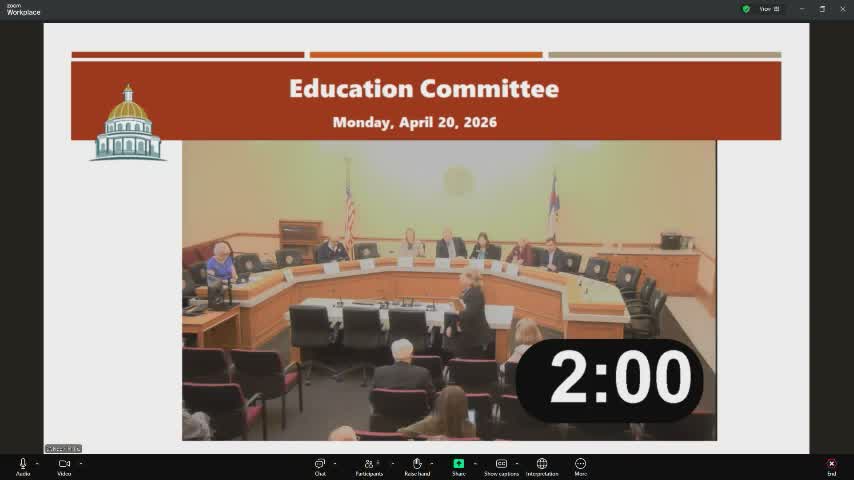
The Senate Education Committee advanced the annual School Finance Act after adopting a package of technical amendments and voted to refer the bill to the Appropriations Committee with a favorable recommendation.
Senator Coker, a bill sponsor, described the measure as "only a 3 page bill" that implements recent changes to Colorado's school funding formula and preserves funding during a difficult budget year. She said the 2024 formula will be phased in (30 percent this year) and explained the bill's averaging approach: three‑year averaging for the new formula and five‑year averaging for the old formula. Citing Legislative Council and Joint Budget Committee work, Coker said statewide total program funding is projected at about $10,200,000,000 for fiscal year 2026–27, with roughly $5,600,000,000 as the state share and $4,600,000,000 as the local share.
"We had a number of stakeholders who have been involved," Coker said, thanking JBC staff and others for helping avoid cuts to K–12 in a difficult budget year. She closed by warning that current modeling shows the state's general fund reserve could be negative by fiscal year 2029–30 without revenue changes, and urged action on long‑term structural funding.
Co‑sponsor Senator Kirk Meyer said the bill "implements current law," credited last year's Kids Matter Fund and prior budget agreements for protecting K–12 funding, and described the measure as a clean bill designed to provide predictability for districts.
A panel of district leaders and education groups testified in support. Matt Cook of the Colorado Association of School Boards said CASB supported early adoption of the act so school boards can finish local budgets on time and asked members for a yes vote. Jonathan Levesque, testifying remotely as a district finance official, called predictability "the biggest thing" for district budgeting and staffing. Scott Smith of Cherry Creek Schools urged the committee to "maintain the 0.5 FTE" funding for legitimate homeschool enrichment programs while preventing misuse.
Melissa Gibson, executive director of the Colorado Association of School Executives (also speaking for the Colorado Education Association), said CASE is working with districts on a proposed smoothing factor to replace the current declining‑enrollment calculation and that a forthcoming amendment will address that change. Janice Sleissner, Douglas County CFO and co‑chair of the Smoothing Factor Working Group, described a planned 50/30/20 weighted average methodology intended to give districts a predictable glide path and avoid midyear budget crises.
Student witness Samira Yusupov said crowded classrooms and unequal program availability make the bill "essential because it ensures that funding finally follows the student," and urged a yes vote to direct more resources to high‑poverty schools.
Committee sponsors moved and the panel approved a series of Department of Education‑requested technical amendments, among them:
- L002: replace the word "reimbursement" with "funding" throughout the statutory section and clarify that a 3 percent offset applies to the Colorado Department of Education rather than districts (adopted).
- L003: technical cleanup to align lists of allowable activities in the School Transformation Grant Program with recent legislation (adopted).
- L004: extend indefinitely a temporary flexibility for small and rural districts facing auditor shortages or emergency cash‑flow needs (originally added during COVID; adopted).
- L005: clarify that assistant principals and assistant superintendents may be included in PERA (Public Employees' Retirement Association); PERA indicated support (adopted).
- L007, L009 and L010: fixes to hold‑harmless language for negative phase‑in amounts, updates to total program figures per the latest LCS forecast, and retention of language enabling the financial transparency website's funding in statute (all adopted).
After closing remarks from sponsors about stakeholder engagement and fiscal risks, Senator Coker moved that the committee refer the School Finance Act to the Appropriations Committee with a favorable recommendation. The committee recorded affirmative responses and the chair announced the bill passes the Senate Education Committee and will proceed to Appropriations. The committee then adjourned.
The committee record shows broad stakeholder support for implementation‑focused changes and several technical cleanups; longer‑term structural revenue questions and the precise smoothing methodology remain to be finalized in follow‑up amendments or in appropriations work.
Next step: the bill will be considered by the Appropriations Committee.
Senator Coker, a bill sponsor, described the measure as "only a 3 page bill" that implements recent changes to Colorado's school funding formula and preserves funding during a difficult budget year. She said the 2024 formula will be phased in (30 percent this year) and explained the bill's averaging approach: three‑year averaging for the new formula and five‑year averaging for the old formula. Citing Legislative Council and Joint Budget Committee work, Coker said statewide total program funding is projected at about $10,200,000,000 for fiscal year 2026–27, with roughly $5,600,000,000 as the state share and $4,600,000,000 as the local share.
"We had a number of stakeholders who have been involved," Coker said, thanking JBC staff and others for helping avoid cuts to K–12 in a difficult budget year. She closed by warning that current modeling shows the state's general fund reserve could be negative by fiscal year 2029–30 without revenue changes, and urged action on long‑term structural funding.
Co‑sponsor Senator Kirk Meyer said the bill "implements current law," credited last year's Kids Matter Fund and prior budget agreements for protecting K–12 funding, and described the measure as a clean bill designed to provide predictability for districts.
A panel of district leaders and education groups testified in support. Matt Cook of the Colorado Association of School Boards said CASB supported early adoption of the act so school boards can finish local budgets on time and asked members for a yes vote. Jonathan Levesque, testifying remotely as a district finance official, called predictability "the biggest thing" for district budgeting and staffing. Scott Smith of Cherry Creek Schools urged the committee to "maintain the 0.5 FTE" funding for legitimate homeschool enrichment programs while preventing misuse.
Melissa Gibson, executive director of the Colorado Association of School Executives (also speaking for the Colorado Education Association), said CASE is working with districts on a proposed smoothing factor to replace the current declining‑enrollment calculation and that a forthcoming amendment will address that change. Janice Sleissner, Douglas County CFO and co‑chair of the Smoothing Factor Working Group, described a planned 50/30/20 weighted average methodology intended to give districts a predictable glide path and avoid midyear budget crises.
Student witness Samira Yusupov said crowded classrooms and unequal program availability make the bill "essential because it ensures that funding finally follows the student," and urged a yes vote to direct more resources to high‑poverty schools.
Committee sponsors moved and the panel approved a series of Department of Education‑requested technical amendments, among them:
- L002: replace the word "reimbursement" with "funding" throughout the statutory section and clarify that a 3 percent offset applies to the Colorado Department of Education rather than districts (adopted).
- L003: technical cleanup to align lists of allowable activities in the School Transformation Grant Program with recent legislation (adopted).
- L004: extend indefinitely a temporary flexibility for small and rural districts facing auditor shortages or emergency cash‑flow needs (originally added during COVID; adopted).
- L005: clarify that assistant principals and assistant superintendents may be included in PERA (Public Employees' Retirement Association); PERA indicated support (adopted).
- L007, L009 and L010: fixes to hold‑harmless language for negative phase‑in amounts, updates to total program figures per the latest LCS forecast, and retention of language enabling the financial transparency website's funding in statute (all adopted).
After closing remarks from sponsors about stakeholder engagement and fiscal risks, Senator Coker moved that the committee refer the School Finance Act to the Appropriations Committee with a favorable recommendation. The committee recorded affirmative responses and the chair announced the bill passes the Senate Education Committee and will proceed to Appropriations. The committee then adjourned.
The committee record shows broad stakeholder support for implementation‑focused changes and several technical cleanups; longer‑term structural revenue questions and the precise smoothing methodology remain to be finalized in follow‑up amendments or in appropriations work.
Next step: the bill will be considered by the Appropriations Committee.
Don't Miss a Word: See the Full Meeting!
Go beyond summaries. Unlock every video, transcript, and key insight with a Founder Membership.
✓
Get instant access to full meeting videos
✓
Search and clip any phrase from complete transcripts
✓
Receive AI-powered summaries & custom alerts
✓
Enjoy lifetime, unrestricted access to government data
30-day money-back guarantee
