Senate committee advances bill to create an invasive species management council
April 17, 2026 | 2026 Legislature Alaska, Alaska
This article was created by AI summarizing key points discussed. AI makes mistakes, so for full details and context, please refer to the video of the full meeting. Please report any errors so we can fix them. Report an error »
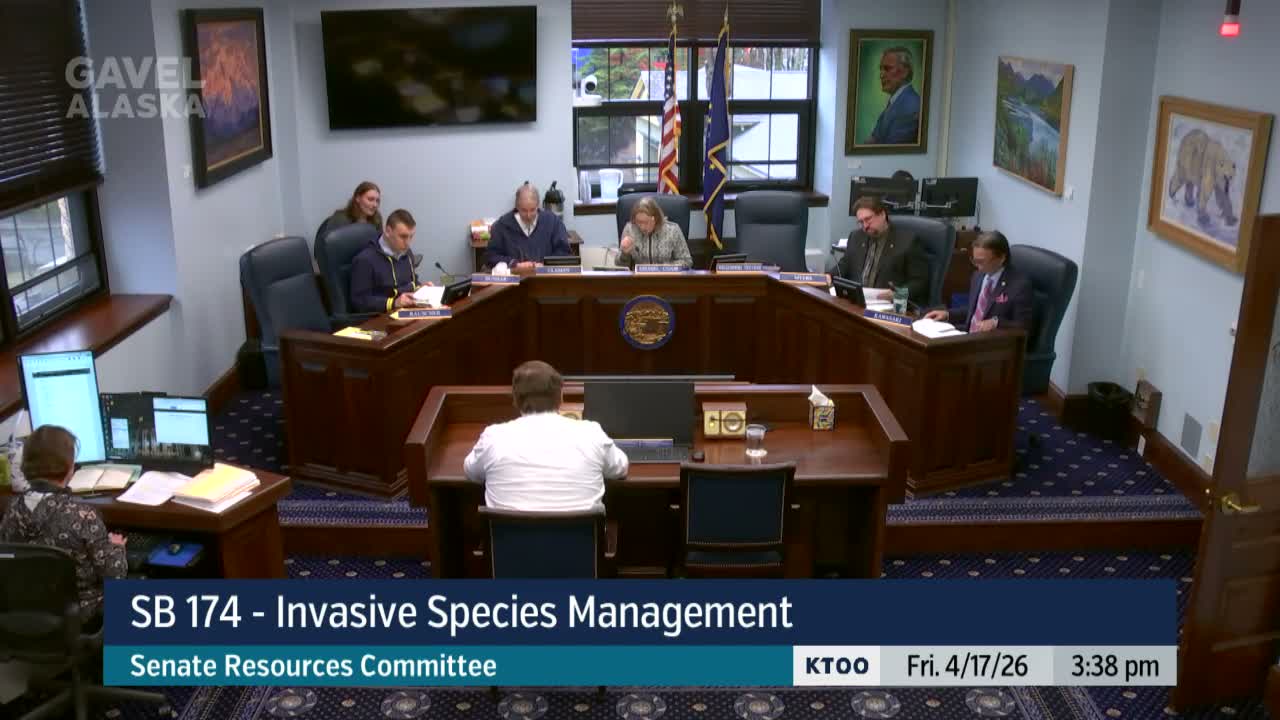
The Senate Resources Committee on April 17 advanced Senate Bill 174, which would create an Invasive Species Management Council to coordinate federal, state and nongovernmental efforts to prevent and control invasive plants and animals in Alaska.
Hunter Lotzfeld, staff to Senator Dunbar, told the committee: "SB 174 creates an invasive species management council, to coordinate both federal, state, and nongovernment organization efforts on controlling invasive species in the state of Alaska, with the recognition that prevention is more cost effective than addressing the problem later in the stage."
Senator Dunbar added that Alaska faces significant challenges from aquatic and terrestrial invasives — she named elodea, northern pike and green crab — and emphasized the need to bring scientific leadership and coordination to prevention and response. She also raised plant examples, noting that the State Department of Transportation historically planted chokecherries for erosion control and that some nonnative cherry varieties planted in Anchorage have become invasive; she said removal can be labor-intensive because roots also must be removed.
The bill carries a fiscal note and will go to finance; presenters said it is not a large fiscal impact but that the bill is not on its final committee referral list. Senator Kawasaki (transcript also shows the motion lines spelled the name as 'Kosaki') moved SB174 from committee with individual recommendations and an attached fiscal note; the chair recorded no objections and the bill "moves from committee." Presenters noted there is a companion bill in the other legislative body.
The committee discussion emphasized coordination across agencies and the scientific community; sponsors framed the council as a structure for shared leadership and more effective prevention efforts rather than a unilateral enforcement mechanism.
Hunter Lotzfeld, staff to Senator Dunbar, told the committee: "SB 174 creates an invasive species management council, to coordinate both federal, state, and nongovernment organization efforts on controlling invasive species in the state of Alaska, with the recognition that prevention is more cost effective than addressing the problem later in the stage."
Senator Dunbar added that Alaska faces significant challenges from aquatic and terrestrial invasives — she named elodea, northern pike and green crab — and emphasized the need to bring scientific leadership and coordination to prevention and response. She also raised plant examples, noting that the State Department of Transportation historically planted chokecherries for erosion control and that some nonnative cherry varieties planted in Anchorage have become invasive; she said removal can be labor-intensive because roots also must be removed.
The bill carries a fiscal note and will go to finance; presenters said it is not a large fiscal impact but that the bill is not on its final committee referral list. Senator Kawasaki (transcript also shows the motion lines spelled the name as 'Kosaki') moved SB174 from committee with individual recommendations and an attached fiscal note; the chair recorded no objections and the bill "moves from committee." Presenters noted there is a companion bill in the other legislative body.
The committee discussion emphasized coordination across agencies and the scientific community; sponsors framed the council as a structure for shared leadership and more effective prevention efforts rather than a unilateral enforcement mechanism.
View the Full Meeting & All Its Details
This article offers just a summary. Unlock complete video, transcripts, and insights as a Founder Member.
✓
Watch full, unedited meeting videos
✓
Search every word spoken in unlimited transcripts
✓
AI summaries & real-time alerts (all government levels)
✓
Permanent access to expanding government content
30-day money-back guarantee
