WSIB sustainability head says physical climate risk now dominant; urges diversified, resilience‑oriented approach
April 16, 2026 | Board Council Commission Agencies , Executive, Washington
This article was created by AI summarizing key points discussed. AI makes mistakes, so for full details and context, please refer to the video of the full meeting. Please report any errors so we can fix them. Report an error »
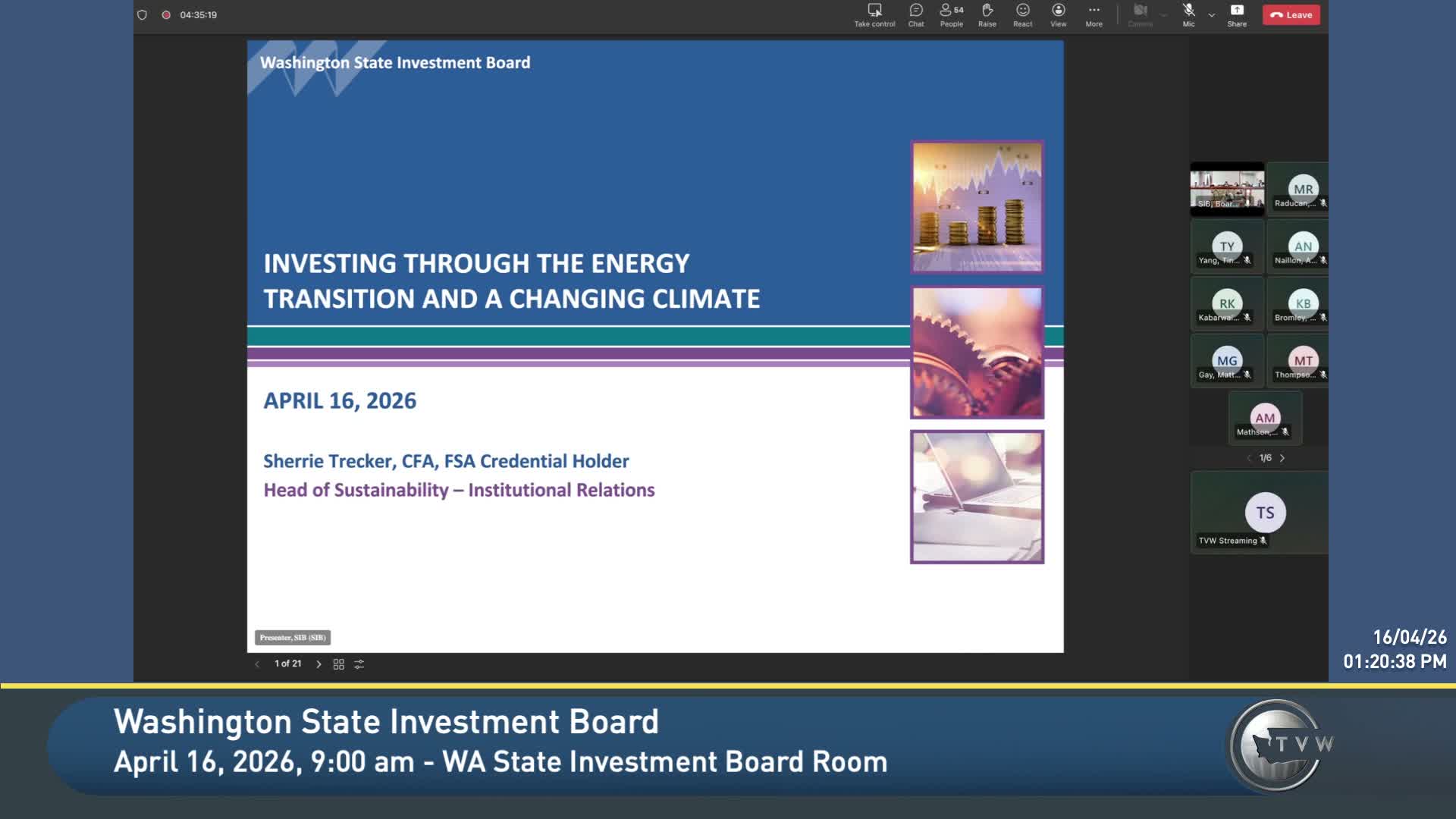
Sherry Trecker, head of sustainability at WSIB, presented staff’s year‑long research on the energy transition and climate risk, arguing that physical impacts of climate change demand increased emphasis in portfolio analysis and management.
"Physical risks from climate change are impacting our investment values now," Trecker said, describing an MSCI–Swiss Re study that found much of the public equity portfolio is exposed to multiple physical hazards, while company disclosure of those hazards remains low. The staff has expanded its climate work beyond emissions reporting to include scenario analysis and asset‑level physical‑risk mapping.
Trecker acknowledged progress in renewable‑energy costs and supportive technologies (EVs, battery storage) but warned that global energy demand continues to rise and fossil fuels remain a material part of the energy mix for decades. She stressed that transitions in developing economies, data‑center growth and critical‑minerals needs complicate any single-pathway assumption.
On asset‑class implications, Trecker said real estate is highly exposed to physical risk and that staff is pursuing building‑level resilience upgrades; fixed income and private credit teams screen for stranded‑asset risk and favor selective fossil‑fuel investments; private equity and co‑investments are being asked to demonstrate climate management practices; tangible‑asset and infrastructure investments will focus on operational resilience and contractual protections.
Staff recommended continuing a strategy of broad diversification, augmenting climate scenario and physical‑risk capabilities, and using active engagement with GPs and public companies to improve disclosure and resilience. The board thanked staff and discussed follow‑up on climate scenario assumptions and disclosure efforts.
"Physical risks from climate change are impacting our investment values now," Trecker said, describing an MSCI–Swiss Re study that found much of the public equity portfolio is exposed to multiple physical hazards, while company disclosure of those hazards remains low. The staff has expanded its climate work beyond emissions reporting to include scenario analysis and asset‑level physical‑risk mapping.
Trecker acknowledged progress in renewable‑energy costs and supportive technologies (EVs, battery storage) but warned that global energy demand continues to rise and fossil fuels remain a material part of the energy mix for decades. She stressed that transitions in developing economies, data‑center growth and critical‑minerals needs complicate any single-pathway assumption.
On asset‑class implications, Trecker said real estate is highly exposed to physical risk and that staff is pursuing building‑level resilience upgrades; fixed income and private credit teams screen for stranded‑asset risk and favor selective fossil‑fuel investments; private equity and co‑investments are being asked to demonstrate climate management practices; tangible‑asset and infrastructure investments will focus on operational resilience and contractual protections.
Staff recommended continuing a strategy of broad diversification, augmenting climate scenario and physical‑risk capabilities, and using active engagement with GPs and public companies to improve disclosure and resilience. The board thanked staff and discussed follow‑up on climate scenario assumptions and disclosure efforts.
Don't Miss a Word: See the Full Meeting!
Go beyond summaries. Unlock every video, transcript, and key insight with a Founder Membership.
✓
Get instant access to full meeting videos
✓
Search and clip any phrase from complete transcripts
✓
Receive AI-powered summaries & custom alerts
✓
Enjoy lifetime, unrestricted access to government data
30-day money-back guarantee
