La Crosse board hears sewer collection update as officials warn of aging pipes and high replacement costs
April 13, 2026 | La Crosse, La Crosse County, Wisconsin
This article was created by AI summarizing key points discussed. AI makes mistakes, so for full details and context, please refer to the video of the full meeting. Please report any errors so we can fix them. Report an error »
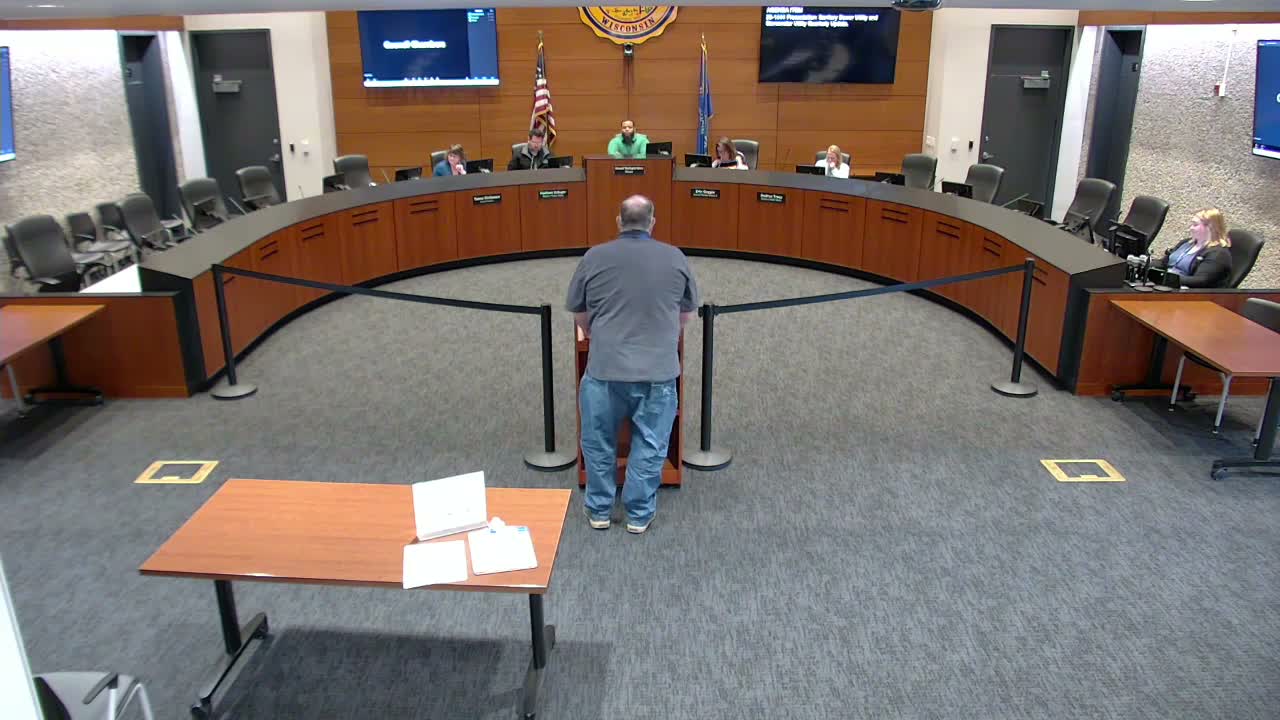
Gerry, the city’s wastewater collection superintendent, told the Board of Public Works on April 13 that the city’s sanitary sewer system requires sustained, costly work to prevent failures and convey sewage safely to the regional wastewater treatment plant.
“We have a 20 MGD wastewater plant that has the ability to treat 20,000,000 gallons a day. We treat 10,000,000 gallons a day,” Gerry said, summarizing the system’s scale and the role of collection infrastructure. He said the collection system includes roughly 205 miles of sanitary sewer pipe and 27 lift stations the city maintains.
Gerry described a mix of approaches to maintaining that infrastructure: televising pipes to inspect conditions, root removal and cleaning, cured‑in‑place lining where appropriate, and full replacement when necessary. He said some pipes have not been touched since the 1940s–1960s and that projects often require bypass pumping and noisy equipment in public places such as Riverside Park.
Examples given to illustrate costs included a lining project from Cass Street to Division Street that was a $2–3 million effort and additional lining work that may require another $1 million. Gerry said lift station upgrades — citing Hager and Pammel stations scheduled this year — can run about $3 million for a multi‑pump station rehabilitation, and that multiplying similar upgrades across the system would create major capital needs.
Board members pressed on what it would take to replace underground pipe en masse. Gerry said full system replacement would be “a tremendous amount of money” and reiterated that the utility budgets for periodic lining projects and condition assessments instead of wholesale replacement.
Gerry also outlined operating practices and inspections: the utility televised 16.5 miles of pipeline in 2025 and 12.5 miles in 2024; it cleans roughly one‑third of the system each year with jetter equipment; and it inspects hundreds to thousands of manholes annually. He highlighted the use of specialized eddy‑current inspections to detect outside‑in corrosion that conventional televising can miss.
On emergency response and regulatory obligations, Gerry described the sanitary sewer overflow (SSO) process: immediate notification to the Wisconsin DNR spill hotline, contact with the DNR basin engineer for La Crosse’s wastewater plant, media notification and a follow‑up report explaining fixes and steps to prevent recurrence. He said the DNR in recent years has emphasized force‑mains and siphons because those parts of the system are often out of sight and can fail without obvious internal signs.
The board did not take formal action on the presentation but encouraged staff to return with needs if emergent funding or additional projects are required. Gerry closed by saying the utility’s proactive program helps minimize emergencies even while it causes temporary disruption during rehabilitation work.
“We have a 20 MGD wastewater plant that has the ability to treat 20,000,000 gallons a day. We treat 10,000,000 gallons a day,” Gerry said, summarizing the system’s scale and the role of collection infrastructure. He said the collection system includes roughly 205 miles of sanitary sewer pipe and 27 lift stations the city maintains.
Gerry described a mix of approaches to maintaining that infrastructure: televising pipes to inspect conditions, root removal and cleaning, cured‑in‑place lining where appropriate, and full replacement when necessary. He said some pipes have not been touched since the 1940s–1960s and that projects often require bypass pumping and noisy equipment in public places such as Riverside Park.
Examples given to illustrate costs included a lining project from Cass Street to Division Street that was a $2–3 million effort and additional lining work that may require another $1 million. Gerry said lift station upgrades — citing Hager and Pammel stations scheduled this year — can run about $3 million for a multi‑pump station rehabilitation, and that multiplying similar upgrades across the system would create major capital needs.
Board members pressed on what it would take to replace underground pipe en masse. Gerry said full system replacement would be “a tremendous amount of money” and reiterated that the utility budgets for periodic lining projects and condition assessments instead of wholesale replacement.
Gerry also outlined operating practices and inspections: the utility televised 16.5 miles of pipeline in 2025 and 12.5 miles in 2024; it cleans roughly one‑third of the system each year with jetter equipment; and it inspects hundreds to thousands of manholes annually. He highlighted the use of specialized eddy‑current inspections to detect outside‑in corrosion that conventional televising can miss.
On emergency response and regulatory obligations, Gerry described the sanitary sewer overflow (SSO) process: immediate notification to the Wisconsin DNR spill hotline, contact with the DNR basin engineer for La Crosse’s wastewater plant, media notification and a follow‑up report explaining fixes and steps to prevent recurrence. He said the DNR in recent years has emphasized force‑mains and siphons because those parts of the system are often out of sight and can fail without obvious internal signs.
The board did not take formal action on the presentation but encouraged staff to return with needs if emergent funding or additional projects are required. Gerry closed by saying the utility’s proactive program helps minimize emergencies even while it causes temporary disruption during rehabilitation work.
Don't Miss a Word: See the Full Meeting!
Go beyond summaries. Unlock every video, transcript, and key insight with a Founder Membership.
✓
Get instant access to full meeting videos
✓
Search and clip any phrase from complete transcripts
✓
Receive AI-powered summaries & custom alerts
✓
Enjoy lifetime, unrestricted access to government data
30-day money-back guarantee
