Housing official asks for expanded nuisance-abatement budget, cites 270 vacant properties
January 25, 2025 | Keokuk City, Lee County, Iowa
This article was created by AI summarizing key points discussed. AI makes mistakes, so for full details and context, please refer to the video of the full meeting. Please report any errors so we can fix them. Report an error »
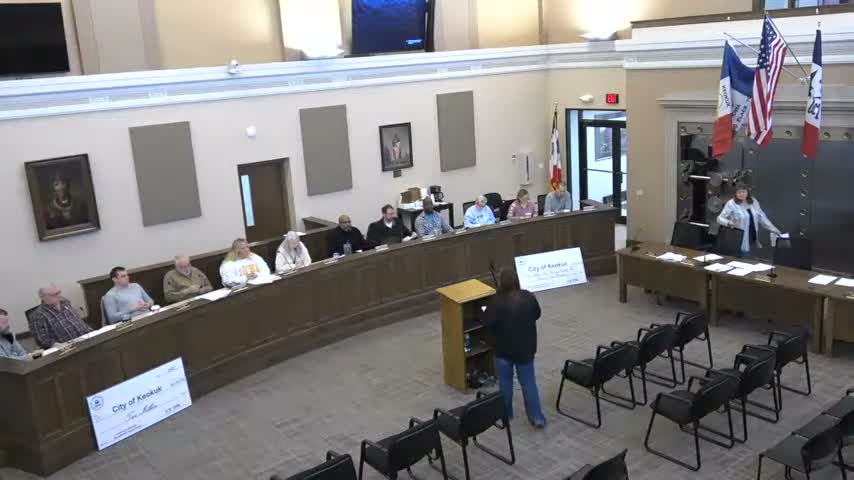
At the Jan. 25 workshop, Casey presented the housing and nuisance-abatement budget and asked the council to increase funding to accelerate demolitions and targeted rehabs in neighborhoods with concentrated vacancy and blight.
Casey said she consolidated prior line items and requested $270,000 for the program, plus roughly $58,000 more to support additional demolitions or rehabilitation work (she described $50,000 of that request as targeted for a small number of roofs or rehab projects and $8,000 for broader nuisance abatement tasks such as cleanups and mowings). "I'm asking for an additional 50,000," Casey said, explaining that those dollars could cover two to three substantial roof repairs that would make properties marketable again.
She provided program metrics to justify the request: about 170 distinct parcels required city mowing last year (amounting to roughly 780 mows), approximately 55 cleanups during the year, and an estimated 270 vacant properties citywide. Casey said the city recovered about $25,000 through lien collection and about $13,000 through court-recovered fines over the prior year.
Council members asked for clarifications of combined line items, how demolitions and rehabilitations are prioritized, and whether incentives or registration changes could improve outcomes. Casey said vacant-property registrations, MLS listings and coordination with local agents were part of the strategy to return homes to productive use.
Next steps include staff follow-up on specific program priorities, a refined budget spreadsheet, and potential council discussion about targeting additional funds for demo vs. rehab.
Casey said she consolidated prior line items and requested $270,000 for the program, plus roughly $58,000 more to support additional demolitions or rehabilitation work (she described $50,000 of that request as targeted for a small number of roofs or rehab projects and $8,000 for broader nuisance abatement tasks such as cleanups and mowings). "I'm asking for an additional 50,000," Casey said, explaining that those dollars could cover two to three substantial roof repairs that would make properties marketable again.
She provided program metrics to justify the request: about 170 distinct parcels required city mowing last year (amounting to roughly 780 mows), approximately 55 cleanups during the year, and an estimated 270 vacant properties citywide. Casey said the city recovered about $25,000 through lien collection and about $13,000 through court-recovered fines over the prior year.
Council members asked for clarifications of combined line items, how demolitions and rehabilitations are prioritized, and whether incentives or registration changes could improve outcomes. Casey said vacant-property registrations, MLS listings and coordination with local agents were part of the strategy to return homes to productive use.
Next steps include staff follow-up on specific program priorities, a refined budget spreadsheet, and potential council discussion about targeting additional funds for demo vs. rehab.
Don't Miss a Word: See the Full Meeting!
Go beyond summaries. Unlock every video, transcript, and key insight with a Founder Membership.
✓
Get instant access to full meeting videos
✓
Search and clip any phrase from complete transcripts
✓
Receive AI-powered summaries & custom alerts
✓
Enjoy lifetime, unrestricted access to government data
30-day money-back guarantee
