Pew: Most states aren’t on track to keep roads and bridges in a ‘state of good repair’; Vermont faces growing shortfall
April 16, 2026 | Transportation, HOUSE OF REPRESENTATIVES, Committees, Legislative , Vermont
This article was created by AI summarizing key points discussed. AI makes mistakes, so for full details and context, please refer to the video of the full meeting. Please report any errors so we can fix them. Report an error »
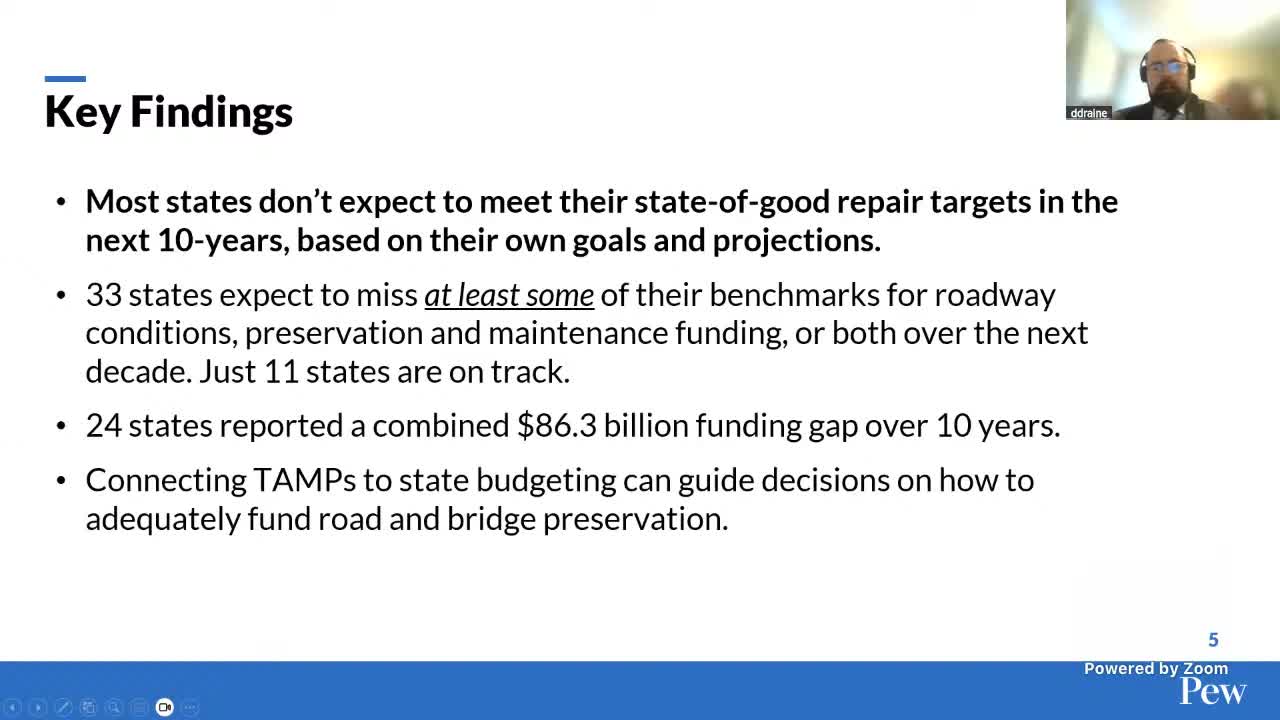
The House Transportation Committee heard a briefing April 15 from the Pew Charitable Trusts outlining national shortfalls in road and bridge maintenance and how states are planning for them. “Most states don't expect to meet their state of good repair targets in the next 10 years,” David Drain, a Pew researcher, told the committee.
Pew analyzed 10-year projections in states’ Transportation Asset Management Plans (TAMPs), federal reports that outline how departments of transportation assess and manage infrastructure. Drain said Pew identified two kinds of shortfalls: a condition gap (when a state's projected conditions fall below its own state‑of‑good‑repair target) and a funding gap (when projected funding falls short of the dollars states say they will need).
The research found 24 states reported quantified funding shortfalls that together add up to about $86,300,000,000 over the coming decade. Drain framed that figure in context: the same states projected roughly $194,000,000,000 in spending on roads and bridges over the 10‑year window, meaning closing the reported shortfalls would require roughly a 44% increase in transportation funding across that group.
At the committee’s request, Pew walked through Vermont’s TAMP materials. Drain said Vermont’s 2022 TAMP showed total projected bridge and pavement needs outpacing expected revenues and that, under baseline projections, Vermont could face an annual shortfall of about $75,000,000 by 2032. Pew emphasized that figure comes from the 2022 TAMP and that TAMPs are produced on a four‑year cycle; updated forecasts may change the projection.
Committee members asked about drivers of the shortfalls. Drain and Fatima Yuzovie, who co‑presented, pointed to higher construction costs and the erosion of fuel‑tax revenue as key pressures. Drain noted one state example where treatment costs rose sharply between plans and later filings, saying the Arizona 2025 materials included much higher cost assumptions than their 2021 plan.
Yuzovie told members that states vary in what they include in TAMPs and in how frequently they report condition data; some states supplement federal TAMPs with annual 'state of good repair' reports that cover additional asset classes and local needs. She also said the federal TAMP focus on National Highway System assets means some local road needs are captured unevenly across states.
The presenters cautioned members that the $86.3 billion figure understates total transportation shortfalls because many locally managed assets and non‑NHS needs are outside TAMP coverage. “This $86.3 billion figure is gonna be an undercount of the total shortfalls that we're seeing for transportation,” Drain said.
The presentation closed with Pew offering to share state examples and promising practices for asset management, budgeting and modeling under different revenue scenarios. Chair Walker thanked the presenters and adjourned the committee.
Next steps: committee members requested Pew’s source materials and promising‑practice recommendations for use in Vermont’s budgeting and resilience planning.
Pew analyzed 10-year projections in states’ Transportation Asset Management Plans (TAMPs), federal reports that outline how departments of transportation assess and manage infrastructure. Drain said Pew identified two kinds of shortfalls: a condition gap (when a state's projected conditions fall below its own state‑of‑good‑repair target) and a funding gap (when projected funding falls short of the dollars states say they will need).
The research found 24 states reported quantified funding shortfalls that together add up to about $86,300,000,000 over the coming decade. Drain framed that figure in context: the same states projected roughly $194,000,000,000 in spending on roads and bridges over the 10‑year window, meaning closing the reported shortfalls would require roughly a 44% increase in transportation funding across that group.
At the committee’s request, Pew walked through Vermont’s TAMP materials. Drain said Vermont’s 2022 TAMP showed total projected bridge and pavement needs outpacing expected revenues and that, under baseline projections, Vermont could face an annual shortfall of about $75,000,000 by 2032. Pew emphasized that figure comes from the 2022 TAMP and that TAMPs are produced on a four‑year cycle; updated forecasts may change the projection.
Committee members asked about drivers of the shortfalls. Drain and Fatima Yuzovie, who co‑presented, pointed to higher construction costs and the erosion of fuel‑tax revenue as key pressures. Drain noted one state example where treatment costs rose sharply between plans and later filings, saying the Arizona 2025 materials included much higher cost assumptions than their 2021 plan.
Yuzovie told members that states vary in what they include in TAMPs and in how frequently they report condition data; some states supplement federal TAMPs with annual 'state of good repair' reports that cover additional asset classes and local needs. She also said the federal TAMP focus on National Highway System assets means some local road needs are captured unevenly across states.
The presenters cautioned members that the $86.3 billion figure understates total transportation shortfalls because many locally managed assets and non‑NHS needs are outside TAMP coverage. “This $86.3 billion figure is gonna be an undercount of the total shortfalls that we're seeing for transportation,” Drain said.
The presentation closed with Pew offering to share state examples and promising practices for asset management, budgeting and modeling under different revenue scenarios. Chair Walker thanked the presenters and adjourned the committee.
Next steps: committee members requested Pew’s source materials and promising‑practice recommendations for use in Vermont’s budgeting and resilience planning.
View the Full Meeting & All Its Details
This article offers just a summary. Unlock complete video, transcripts, and insights as a Founder Member.
✓
Watch full, unedited meeting videos
✓
Search every word spoken in unlimited transcripts
✓
AI summaries & real-time alerts (all government levels)
✓
Permanent access to expanding government content
30-day money-back guarantee
