States experiment with mileage fees, EV charges and bond programs as gas‑tax revenue erodes
April 16, 2026 | Transportation, HOUSE OF REPRESENTATIVES, Committees, Legislative , Vermont
This article was created by AI summarizing key points discussed. AI makes mistakes, so for full details and context, please refer to the video of the full meeting. Please report any errors so we can fix them. Report an error »
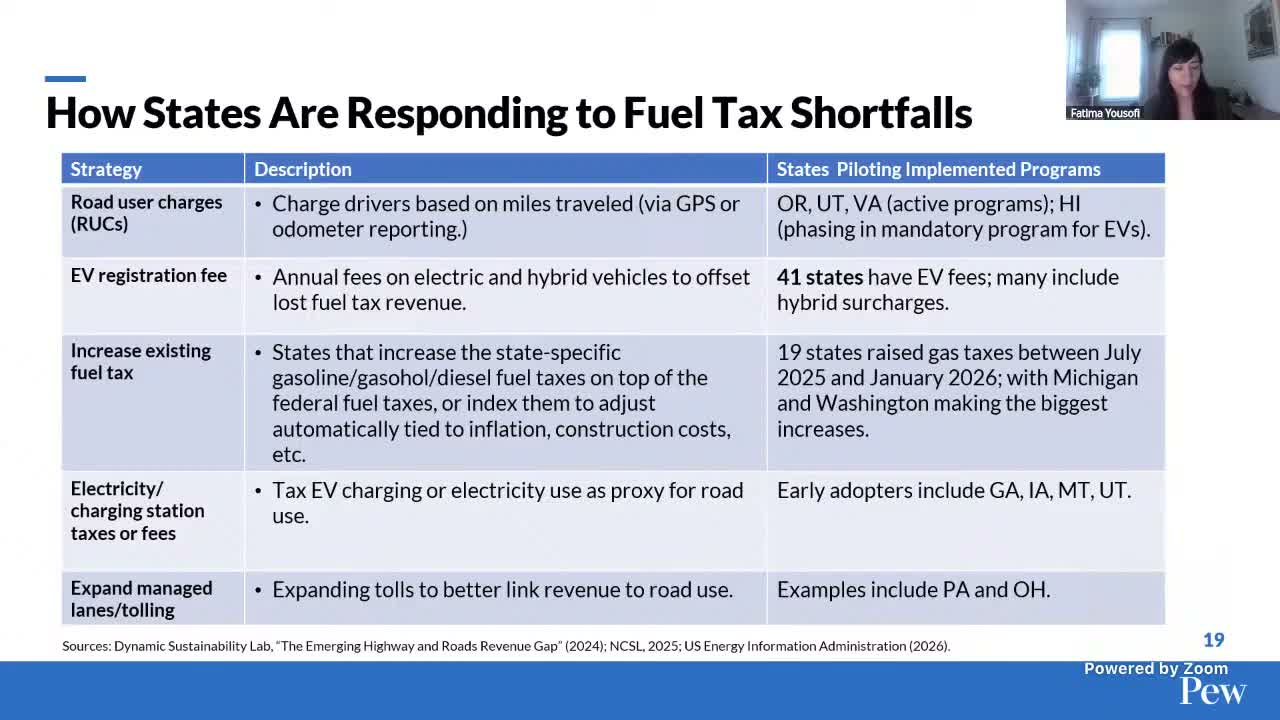
Committee members pressed Pew researchers on how states are responding to the structural erosion of fuel‑tax revenues and rising construction costs. “State fuel taxes have really started to decline notably,” Fatima Yuzovie said, and Pew described a range of policy experiments states are piloting or have adopted.
Common approaches include mileage‑based user fees (pilots in several states), EV registration and charging fees designed to mimic gas taxes, expanded tolling or managed lanes where politically and legally feasible, and the use of bonds or state infrastructure banks to frontload repairs and bridge timing gaps for disaster reimbursements.
Yuzovie told the committee that roughly 41 states now use some form of EV registration fee; several states are testing electricity‑based charging fees that try to recapture the user‑fee logic of the gas tax, though utilities and charging‑station operators have sometimes resisted on technical and billing grounds. “It was a challenge,” she said of early EV charging fee efforts, citing Montana as an example where administration met resistance.
Members also asked about ways to pay for resilience after storms. Pew highlighted examples: Vermont’s Bond Bank offered low‑cost bridge loans for storm repairs in 2021–2022 to help localities while they awaited FEMA reimbursements; Hawaii enacted a visitor‑focused hotel fee to fund coastal resiliency; other states create tax‑increment or resiliency financing districts.
Presenters cautioned that no single alternative yet replaces the dedicated revenue that gas taxes historically provided and urged better modeling and integration of TAMP data into budget decisions so policymakers can see the revenue‑condition tradeoffs.
Committee members requested Pew’s compiled list of promising practices and technical details on EV fee and mileage‑charge pilots to inform potential state policy options.
What happened next: Pew offered to share its state examples and implementation details; the committee will review those materials as it considers policy options to sustain maintenance and resilience investments.
Common approaches include mileage‑based user fees (pilots in several states), EV registration and charging fees designed to mimic gas taxes, expanded tolling or managed lanes where politically and legally feasible, and the use of bonds or state infrastructure banks to frontload repairs and bridge timing gaps for disaster reimbursements.
Yuzovie told the committee that roughly 41 states now use some form of EV registration fee; several states are testing electricity‑based charging fees that try to recapture the user‑fee logic of the gas tax, though utilities and charging‑station operators have sometimes resisted on technical and billing grounds. “It was a challenge,” she said of early EV charging fee efforts, citing Montana as an example where administration met resistance.
Members also asked about ways to pay for resilience after storms. Pew highlighted examples: Vermont’s Bond Bank offered low‑cost bridge loans for storm repairs in 2021–2022 to help localities while they awaited FEMA reimbursements; Hawaii enacted a visitor‑focused hotel fee to fund coastal resiliency; other states create tax‑increment or resiliency financing districts.
Presenters cautioned that no single alternative yet replaces the dedicated revenue that gas taxes historically provided and urged better modeling and integration of TAMP data into budget decisions so policymakers can see the revenue‑condition tradeoffs.
Committee members requested Pew’s compiled list of promising practices and technical details on EV fee and mileage‑charge pilots to inform potential state policy options.
What happened next: Pew offered to share its state examples and implementation details; the committee will review those materials as it considers policy options to sustain maintenance and resilience investments.
View the Full Meeting & All Its Details
This article offers just a summary. Unlock complete video, transcripts, and insights as a Founder Member.
✓
Watch full, unedited meeting videos
✓
Search every word spoken in unlimited transcripts
✓
AI summaries & real-time alerts (all government levels)
✓
Permanent access to expanding government content
30-day money-back guarantee
