Chair approves agenda and moves meeting into executive session under ORS 192.660(2)(h)
April 18, 2026 | Curry County, Oregon
This article was created by AI summarizing key points discussed. AI makes mistakes, so for full details and context, please refer to the video of the full meeting. Please report any errors so we can fix them. Report an error »
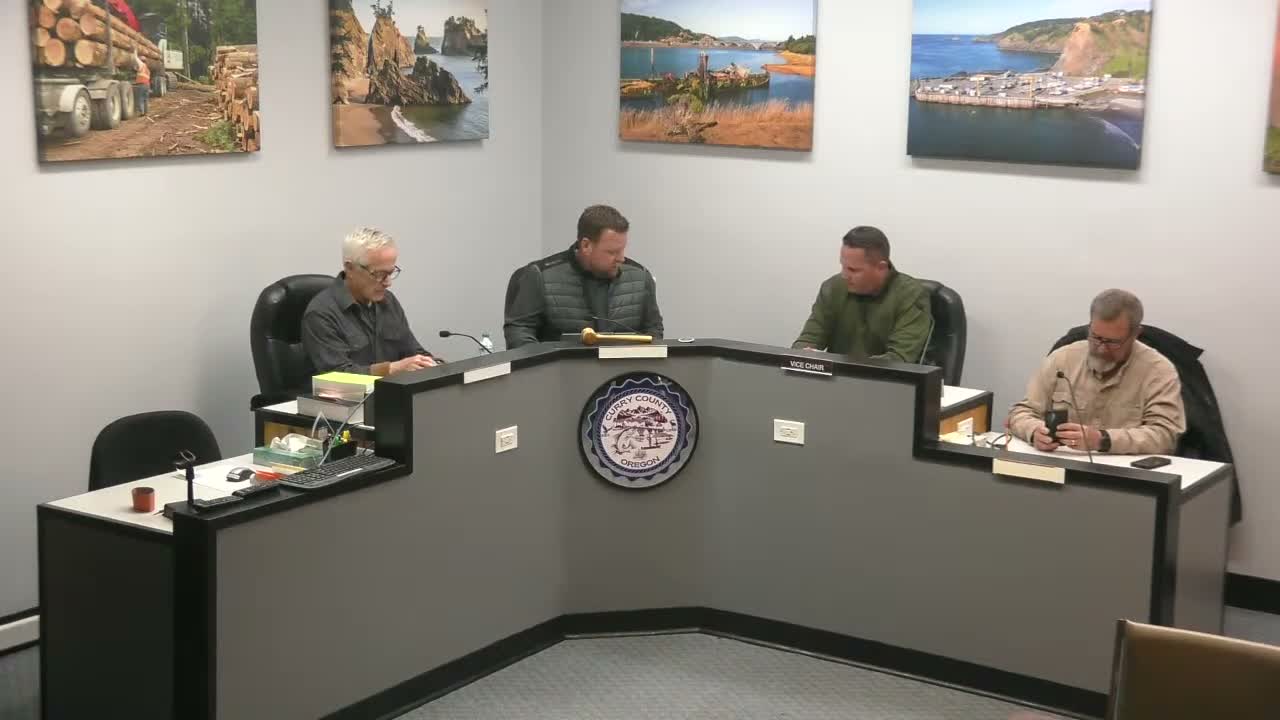
The chair called a special meeting to order on April 17 at 10:00 a.m. and moved to approve the agenda; the motion passed by voice vote and the body then entered an executive session under Oregon statute ORS 192.660(2)(h) to consult with counsel on litigation. The transcript records no substantive open-session business after the executive session and the meeting was adjourned after returning to open session.
The chair opened the agenda item, saying there were no amendments and stating, "Then I'll I'll make a motion to approve the agenda." A second was recorded (no name given). The transcript shows the chair calling for the vote and the affirmative responses: the chair asked for Commissioner Coker (followed by "Aye"), asked for Commissioner Hollinger (followed by "Yes"), and the chair said, "And I as well," indicating three affirmative responses were recorded in the transcript. The mover is recorded as the chair; the transcript does not identify who seconded the motion.
The chair announced that the meeting would convene in executive session "pursuant to ORS 192.660(2)(h), which allows the board to meet in executive session to consult with counsel regarding the legal rights and duties of a public body with regard to current litigation or litigation likely to be filed." The chair also instructed that "Representatives of the news media and designated staff shall be allowed to attend the executive [session]" but were "specifically directed to not report nor otherwise disclose any of the deliberations." The chair reminded attendees that "No decision may be made in executive session." These statements were made on the public record prior to entering closed session.
A brief exchange in the transcript records the name "Mike Hamilton" when the chair asked, "Who is Mike?" The transcript does not specify Hamilton's role or affiliation. The transcript also contains an internal inconsistency on timing: it begins with "It's April 17, 10AM" but records the adjournment time as "11:06 on Friday, February 7." The article reflects those two timestamps exactly as they appear in the transcript and notes the discrepancy.
No motions or substantive actions taken in open session beyond approving the agenda are recorded in the transcript. The executive session was convened for confidential consultation with counsel; by statute and as stated in the transcript, deliberations from that session are not disclosed and no decisions were recorded during the closed portion of the meeting.
The transcript does not identify the governing body by name and does not assign distinct speaker labels for each person who spoke; where the transcript provides explicit names (for example, "Commissioner Coker," "Commissioner Hollinger," and "Mike Hamilton") those names are used. The record does not show any additional votes, agenda items, or public comments in open session.
The chair opened the agenda item, saying there were no amendments and stating, "Then I'll I'll make a motion to approve the agenda." A second was recorded (no name given). The transcript shows the chair calling for the vote and the affirmative responses: the chair asked for Commissioner Coker (followed by "Aye"), asked for Commissioner Hollinger (followed by "Yes"), and the chair said, "And I as well," indicating three affirmative responses were recorded in the transcript. The mover is recorded as the chair; the transcript does not identify who seconded the motion.
The chair announced that the meeting would convene in executive session "pursuant to ORS 192.660(2)(h), which allows the board to meet in executive session to consult with counsel regarding the legal rights and duties of a public body with regard to current litigation or litigation likely to be filed." The chair also instructed that "Representatives of the news media and designated staff shall be allowed to attend the executive [session]" but were "specifically directed to not report nor otherwise disclose any of the deliberations." The chair reminded attendees that "No decision may be made in executive session." These statements were made on the public record prior to entering closed session.
A brief exchange in the transcript records the name "Mike Hamilton" when the chair asked, "Who is Mike?" The transcript does not specify Hamilton's role or affiliation. The transcript also contains an internal inconsistency on timing: it begins with "It's April 17, 10AM" but records the adjournment time as "11:06 on Friday, February 7." The article reflects those two timestamps exactly as they appear in the transcript and notes the discrepancy.
No motions or substantive actions taken in open session beyond approving the agenda are recorded in the transcript. The executive session was convened for confidential consultation with counsel; by statute and as stated in the transcript, deliberations from that session are not disclosed and no decisions were recorded during the closed portion of the meeting.
The transcript does not identify the governing body by name and does not assign distinct speaker labels for each person who spoke; where the transcript provides explicit names (for example, "Commissioner Coker," "Commissioner Hollinger," and "Mike Hamilton") those names are used. The record does not show any additional votes, agenda items, or public comments in open session.
Don't Miss a Word: See the Full Meeting!
Go beyond summaries. Unlock every video, transcript, and key insight with a Founder Membership.
✓
Get instant access to full meeting videos
✓
Search and clip any phrase from complete transcripts
✓
Receive AI-powered summaries & custom alerts
✓
Enjoy lifetime, unrestricted access to government data
30-day money-back guarantee
