Kane County recycling falls short of 52% diversion goal; staff outline steps and data
April 18, 2026 | Kane County, Illinois
This article was created by AI summarizing key points discussed. AI makes mistakes, so for full details and context, please refer to the video of the full meeting. Please report any errors so we can fix them. Report an error »
County staff presented detailed 2025 waste and recycling data and warned the county remains far from its long‑standing diversion target.
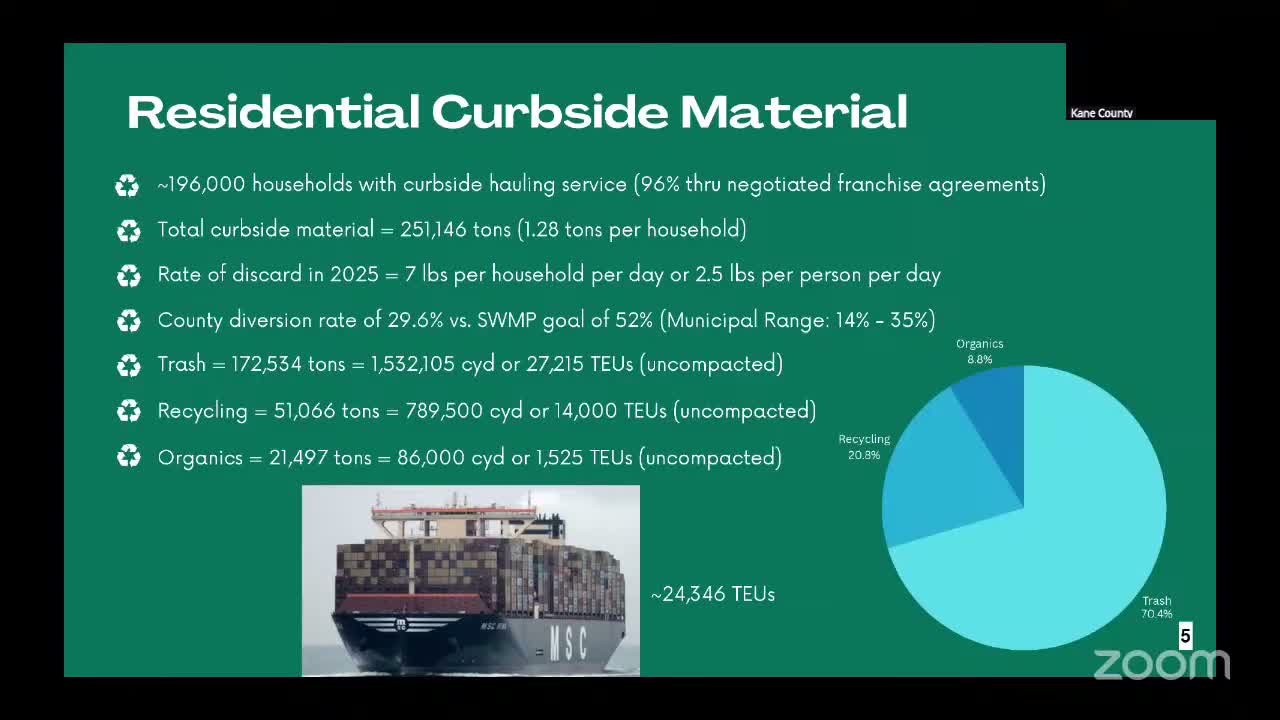
Claire, the county’s recycling presenter, told the Energy & Environment Committee that staff collected data on roughly 196,000 households with curbside service and that curbside trucks reported just over a quarter‑million tons of material last year — about 1.28 tons per household. Claire said that, when expressed per household, the figure equates to roughly 7 pounds per household per day.
The county’s stated diversion goal in its solid‑waste plan is 52%, a benchmark adopted in 2005; Claire reported a 2025 diversion rate of about 29.6%. “So we’re at 30 versus 52,” she said, noting the county has made little progress toward the long‑standing goal and that staff are considering more aggressive measures such as composting initiatives.
Staff broke down material composition: trash accounted for just over 70% of curbside material, recycling just under 21%, and organics close to 9% (residential organics largely landscape waste). On the commercial side, staff said haulers reported 6,943 commercial accounts; 47.2% of those accounts reported having a recycling dumpster. Claire noted the county has an ordinance requiring businesses that generate recycling to maintain recycling service but has not resourced proactive enforcement.
Two county eWORKS recycling centers (Fabian Parkway and West Dundee) together collected 413 tons in 2025, up from just over 300 tons in 2024, driven by higher visits (an estimated 15,000 visits countywide and as many as 80–100 visits per day at Fabian on busy days). Events and pop‑ups accounted for about 91 tons collected in 2025.
Committee members asked about best practices from other cities; Claire said jurisdictions that collect food waste curbside (for example, Minneapolis and New York City) tend to see substantially higher diversion. She cautioned, however, that cross‑jurisdictional comparisons must account for differing counting methods.
The presentation concluded with outreach metrics: about 15,000 program postcards distributed, roughly 10,000 uses of the Recycle Coach web tool and 3,500 app users, and an embedded set of county webpages that together received about 124,000 visits.
Claire, the county’s recycling presenter, told the Energy & Environment Committee that staff collected data on roughly 196,000 households with curbside service and that curbside trucks reported just over a quarter‑million tons of material last year — about 1.28 tons per household. Claire said that, when expressed per household, the figure equates to roughly 7 pounds per household per day.
The county’s stated diversion goal in its solid‑waste plan is 52%, a benchmark adopted in 2005; Claire reported a 2025 diversion rate of about 29.6%. “So we’re at 30 versus 52,” she said, noting the county has made little progress toward the long‑standing goal and that staff are considering more aggressive measures such as composting initiatives.
Staff broke down material composition: trash accounted for just over 70% of curbside material, recycling just under 21%, and organics close to 9% (residential organics largely landscape waste). On the commercial side, staff said haulers reported 6,943 commercial accounts; 47.2% of those accounts reported having a recycling dumpster. Claire noted the county has an ordinance requiring businesses that generate recycling to maintain recycling service but has not resourced proactive enforcement.
Two county eWORKS recycling centers (Fabian Parkway and West Dundee) together collected 413 tons in 2025, up from just over 300 tons in 2024, driven by higher visits (an estimated 15,000 visits countywide and as many as 80–100 visits per day at Fabian on busy days). Events and pop‑ups accounted for about 91 tons collected in 2025.
Committee members asked about best practices from other cities; Claire said jurisdictions that collect food waste curbside (for example, Minneapolis and New York City) tend to see substantially higher diversion. She cautioned, however, that cross‑jurisdictional comparisons must account for differing counting methods.
The presentation concluded with outreach metrics: about 15,000 program postcards distributed, roughly 10,000 uses of the Recycle Coach web tool and 3,500 app users, and an embedded set of county webpages that together received about 124,000 visits.
Don't Miss a Word: See the Full Meeting!
Go beyond summaries. Unlock every video, transcript, and key insight with a Founder Membership.
✓
Get instant access to full meeting videos
✓
Search and clip any phrase from complete transcripts
✓
Receive AI-powered summaries & custom alerts
✓
Enjoy lifetime, unrestricted access to government data
30-day money-back guarantee
