Researchers urge courts to build communications capacity to counter disinformation and threats
April 17, 2026 | Other Court, Judicial , Washington
This article was created by AI summarizing key points discussed. AI makes mistakes, so for full details and context, please refer to the video of the full meeting. Please report any errors so we can fix them. Report an error »
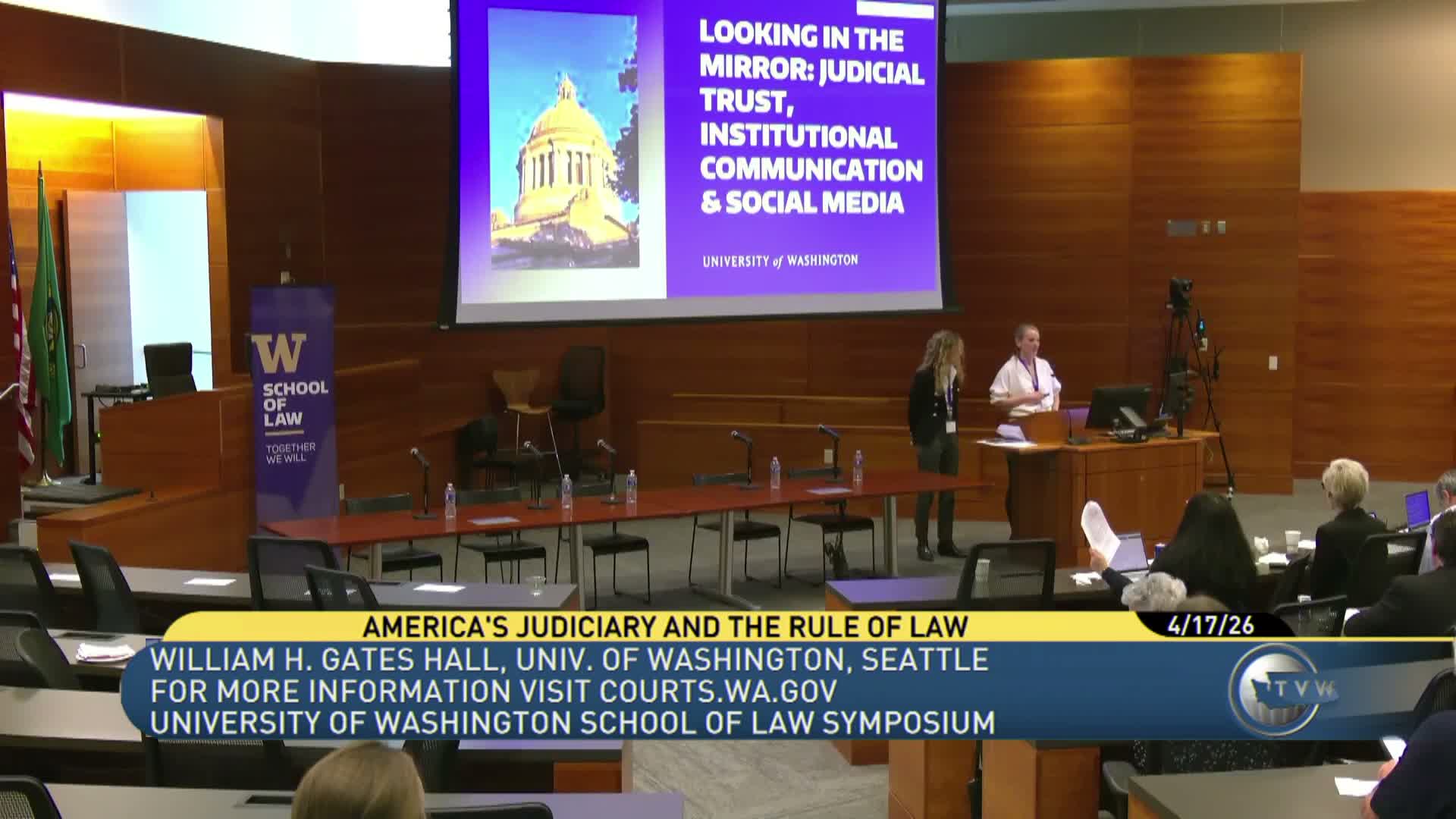
Allie Duran, a policy fellow at the Center for an Informed Public, told a University of Washington symposium that her team's research with the Washington State Bar Association has found three recurring problems: a cultural hesitancy among judges and lawyers to speak publicly, a lack of institutional communications capacity in courts, and no widely accepted narrative to explain the rule of law to the public.
"We must figure out how to communicate the rule of law and its value to our society," Duran said. Danielle Thompson, the Center's research manager, said the team combined ethnographic interviews with social-listening analysis and found judges and their staffs often default to silence for ethical and professional reasons.
The panel described concrete reform models from abroad: Taiwan, which set up a judicial spokesperson's office and a dialogue group that produced shareable case summaries and a social-media presence, and Canada, which has centralized spokesperson functions and posts accessible briefs for the public. Duran said those practices helped boost public trust in those systems and could be adapted for U.S. courts.
Speakers urged courts and funders to invest in communication staff, training and monitoring tools rather than expecting individual judges to become social-media influencers. "This isn't just judges talking," Thompson said; the work, she said, requires "financial, artistic, legislative" resources and networks of trusted spokespeople beyond the bench.
Researchers also raised data and methodological questions. Amrit Singh of NYU's Rule of Law Lab, participating on the panel, described an ongoing study that seeks to document threats to federal judges and called for clearer public definitions of what agencies count as a 'threat.'
The Center said its work is ongoing; it plans additional social-listening analysis and to publish materials and slide decks for public use. Panelists encouraged law schools and bar associations to expand media-training and to develop consistent, authentic narratives that acknowledge historic grievances while explaining the courts' role in protecting rights and civic order.
The panel closed by urging practical next steps: create or restore public-information officers where feasible, build small communication units that can publish short, accessible explanations of rulings, and partner with community messengers to reach diverse audiences.
"We must figure out how to communicate the rule of law and its value to our society," Duran said. Danielle Thompson, the Center's research manager, said the team combined ethnographic interviews with social-listening analysis and found judges and their staffs often default to silence for ethical and professional reasons.
The panel described concrete reform models from abroad: Taiwan, which set up a judicial spokesperson's office and a dialogue group that produced shareable case summaries and a social-media presence, and Canada, which has centralized spokesperson functions and posts accessible briefs for the public. Duran said those practices helped boost public trust in those systems and could be adapted for U.S. courts.
Speakers urged courts and funders to invest in communication staff, training and monitoring tools rather than expecting individual judges to become social-media influencers. "This isn't just judges talking," Thompson said; the work, she said, requires "financial, artistic, legislative" resources and networks of trusted spokespeople beyond the bench.
Researchers also raised data and methodological questions. Amrit Singh of NYU's Rule of Law Lab, participating on the panel, described an ongoing study that seeks to document threats to federal judges and called for clearer public definitions of what agencies count as a 'threat.'
The Center said its work is ongoing; it plans additional social-listening analysis and to publish materials and slide decks for public use. Panelists encouraged law schools and bar associations to expand media-training and to develop consistent, authentic narratives that acknowledge historic grievances while explaining the courts' role in protecting rights and civic order.
The panel closed by urging practical next steps: create or restore public-information officers where feasible, build small communication units that can publish short, accessible explanations of rulings, and partner with community messengers to reach diverse audiences.
View the Full Meeting & All Its Details
This article offers just a summary. Unlock complete video, transcripts, and insights as a Founder Member.
✓
Watch full, unedited meeting videos
✓
Search every word spoken in unlimited transcripts
✓
AI summaries & real-time alerts (all government levels)
✓
Permanent access to expanding government content
30-day money-back guarantee
