Needles details roughly $15 million in water upgrades funded by state grant
April 18, 2026 | Needles City, San Bernardino County, California
This article was created by AI summarizing key points discussed. AI makes mistakes, so for full details and context, please refer to the video of the full meeting. Please report any errors so we can fix them. Report an error »
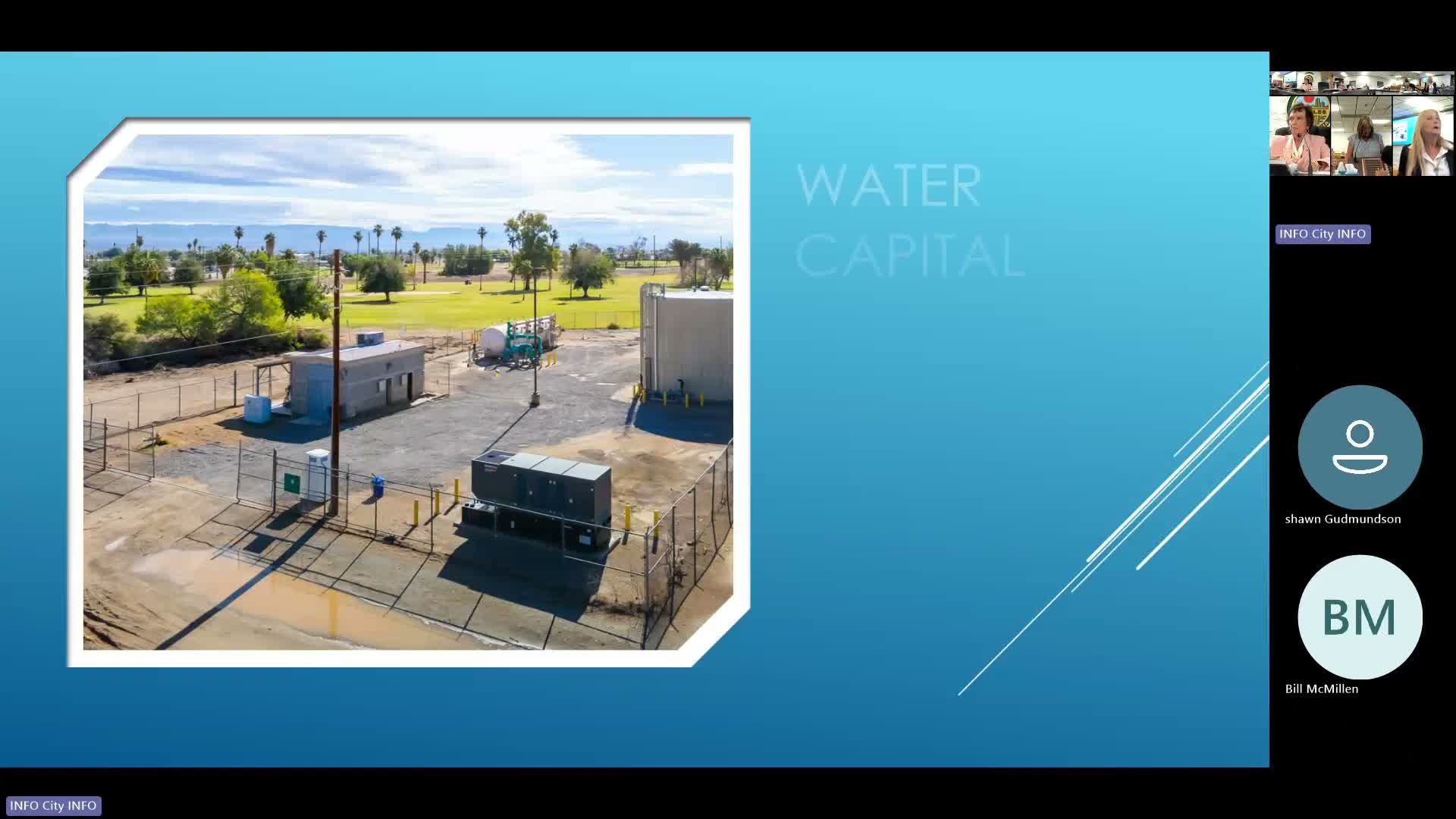
Development Services Director Kathy Rasch told the City Council on April 14 that Needles has completed the majority of water capital work funded through a 2020 drinking‑water construction grant from the California State Water Resources Control Board and subsequent amendments.
Rasch said the grant and later amendments supplied about $14.3 million for six projects. Major items Rasch listed included an L Street water booster station (about $897,814), the Lily Hill booster station (about $2.2 million), a Well‑11 centralized treatment facility (reported at about $6.0–6.3 million), a transmission line connecting Well 11 to Well 15 (about $970,000), and a Well 15 backup generator (about $375,000). Staff also reported manifold and distribution work on Monterey and River Road (estimated at about $1.5 million). Rasch said soft‑cost reimbursements (engineering, construction management, testing and signage) are roughly $500,000 and water‑service replacements associated with paving projects total about $2.4 million, which together bring expenditures to around $15,000,000 to date.
"In 2020, the city received a drinking water construction grant from the California State Water Resources Control Board and subsequent amendments over four amendments for a total of $14,300,000 in funding for six projects," Rasch said during her presentation, summarizing the large projects and their purposes, including continuous removal of iron and manganese at the Well‑11 treatment site.
Council members thanked staff for securing external funding and completing the work with minimal service interruptions. Rasch said nearly all grant‑funded work is complete except for a manifold component that is expected to finish in about 30 days; staff will prepare the final report to the state when work is complete.
Why it matters: the upgrades create new treatment capacity and increase distribution reliability without a general‑fund capital outlay for the utility; staff said the work reduces operational vulnerability and positions the city to meet drinking‑water standards.
Next steps: staff will finish the remaining manifold work, file final reports required by the state grant, and return on any substantive outstanding implementation items when required.
Rasch said the grant and later amendments supplied about $14.3 million for six projects. Major items Rasch listed included an L Street water booster station (about $897,814), the Lily Hill booster station (about $2.2 million), a Well‑11 centralized treatment facility (reported at about $6.0–6.3 million), a transmission line connecting Well 11 to Well 15 (about $970,000), and a Well 15 backup generator (about $375,000). Staff also reported manifold and distribution work on Monterey and River Road (estimated at about $1.5 million). Rasch said soft‑cost reimbursements (engineering, construction management, testing and signage) are roughly $500,000 and water‑service replacements associated with paving projects total about $2.4 million, which together bring expenditures to around $15,000,000 to date.
"In 2020, the city received a drinking water construction grant from the California State Water Resources Control Board and subsequent amendments over four amendments for a total of $14,300,000 in funding for six projects," Rasch said during her presentation, summarizing the large projects and their purposes, including continuous removal of iron and manganese at the Well‑11 treatment site.
Council members thanked staff for securing external funding and completing the work with minimal service interruptions. Rasch said nearly all grant‑funded work is complete except for a manifold component that is expected to finish in about 30 days; staff will prepare the final report to the state when work is complete.
Why it matters: the upgrades create new treatment capacity and increase distribution reliability without a general‑fund capital outlay for the utility; staff said the work reduces operational vulnerability and positions the city to meet drinking‑water standards.
Next steps: staff will finish the remaining manifold work, file final reports required by the state grant, and return on any substantive outstanding implementation items when required.
Don't Miss a Word: See the Full Meeting!
Go beyond summaries. Unlock every video, transcript, and key insight with a Founder Membership.
✓
Get instant access to full meeting videos
✓
Search and clip any phrase from complete transcripts
✓
Receive AI-powered summaries & custom alerts
✓
Enjoy lifetime, unrestricted access to government data
30-day money-back guarantee
