Consultant outlines five‑year CIP for San Luis and says bonds/secondary property tax are options; staff to seek public input
April 18, 2026 | San Luis, Yuma County, Arizona
This article was created by AI summarizing key points discussed. AI makes mistakes, so for full details and context, please refer to the video of the full meeting. Please report any errors so we can fix them. Report an error »
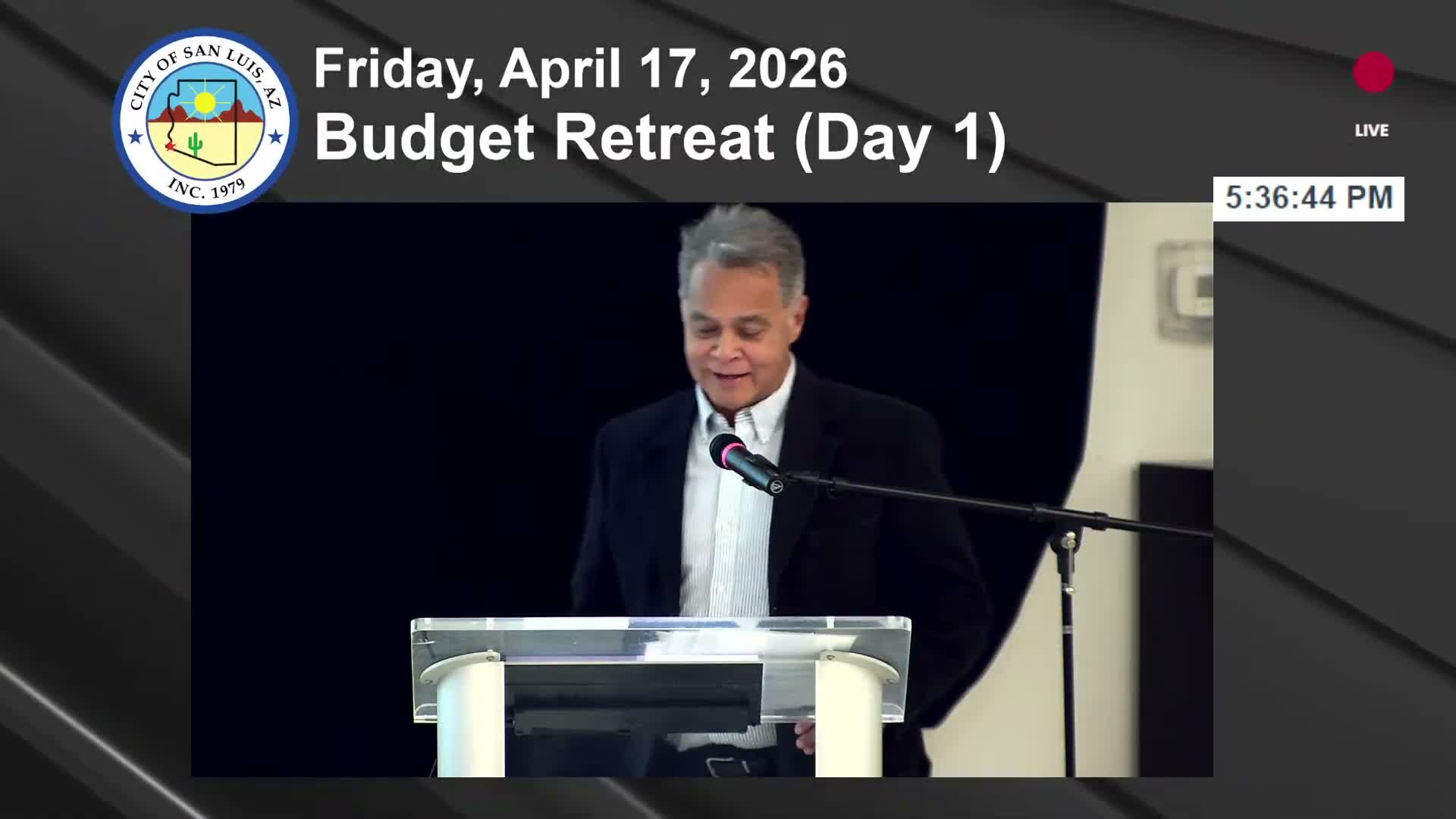
Anthony Arasa, the city’s capital improvement program (CIP) consultant, presented a five‑year CIP at the retreat, explaining the program is intended to catalog and prioritize one‑time, large capital projects such as road reconstruction, water/wastewater facilities, parks, buildings and public safety investments.
Arasa cited an Arizona Revised Statute requirement for a five‑year program and explained that a capital project typically has a life of more than one year and is capitalized when the estimated cost meets the city’s threshold (roughly $15,000, with stated exceptions). He described stages of projects from master planning, predesign, procurement, construction and closeout, and stressed cross‑departmental coordination with finance and engineering to avoid audit findings: “So the proper infrastructure’s gotta be charged to the proper fund source,” he said.
Arasa grouped projects into four broad categories for the five‑year horizon — general government (buildings and IT), parks and recreation, public safety (stations, apparatus, radios) and water/wastewater — and presented counts and dollar distributions across those categories. He emphasized that capital spending consumes significant revenue and recommended prioritization: staff and council should match projects to revenues or identify new revenue sources.
On funding, Arasa discussed bond financing and the secondary property tax as common tools. He said secondary tax proceeds and general obligation bonds typically require voter approval and presented an example of how modest annual costs per household can fund large capital programs over 20–30 years: “It usually goes to a ballot to be approved,” he said of bond measures. He also described delivery methods (design‑bid‑build, construction manager at risk, job order contracting, design‑build) and recommended using indices to update cost estimates across the five‑year book.
Council members asked about public outreach; Arasa confirmed the CIP was produced by department heads and did not include public input to date and recommended a future public hearing before tentative adoption. One council member said parks represented about 8% of the CIP and asked the administration to consider shifting priorities given San Luis’s relatively young population.
Next steps: Arasa will incorporate council feedback, prepare a printed ‘‘five‑year book’’ showing project stories and cash flows, and staff will consider a public hearing in advance of the tentative adoption process.
Arasa cited an Arizona Revised Statute requirement for a five‑year program and explained that a capital project typically has a life of more than one year and is capitalized when the estimated cost meets the city’s threshold (roughly $15,000, with stated exceptions). He described stages of projects from master planning, predesign, procurement, construction and closeout, and stressed cross‑departmental coordination with finance and engineering to avoid audit findings: “So the proper infrastructure’s gotta be charged to the proper fund source,” he said.
Arasa grouped projects into four broad categories for the five‑year horizon — general government (buildings and IT), parks and recreation, public safety (stations, apparatus, radios) and water/wastewater — and presented counts and dollar distributions across those categories. He emphasized that capital spending consumes significant revenue and recommended prioritization: staff and council should match projects to revenues or identify new revenue sources.
On funding, Arasa discussed bond financing and the secondary property tax as common tools. He said secondary tax proceeds and general obligation bonds typically require voter approval and presented an example of how modest annual costs per household can fund large capital programs over 20–30 years: “It usually goes to a ballot to be approved,” he said of bond measures. He also described delivery methods (design‑bid‑build, construction manager at risk, job order contracting, design‑build) and recommended using indices to update cost estimates across the five‑year book.
Council members asked about public outreach; Arasa confirmed the CIP was produced by department heads and did not include public input to date and recommended a future public hearing before tentative adoption. One council member said parks represented about 8% of the CIP and asked the administration to consider shifting priorities given San Luis’s relatively young population.
Next steps: Arasa will incorporate council feedback, prepare a printed ‘‘five‑year book’’ showing project stories and cash flows, and staff will consider a public hearing in advance of the tentative adoption process.
View the Full Meeting & All Its Details
This article offers just a summary. Unlock complete video, transcripts, and insights as a Founder Member.
✓
Watch full, unedited meeting videos
✓
Search every word spoken in unlimited transcripts
✓
AI summaries & real-time alerts (all government levels)
✓
Permanent access to expanding government content
30-day money-back guarantee
