Commission hears Pacific Salmon Treaty briefing as renegotiation approaches
April 17, 2026 | Board Council Commission Agencies , Executive, Washington
This article was created by AI summarizing key points discussed. AI makes mistakes, so for full details and context, please refer to the video of the full meeting. Please report any errors so we can fix them. Report an error »
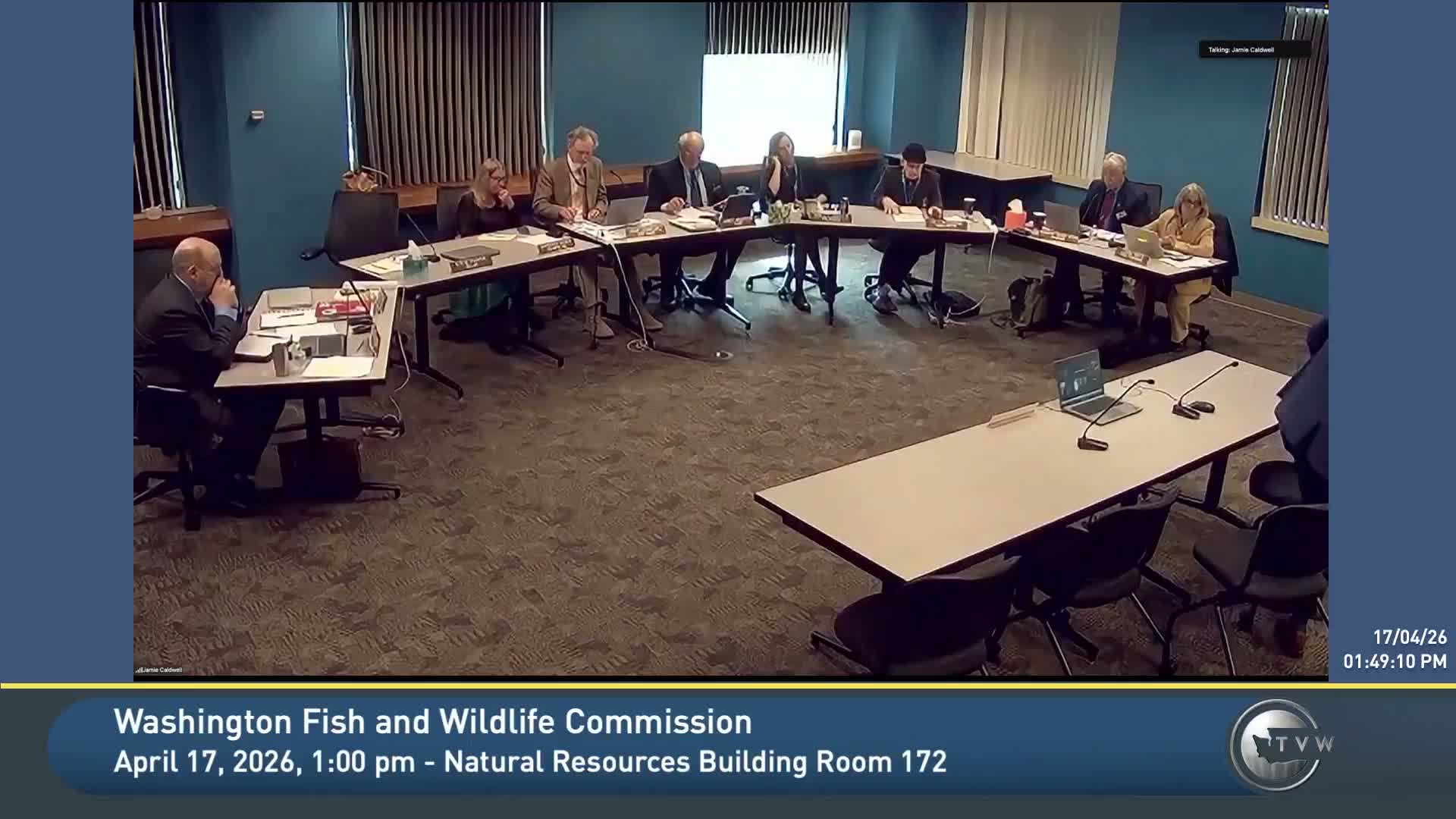
The commission heard a briefing on the Pacific Salmon Treaty from Phil Anderson, the U.S. commissioner representing Washington and Oregon and current chair of the commission. Anderson framed the treaty as a core instrument for coordinating international management of Pacific salmon stocks and described upcoming renegotiations that aim for implementation beginning in 2029.
Anderson reviewed treaty history and structure, noting 10-year agreements that currently run through Dec. 31, 2028. He described treaty chapters and stock-based management (Chinook, coho, Fraser River sockeye, etc.), and stressed that interception of Washington-origin salmon in northern fisheries is a central concern for coastal Chinook stocks.
Funding and outcomes: Anderson summarized finance mechanisms established during past renegotiations'two endowment funds (Northern and Southern) seeded with federal funds (cited $55 million for the Southern Fund and $65 million for the Northern Fund) that, by 2004, supported conservation grants; he said roughly $155 million in grants have been awarded to more than 1,900 projects since that time and cited a recent year in which the Southern Fund invested about $4.62 million across 47 projects. Anderson also said WDFW has increased PSC-related contributions and that he worked to secure more federal support for state implementation.
Process and timeline: Anderson said the U.S. must secure Section 107 approval before bilateral talks with Canada; that approval had not yet been received, and bilateral sessions are not expected to begin until early September. He described a negotiation timetable that would allow about 15 months to complete technical and legal reviews so a renewed set of agreements could be ready for implementation in January 2029.
Commissioners asked whether the negotiation agenda includes economic analysis; Anderson said an economic study is beginning to inform U.S. positions, and he emphasized that conservation is the primary priority, followed by fair allocation, with economics considered after those objectives. Commissioners also pressed about impacts from Alaska and Canadian fisheries; Anderson said quota reductions and tracking of exploitation rates are part of the negotiation dialogue and that impacts vary by stock and region.
Anderson closed by offering to return with updates and by encouraging continued stakeholder engagement, including with groups such as Wild Fish Conservancy and tribes that participate on PSC panels and technical committees.
Anderson reviewed treaty history and structure, noting 10-year agreements that currently run through Dec. 31, 2028. He described treaty chapters and stock-based management (Chinook, coho, Fraser River sockeye, etc.), and stressed that interception of Washington-origin salmon in northern fisheries is a central concern for coastal Chinook stocks.
Funding and outcomes: Anderson summarized finance mechanisms established during past renegotiations'two endowment funds (Northern and Southern) seeded with federal funds (cited $55 million for the Southern Fund and $65 million for the Northern Fund) that, by 2004, supported conservation grants; he said roughly $155 million in grants have been awarded to more than 1,900 projects since that time and cited a recent year in which the Southern Fund invested about $4.62 million across 47 projects. Anderson also said WDFW has increased PSC-related contributions and that he worked to secure more federal support for state implementation.
Process and timeline: Anderson said the U.S. must secure Section 107 approval before bilateral talks with Canada; that approval had not yet been received, and bilateral sessions are not expected to begin until early September. He described a negotiation timetable that would allow about 15 months to complete technical and legal reviews so a renewed set of agreements could be ready for implementation in January 2029.
Commissioners asked whether the negotiation agenda includes economic analysis; Anderson said an economic study is beginning to inform U.S. positions, and he emphasized that conservation is the primary priority, followed by fair allocation, with economics considered after those objectives. Commissioners also pressed about impacts from Alaska and Canadian fisheries; Anderson said quota reductions and tracking of exploitation rates are part of the negotiation dialogue and that impacts vary by stock and region.
Anderson closed by offering to return with updates and by encouraging continued stakeholder engagement, including with groups such as Wild Fish Conservancy and tribes that participate on PSC panels and technical committees.
View the Full Meeting & All Its Details
This article offers just a summary. Unlock complete video, transcripts, and insights as a Founder Member.
✓
Watch full, unedited meeting videos
✓
Search every word spoken in unlimited transcripts
✓
AI summaries & real-time alerts (all government levels)
✓
Permanent access to expanding government content
30-day money-back guarantee
