Committee hears plan to license early childhood educators, create state board and phased implementation
April 17, 2026 | Human Services, HOUSE OF REPRESENTATIVES, Committees, Legislative , Vermont
This article was created by AI summarizing key points discussed. AI makes mistakes, so for full details and context, please refer to the video of the full meeting. Please report any errors so we can fix them. Report an error »
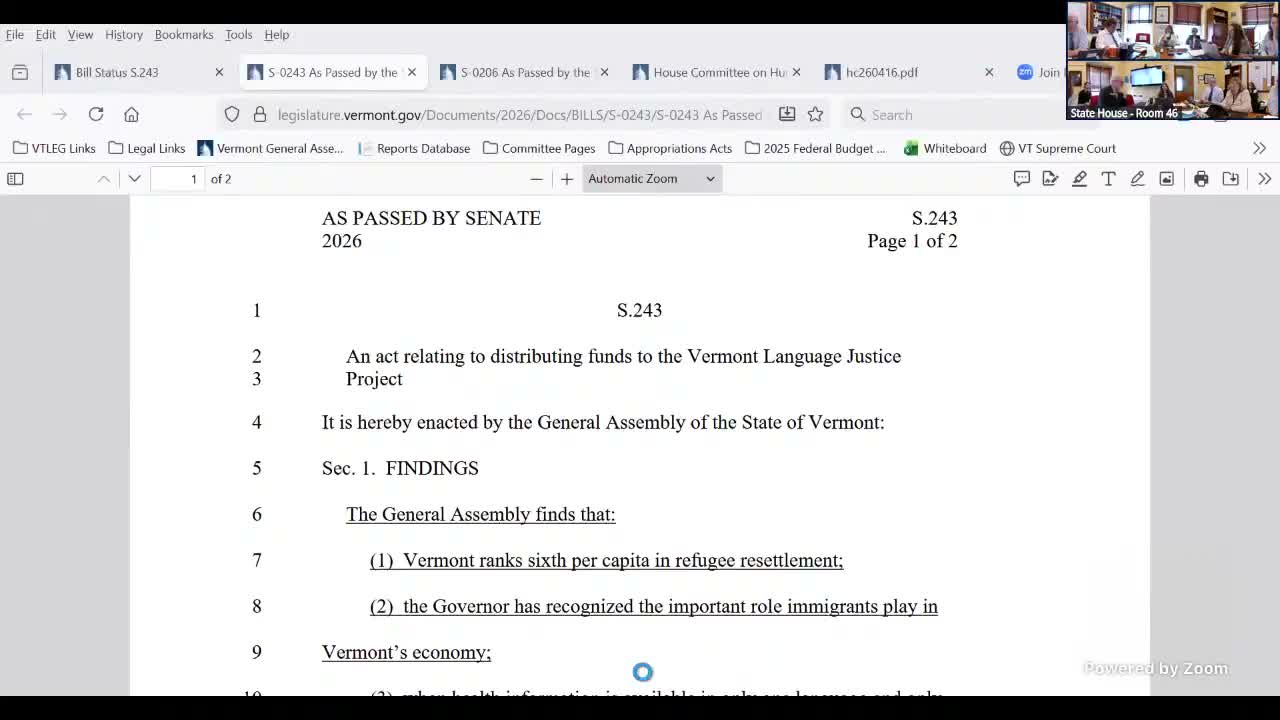
Legislative counsel and staff walked the committee through S206, a bill to create a professional‑regulation chapter (chapter 26) for early childhood educators (ECEs) who work in programs regulated by the Child Development Division (CDD). Counsel said the bill adds early childhood educators to the list of professions overseen by the Office of Professional Regulation (OPR) and requires the governor to appoint a nine‑member Board of Early Childhood Education with specific qualifications and term limits.
The draft defines four licensure categories: ECE1 (assistant-level with at least 120 hours of approved training), ECE2 (lead/primary educator with associate's degree or equivalent credits), ECE3 (lead with a bachelor’s degree or equivalent), and a legacy family child care provider license that would stop accepting new applicants after 01/01/2029. The bill creates transitional and temporary variances (including multi‑renewable two‑year transitional licenses) designed to allow current practitioners to come into the new system while meeting educational requirements over time.
Members asked about implementation specifics: who posts family-facing disclosures (individual ECE vs. program/provider), how school‑based childcare staff are treated for exemptions, and whether the initial board appointments should be tailored to qualifications that don't exist yet. Counsel said some definitions and provisions would take effect in phases and repeated the bill authorizes rulemaking for exams, continuing education, staffing and fees.
The bill also includes an appropriation (FY27) of $262,000 to OPR to establish positions (an executive officer and a full‑time staff attorney) contingent on general‑fund availability. OPR must submit an 11/01/2031 report evaluating license counts, complaints/enforcement actions and resources needed to run the program.
What happens next: The committee will take testimony on S206 in future hearings; staff and members noted the need for a comparative chart of current vs. proposed requirements to inform practitioners and providers.
The draft defines four licensure categories: ECE1 (assistant-level with at least 120 hours of approved training), ECE2 (lead/primary educator with associate's degree or equivalent credits), ECE3 (lead with a bachelor’s degree or equivalent), and a legacy family child care provider license that would stop accepting new applicants after 01/01/2029. The bill creates transitional and temporary variances (including multi‑renewable two‑year transitional licenses) designed to allow current practitioners to come into the new system while meeting educational requirements over time.
Members asked about implementation specifics: who posts family-facing disclosures (individual ECE vs. program/provider), how school‑based childcare staff are treated for exemptions, and whether the initial board appointments should be tailored to qualifications that don't exist yet. Counsel said some definitions and provisions would take effect in phases and repeated the bill authorizes rulemaking for exams, continuing education, staffing and fees.
The bill also includes an appropriation (FY27) of $262,000 to OPR to establish positions (an executive officer and a full‑time staff attorney) contingent on general‑fund availability. OPR must submit an 11/01/2031 report evaluating license counts, complaints/enforcement actions and resources needed to run the program.
What happens next: The committee will take testimony on S206 in future hearings; staff and members noted the need for a comparative chart of current vs. proposed requirements to inform practitioners and providers.
View the Full Meeting & All Its Details
This article offers just a summary. Unlock complete video, transcripts, and insights as a Founder Member.
✓
Watch full, unedited meeting videos
✓
Search every word spoken in unlimited transcripts
✓
AI summaries & real-time alerts (all government levels)
✓
Permanent access to expanding government content
30-day money-back guarantee
